Showing posts with label Brotherhood of Eternal Love. Show all posts

Sunday, December 1, 2019

Discussing the Process on Up is Down


Making the podcast rounds again, this time on the Up is Down with Dean Reiner. This week's chat was mostly centered around this infamous Process Church of the Final Judgment. This was a fun chat for me in no small part because it allowed me to provide new information on the the Process, which I hadn't previously covered directly for a number of years. Over time, I've had to rethink my views somewhat on this entity.

In relation to the Process, we discuss the Malayan Emergency and the birth of modern counterinsurgency doctrine; the Profumo Affair; the Mayfair Set, their links to a plot destabilize the British government during the late 1960s-early 1970s, and their long-term influence on Brexit; the curious places where the Process turned up; Thomas Jude Baumler and the enigmatic "Bishop" Carl Maria Stanley; the Sovereign Order of Saint John; Manson and the Process; the overlap between the Process, Manson, and the far right; their ties with the alleged Son of Sam cult; the support given to Maury Terry by Rupert Murdoch; the terrible fate of the Process children; and so much more.

The podcast can be found here.

For more information of the topics discussed, check the following:

The Process: A Strange and Terrible Journey
Part One
Part Two
Part Three
Part Four

On Baumler and Stanley:
The JFK Assassination: A Strange and Terrible Saga Part VII

On Manson and the Far Right:
Man's Son or the Children of the Sun

On the Son of Sam cult and Profumo
Goodfellas Part VII: Sons of Cohn

On the Mayfair Set


As always dear readers, I hope that you enjoy. Until next time, stay tuned.


Wednesday, August 21, 2019

Back on THC


Greg Carlwood of The Higherside Chats (THC) was kind enough to have me back on the air recently. I had previously appeared on THC in 2017 to discuss The Nine, Roswell, and my "Fringe" series. This time around we tackled Jeffrey Epstein and a host of other related topics: NXIVM, Roger Stone (whose people had actually approached Greg about appearing on THC at one point!), Roy Cohn, Profumo and the extensive family connections between that decades old scandal and the names appearing in Epstein's black book, the World Commerce Corporation, the Anglo-American Establishment, and Robert Maxwell.

On that note, we also discussed new information not yet published on this blog further linking both Robert Maxwell and Epstein to Le Cercle. For those of you just joining the party, the Cercle is officially a foreign policy think tank, but in actuality has served as a vast private intelligence network since at least the late 1960s. It originally emerged in the 1952-1953 period as an auxiliary to the Bilderberg group. It always had a much more rightward drift, however. Much of its early membership was dominated by members of especially reactionary Catholic orders such as the Sovereign Military Order of Malta and Opus Dei. In more recent years, it has become a kind of secret society behind the British Tories and driving force behind Euroscepticism and Brexit. Much more information on the Cercle can be found here.

Enjoy these new revelations. I'll be expanding upon them on a blog I'm currently working on that will also include source material.

Greg and I also fund time to address some of the bizarre aspects of the Epstein case, most notably the strange doings in New Mexico. If you want speculation on underground bases, black ops technology, and ancient astronauts, you will find it in this podcast. I also get around to ranting about the conspiratorial perspective of the Clintons and To the Stars Academy.

A portion of the podcast can be found here. The full two hours are only available in the members section.


For those of you looking for additional background material on my work on Epstein, check out these posts:

Maxwell's Silver Hammer
Epstein's Little Black Book
Epstein Dies: Long Live the New Mexico Connection?

For more information on Trump, Roy Cohn, and their criminal and deep connections, check here.

Oh, and I also announced that I've started working on book concerning Epstein and the network/cabal that spawned him. I'm tentatively calling it A Special Relationship. We'll see how that goes.

As always dear readers, I hope that you enjoy. Until next time, stay tuned.


Sunday, July 7, 2019

House of Mellon Part V: A Distant Cousin


In a recent email exchange, a reader dropped a most interesting name on your humble researcher: Jim Mellon. Of course, long time readers of this blog are well aware that Recluse is obsessed with all things related (har har) to the famed Pittsburgh dynasty. For decades now, they have been among the most powerful and well connected families in this nation. Family patriarch Thomas Mellon established the Mellon Bank in 1869. By the onset of the twentieth century, it had become one of the most profitable financial institutions in the United States outside of New York City.

From there, the Mellons would branch out into a host of other industries. Mellons and their capital helped establish Alcoa, Gulf Oil, Westinghouse, and Rockwell International (a major defense contractor with extensive ties to both the US intelligence community and far right, as was noted before here), among others. Companies like Heinz, Koppers, and General Motors also received early financial backing from the Pittsburgh dynasty as well. 

Probably the most famous (or infamous, depending upon one's point of view) Mellon was Andrew, who took over management of the family bank around 1873. While Judge Thomas Mellon may well be the family patriarch, it was his son Andrew who turned the family into one of the wealthiest in the world. His financial prowess eventually led to Andrew being appointed the US Secretary of the Treasury in 1921. Mellon would go on to become one of the longest serving Treasury Secretaries in the history of the nation, serving from 1921 until 1933. During this time frame he oversaw both the boom years of the Roaring Twenties and the stock market crash of 1929 that ushered in the Great Depression. As was noted before here, there is much dispute as to how much blame Andrew Mellon deserved for the latter.

Andrew Mellon
At the onset of World War II, the Mellons managed a spot on the ground floor of what would become one of the boom industries of the twentieth century and beyond: intelligence. Numerous Mellons and their in-laws would sign up with the Office of Strategic Services (OSS), the WWII-era predecessor to the CIA. Among the most noteworthy were Andrew's son, Paul; and son-in-law, David Bruce. Bruce in particular was a close aide to OSS founder and director William "Wild Bill" Donovan who would become the station chief in London, arguably the spy agency's most important station during the war. Bruce was divorced from Ailsa Mellon Bruce in 1945 (on Hitler's birthday no less), but Bruce maintained contacts with the Mellon clan for years afterwards. And indeed, some of the contacts may have been related to intelligence operations.

David Bruce
For instance, Bruce was in contact with the enigmatic William Mellon Hitchcock in London during the early 1960s while Bruce was serving as the US ambassador there. Hitchcock was reportedly living in London at the time as part of various business ventures he was engaged in, but appears to have spent much of his time investigating a sex ring exposed by the Profumo Affair. This particular ring involved both British and Soviet intelligence. As was noted before here, it appears that Bruce himself had approached Hitchcock via a mutual friend to investigate the tangled web of Profumo, which ultimately brought down the government of Harold Macmillan and threatened to ensnare the presidency of JFK.

Not long after returning to the US, in 1963, Hitchcock shifted gears and became the principal financial patron of LSD guru Timothy Leary (he met Leary through his sister, Peggy, who was having an affair with the former Harvard professor). Hitchcock eventually broke with Leary during the mid-1960s, but he was not yet done with LSD. Indeed, he had become the de facto banker for the Brotherhood of Eternal Love, the largest LSD syndicate in the world at the time (noted before here). By the late 1960s, he became involved with the uber-spooky Resorts International (noted before here), which President Donald Trump would become the CEO of during the 1980s.

While there is much dispute as to whether Hitchcock had some type of relationship with the US intelligence community, there is no such ambiguity concerning another Mellon heir of the same generation. Richard Mellon Scaife has openly acknowledged to funding Forum World News, a CIA front, during the 1970s. This is likely only scratching the surface of Scaife's deep funding. As was noted in my examination of the Cercle complex (which can be here and here), Scaife also contributed heavily to various organizations linked to the uber intelligence-connected complex, which counted several former CIA directors (and their European counterparts) as members.

Richard Mellon Scaife
Elsewhere, Scaife became one of the leading financiers for the American conservative revival that kicked off during the 1970s. Everything from the pro-life movement to The Clinton Chronicles was graced by Scaife's largess. Much more information on these activities can be found here.

It would appear that the Mellon family's "special" relationship with the US intelligence community has continued well into the twenty-first century. Christopher Mellon served on the staff of the Senate Select Committee on Intelligence, eventually become the Staff Director. Later, he served as the Deputy Assistant Secretary of Defense for Intelligence, at the time the Pentagon's highest ranking intelligence post. In recent years, he has become a prominent proponent of UFO Disclosure, and is actively involved with Tom DeLonge's To the Star Academy of Arts and Sciences. Christopher's brother, Matthew, was a cryptocurrency billionaire and financial patron of the alt-right before his bizarre death in 2018. More information on the Brothers Mellon can be found here and here.


You Don't Mess Around With Jim

And that brings us to Jim. This particular Mellon is not related to the American branch of the family. Rather, he is a distant cousin from the Old Country. The Mellons of Pittsburgh hailed from Ireland, and later departed there for the States. Jim's family also left Ireland around the same time, but opted to relocate to Scotland instead. But despite the gap of centuries and the Atlantic Ocean, Jim Mellon eventually established ties with at least one member of the Pittsburgh branch. He corresponded for a time with Paul Mellon, the son of Andrew and a former OSS man.

Paul Mellon
As far as intelligence connections are concerned, Jim likely had closer links in his immediate family. His father, Sir James, was a longtime British diplomat who appears to have occasionally been involved with intelligence-related activities. As a diplomat's son, Jim Mellon spent many of his formative years in embassies. No doubt he encountered many spooks in the process. But beyond this, he is also a graduate of Oxford University. Oxford of course has a longstanding reputation as being a popular recruiting ground for both MI5 and MI6.

Sir James Mellon and his wife
Families ties to one of the wealthiest and most intelligence-connected (and Anglophilic) families in the States? A diplomat for a father who at a minimum would have dealt regularly spooks in various embassies? And admittance to an elite university routinely used to recruit for the secret services? Certainly Mr. Mellon has all of the makings of an MI6 man. And indeed, his business career would have an uncanny knack for taking him to emerging markets in geopolitical sensitive spots across the globe.

Upon graduating Oxford in 1979, Mellon went to work for GT Management (which was eventually taken over by Invesco). He was briefly detailed to Hong Kong before being moved to the company's San Francisco offices. He would spent the next four years in San Fran. It would appear that some of the zeitgeist there rubbed off on Mr. Mellon. Of late, he's become a major investor in various life extension ventures, and even wrote a book on such things. Life extension is of course a major obsession of Silicon Valley and Mellon still maintains a residency in San Francisco.


In 1984, he left GT with one of its co-founders, Richard Thornton, who was then setting up his own investment house. Mellon returned to Hong Kong during that year to take over the office of what became Thornton Management. Mellon then left Thornton Management and Hong Kong four years later a millionaire before he had even turned 30.

In 1990 he co-founded his own firm, Regent Pacific, based in Hong Kong. It quickly earned the nickname the "Vulture Fund" due to its reputedly unscrupulous practices. Mellon truly became an international player when he began investing heavily in Russia in the immediate aftermath of privatization efforts in 1994. Mellon made ample use of the chaos, often buying up vouchers for Russian stocks for pennies. All told, Mellon spent some $2 million on these investments during that year, and within six weeks said investments were worth $17 million. By 1997 these investments were worth nearly a quarter of a billion dollars.

During that same year, Mellon purchased a stake in Hambros Bank. Hambros was not just any bank, but had in fact been one of the most powerful financial institutions in the UK for much of the twentieth century.
"As part of the system and at the core of English financial life have been seventeen private firms of merchant bankers who find money for established and wealthy enterprises on either a long-term (investment) or a short-term ('acceptances') basis. These merchant bankers, with a total of less than a hundred active partners, include the firms of Baring Brothers, N.M. Rothchild, J. Henry Schroder, Morgan Grenfell, Hambros, and Lazard Brothers. These merchant bankers in the period of financial capitalism had a dominant position with the Bank of England and, strangely enough, still retain some of this, despite the nationalization of the bank by the Labour government in 1946. As late as 1961 a Baring (Lord Cromer) was named governor of the bank, and his board of directors, called the 'Court' of the bank, included representatives of Lazard, of Hambros, and of Morgan Grenfell, as well as of an industrial farm (English Electric) controlled by these."
(Tragedy & Hope, Carroll Quigley, pgs. 499-500)

Hambros Bank then was clearly in very exclusive company. Unsurprisingly, both the bank and the Hambro family had extensive ties to the UK intelligence community. Sir Charles Hambro, a Bank of England director by age 30 and eventual chairman of Hambros, became the head of the Special Operations Executive (SOE) during WWII. The SOE was tasked with carrying out the UK's covert operations and other dirty tricks during that era. Much more information can be found on it here.

The Hambros family originated from Denmark. Before becoming head of the SOE, Sir Charles oversaw its operations in Scandinavia. During the Cold War, both Sir Charles and his bank would continue to provide covert support to MI6 in that region of the world.
"Norway had one of the world's biggest merchant navy fleets, sailing to all the great seaports of the Soviet Union, eastern Europe and China... MI6 also helped the Norwegians establish a separate shipping company, Egerfangst, to undertake operations... They could draw on the support of Sir Charles Hambro and his merchant bank, Hambros, which had a substantial stake in the Norwegian shipping empire, providing hundreds of millions of pounds of finance. Hambros Bank had a long-standing financial interest in Norway and Scandinavia, and Sir Charles had been controller of SOE's Scandinavian section with another influential Hambros director, Harry Sporborg, as its head. Hambro had also chaired the Anglo-Norwegian Collaboration Committee which co-ordinated resistance plans."  
(MI6: Inside the Covert World of Her Majesty's Secret Intelligence Service, Stephen Dorril, pgs. 524-525)
Sir Charles
The above-mentioned Harry Sporborg was a future member of the Cercle complex as well as Shield, a private intelligence network established by Brian Crozier during the 1970s. More information can be found on Sporborg here. But moving along.

I bring up the Hambro connection to Scandinavia because Sir James Mellon, Jim's father, was not only the UK's ambassador to Denmark during the mid-1980s, but also had longstanding ties to the nation. A Danish speaker, Sir James had briefly attended Aarhus University during the early 1950s and would find his way back to the country time and again over the years.

All of this makes Jim Mellon's relationship with Hambros Bank all the more curious. Upon becoming a shareholder in the institution, he immediately launched an attack on the board of directors. Mellon's criticism of the bank is generally credited with the break up that occurred in 1998, with much of the institution being sold to the French Société Générale, one of the largest banks in Europe. At the time Baron Hamro, the son of Sir Charles, was still involved with the bank in some capacity. However, Hambro family influence had declined steadily since that Hambros had dissolved their family trust in 1986. This led to Sir Chippendale "Chips" Keswick being appointed chairman during that year, a post he held until 1998 when the bank was sold. Sir Chips is a member of the Keswick family that has long controlled Jardine Matheson, a major player in Asian markets for nearly two centuries.

Sir Chips
Jardine has long been headquartered in Hong Kong, raising the possibility that their was already bad blood between Mellon and Sir Chips prior to the former's involvement in Hambros. Upon acquiring his stake in Hambros, Mellon came to the conclusion that the Keswicks were running the bank like their own fiefdom. The fallout from Mellon's criticism of Sir Chips was such that Sir James had to intervene to smooth over the assorted ruffled feathers. Was Mellon then dispatched to Hambros to force out the Keswicks, whose management had run what had previously been one of the most powerful banks in Europe into the ground? And what of the possibility that Sir James had had prior dealings with the Hambro family? Has this possibly led to Mellon's intervention into the bank? This researcher firmly believes there is much more to this story, though unfortunately the dissolution Hambros has drawn far less notice than it should have.


Getting Political

Mellon had generally avoided politics until the twenty-first century. During the tale end of the '00s, he became a staunch supporter of future Prime Minister David Cameron. Cameron, in turn, has some curious connections to the Mellon family of Pittsburgh. His father-in-law, Lord William Waldorf Astor III, is the son of the Lord Astor ensnared in the Profumo Affair. That Lord Astor was on friendly terms with David Bruce and encountered William Mellon Hitchcock at times as well. Lord Astor was the scion of the fabulously powerful Anglo-American Astor family, of which I've written more on here. Indeed, the Astors and Mellons have likely had dealings with one another for decades if not centuries now. 

At one point the present Lord Astor was having an affair with Rachel Whetstone, a public relations exec who was a key member of Cameron's entourage before the affair strained relations. Whetstone is the granddaughter of Sir Antony Fisher, a British business man most well known for founding libertarian-centric think tanks across the world. One of the most well known is the Manhattan Institute, which he co-founded with future CIA director William Casey. According Jane Meyer in Dark Money, Richard Mellon Scaife was for years the think tank's largest financial contributor. As Fisher founded nearly 150 right wing think tanks, this is likely not the only time Fisher and Scaife's paths crossed. This raises the possibility that Whetstone's mother, who is quite devoted to Fisher's causes, had encountered Scaife at some point as well.

Rachel Whetstone
In more recent years, Mr. Mellon has become a staunch Eurosceptic and crucial backer of Brexit. Mellon is known to have donated at least £100,000 to Brexit efforts during 2015. But beyond this, he is also a business partner of Arron Banks. Banks is a co-founder of the Leave.EU campaign and was for a time one of the largest donors to Nigel Farage's UK Independence Party (UKIP). Curiously, Jim Mellon is reportedly the man who first introduced Banks to Farage.

Arron Banks
As noted above, Mellon and Banks are business partners. As of 2016, Banks owned a 25% stake in Manx Financial Group, which Mellon is the founder and chairman of. Manx Financial is named after the historic language of the Isle of Man. Both Banks and Mellon have considerable ties to the island. A holding company linked to several businesses Banks is involved with is based there. As for Mellon, he is both the largest property owner and employer on the island.

Superficially, there is a rather obvious reason why men like Banks and Mellon would be attracted to the Isle of Man: it is one of the leading tax havens in the world. Regular readers of this blog are probably more familiar with the mythology surrounding the island, however. Until relatively recent times, the old ways were still preserved on this tiny island. Frazer once noted:
"... In the Isle of Man, one of the fortresses in which the Celtic language and lore longest held out against the siege of the Saxon invaders, the first of November, Old Style, had been regarded as New Year's Day down to recent times. Thus Manx mummers used to go round on Hallowe'en (Old Style), singing, in the Manx language, a sort of Hogmanay song which began 'Tonight is New Year's Night, Hogunnaa!' One of Sir John Rhys's Manx informants, an old man of sixty-seven, 'had been a farm servant from the age of sixteen until he was twenty-six to the same man, near Regaby, in the parish of Andreas, and he remembers his master and a near neighbor of his discussing the term New Year's Day as applied to the first of November, and explaining to the younger men that it had always been so in old times. In fact, it seemed to him natural enough, as all tenure of land ends at that time, and as all servant men began their service then.'...
(The Golden Bough, James George Frazer, pgs. 731-732)

The Isle of Man was also a long time stronghold of the fairy faith as well. Walter Evans-Wentz still found it going strong during the early twentieth century when he was researching his classic work on fairies and the Celts.

While I have no evidence to indicate that this contributed to Mellon's fixation with the Isle, the American Mellon family has long maintained eccentric interests: Andrew Mellon was a high ranking Freemason (noted before here), while the family has sponsored occultic architecture (noted before here) in both Pittsburgh and Washington, DC.  And then there's William Mellon Hitchcock's time as a major LSD guru and Christopher Mellon's obsession with UFOs. There are even indication that Matthew Mellon subscribed to the Dark Enlightenment (noted before here). Jim Mellon picking up some curious beliefs from his American cousins would hardly be the strangest thing a Mellon has embraced. So while taxes were surely the driving factor in maintaining a residency there, I find it curious that Mellon went so far as to become the largest land owner on the island.

And so concludes this look at yet another powerful, and likely intelligence-connected, member of the Mellon clan. A big thank you again to the reader who altered me to this particular incarnation. There are just to many Mellons for one researcher to keep track of without a little help now and again. But I do my best and, as always, stay tuned dear reader until next time. 


Friday, June 7, 2019

You're Gonna Miss Me


Roger Kynard "Roky" Erickson was both an American original and an American tragedy. He is most well known now as the American Syd Barrett, but with a somewhat happier ending. The body of work Erickson put together over the course of nearly six decades in the music industry (sans a decade or two when he gave up music) has proven to be enormously influential. A host of acts ranging from ZZ Top, Echo & the Bunnymen, Julian Cope, the Butthole Surfers, R.E.M., Primal Scream, and legions of modern neo-psych bands claim him as an influence.  When Erickson passed away on May 31, he was several decades into a remarkable career resurgence that would have seemed impossible in the 1980s.

During that particular decade Erickson was practically homeless at times, almost completely incapacitated by mental illness, and suffering numerous other health and substance abuse problems. He had almost completely given up on music, and was often seen wandering about Austin, Texas in a disheveled state, adding to his legacy as one of the 1960s most notorious acid causalities. And yet, by the middle of the last decade, he was the subject of a successful documentary, releasing new studio albums, and even performing live with upstarts acts such as the Black Angels who based so much of their sound on Erickson's work from the 1960s.

After enjoying some regional success with the Spades, his first band, Erickson co-founded the legendary 13th Floor Elevators in 1965. The Elevators, in turn, are considered to be one of the pioneering psychedelic acts, their sound crystallizing concurrent to, and largely independent of, the far more well known San Francisco sound. Indeed, it is likely that the San Francisco psychedelic scene was even more influenced by happenings in Texas than vice versa. Both Janis Joplin and Family Dog's Chet Helms had spent time in the same Austin scene that spawned the Elevators before relocating to San Fran. Helms in particular would play an enormous role in shaping both the music and counterculture of the city during the 1960s to the point that he has been described as the father of the Summer of Love.

Janis Joplin and Chet Helms
The Elevators emerged out of the burgeoning psychedelic scene centered around the University of Texas at Austin (UT Austin) during the early 1960s. This scene was fueled, unlike other such happenings, by peyote rather than LSD. The hallucinogenic and spiritual properties of the cactus buttons had first been observed by anthropology students during 1960 and later spread to others across the campus. At the same time, some curious figures were lurking about the school.

There was Whitley Strieber, the famed horror novelist turned UFO abductee and New Age guru. And then there was the infamous Charles Whitman. At one time a student at the Austin branch of the University of Texas during the early 1960s, the former Marine would return there on August 1, 1966, and embark upon a shooting spree that earned him the nickname the "Texas Tower Sniper." Whitman used the university tower as a sniper's nest, using multiple firearms to pick off students indiscriminately. When all was said and done, fourteen people were dead with an additional 31 wounded. At the time, the Elevators had just been subjected to the first of many drugs busts days before hand.


Strieber (top) and Whitman (bottom), who were both students at the UT Austin during the early 1960s along with several future Elevators
Austin remains a curious place to this day. In many ways, it seems like it should be a part of California. Its music scene, which the Elevators played no small part in putting on the map, has become the stuff of legends. Thanks to the efforts of filmmaker Richard Linklater and his Austin Film Society, it has a vibrant role in the motion picture industry as well. Elsewhere, Austin has become one of the leading tech hubs in the South as well. Locals have even gone so far as to refer to a part of the city as Silicon Hills.

As both the entertainment and tech industries are closely related to the intelligence sector, it should come as little surprise that at least one major private intelligence company calls Austin home. That would be Stratfor, which Barron's once referred to as "the shadow CIA." Unsurprisingly, famed conspiracy theorists (and CIA asset) Alex Jones also calls Austin home.

Jones
Given all these associations, it should come as little surprise that the Elevators have provided ample fodder to the likes of David McGowan and Jan Irvin in their efforts to prove every aspect of the 1960s counterculture as some type of CIA plot. And indeed, if one subscribes to this particular brand of "Aquarian conspiracies," no 1960s rock 'n roll band may better fit this mold than the Elevators. They and their hanger-ons were all from solidly upper middle class backgrounds, and had parents connected to the military and/or the Texas elite of the time. The band sold drugs, most notably LSD, to make ends meet, with one member eventually linking up with the Brotherhood of Eternal Love. 

That member, electric jug player and chief lyricist Tommy Hall (who had previously displayed far right views), made no bones about his agenda for the band: namely, to use it as venue to promote his acid-fried spiritual vision that adopted a host of occultic and esoteric concepts. Indeed, Hall had a far more profound notion of occult doctrine that practically any other rock 'n roller circa 1965. While the Beatles were just beginning to dip their toes in, Hall had already catapulted into the deep end. Hell, they even adopted Great Pyramid and All Seeing Eye as their logo! The band had all but walked out of the Illuminatus! Trilogy.


But things are not always as they seem. Unlike their LA and San Francisco counterparts, the Elevators were crack musicians (at least until they toured San Fran and embraced the habit of not practicing) who wrote the bulk of their own material. In other words, they were not a studio creation like so many LA and San Fran bands of the era (see The Wrecking Crew). Further, rather than achieving stardom, the Elevators were confined to cult status thanks to the inexplicable ineptitude of their label, the infamous International Artists (IA). With little promotion, the Elevators had achieved a hit single in "You're Gonna Miss Me."  This, combined with the musical/songwriting prowess of the band and Erickson's movie star good looks, all but ensured they could have been huge. If you thought the occult influence of the Beatles and the Stones on America's youth during this era was a problem, be thankful that Tommy Hall never got such a platform.

the enigmatic Tommy Hall
Indeed, IA appears to have done everything in their power to suppress the band, effectively refusing to promote any of their material after "You're Gonna Miss Me." This ensured that the Elevators were rarely heard outside of Texas during the 1960s. And as for the band members themselves, they suffered profound personal tragedies --unlike so many of their California counterparts.

At the forefront was Roky Erickson. In 1969, after a minor drug bust, he was admitted to Rusk State Hospital in 1969. There, he was subjected to electroshock "therapy" while rubbing elbows with the criminally insane that comprised the bulk of Rusk's population. Former bandmates and family members largely insist that Roky's time in Rusk is what fueled his later mental health problems rather than the LSD, as is commonly claimed. While the acid no doubt contributed on some level, there's no question that the three years he spent in Rusk profoundly changed Roky. It especially evident in Erickson's post-Elevators solo work.
"Meanwhile Roky survived hell at Rusk. His resurrection was simple – Horror Rock. The whole point of good horror is that the audience is meant to suffer and, in turn, horror could be viewed as a subtle form of revenge for what had happened to him. One of Roky's biggest problems was countering his sense of the mundane, and horror offered a highly theatrical cast of monsters and gremlins to express himself. Although he prefers not to elaborate on the background of his songs, it's not hard to spot the adaptation of horror titles from his youth into autobiographical metaphors: 1943's 'I Walked With a Zombie' for the 'Thorazine shuffle' and 1957's 'Night of the Demon' for Rusk and 1955's 'Creature With the Atom Brain' for electric shock treatment. Screamin' Jay Hawkins employed voodoo and the macabre in his songs and Roky's hero Joe Meek used extraterrestrials. In 1975 Roky lost all his manuscripts in a huge fire and set about a marathon typing session assisted by Billy Miller in which he recalled all of his songs. What's intriguing was that Roky had become absorbed in the twin motion of acceptance and rejection and typed many of the songs with the lyrics 'God' and 'Jesus,' which were then crossed through with red pen and then replaced with 'Lucifer' and 'Satan.' "
(Eye Mind, Paul Drummond, pg. 380)
While I've always preferred Roky's work with the Elevators, there's no denying the power of his "Horror Rock" stage. While look to both 1950s horror and rock 'n roll for inspiration, Roky offered up a truly demented attempt to make sense of his experiences at Rusk. In addition to "Creature with the Atom Brain," there's no question that songs such as "Bloody Hammer" were also attempts to make sense of the electroshock "therapy" he was subjected too. An effort was made by Creedence Clearwater Revival's Stu Cook to record many of these songs during the late 1970s. Eventually, they were collected together during the early 1980s for the classic The Evil One.


But despite the creativity Roky was still capable of in the 1970s, there's no question his mental state had seen better days. In 1975, he had an attorney draw up an official document declaring that he was not human, but rather a Martian. Erickson's mental state would only get worse. By the 1980s, he had largely given up on music all together, as well as basic hygiene. Erickson had claimed to have heard voices since the late 1960s, but by the 80s the situation had become dire. Erickson, by now a recluse, spent much of his time holed up in his house with countless TVs and radios, all tuned to different stations, blaring at once. He allegedly used the white noise from these devices to drawn out the voices in his head. This would remain his preferred form of medication until the 1990s.

While Erickson seemed destined to fade away into obscurity, the Herculean efforts of his brother, Sumner, during the early 00s spurred a remarkable transformation in Roky. After wresting away custody from their mother in 2001, Roky was finally able to get effective psychiatric treatment. By the end of the decade, he was once gain touring and even recording.

After spending much of the 1980s and early 1990s in a special kind of hell, Roky's striking career resurgence was a fitting coup de grace for one of the most enigmatic figures in rock 'n roll. After years of obscurity, Roky finally possessed a fitting cult following of a respectable scale. And the poor bastard finally made some money, after years of being exploited by family members and assorted hanger-ons. As such, Roky had about the closet thing to happy ending as this type of saga is likely to produce.

the Elevators
But Roky will always be most remembered for his work with the Elevators. And the Elevators' story is ultimately a tragic one. Like Icarus flying to close to the sun, the band rubbed shoulders with powerful forces as part of their psychedelic evangelicalism and more than a few band members were burned in the process. For more information on these tragedies, check out my early series on the Elevators, "Slip Inside This House: The Nightmare Trip of the 13th Floor Elevators":

Part One
Part Two
Part Three
Part Four
Part Five

Before signing off, I would like to note that the reverberations continued even with Erickson's death. As was noted above, he died on May 31. Reverse the numbers in 31 and one is left with a 13. And it just so happens, Roky's death is not the only tragedy that unfolded on May 31, 2019 related to 13. That date also witnessed a mass shooting, the Virginia Beach shooting, to be precise. Twelve individuals were gunned down by the perpetrator, who was later was killed by police. This resulted in a total of 13 deaths.

Powerful forces, indeed. And with that, I shall sign off. Until next time dear readers, stay tuned.


Sunday, July 8, 2018

Goodfellas Part VII: Jack and Bobby


Welcome to the seventh installment in my "Goodfellas" series. When I began this project in November of 2017 it was intended to explore the ties between President Donald J. Trump and organized crime. But over the preceding months it has taken on a life of its own, now encompassing the network (cult?) behind Trump's rise to power. For those of you just joining us, here is a brief recap of what has already been addressed:

The project began with a standalone piece that considered Trump's links to Resorts International, a notorious gaming interest with extensive ties to both organized crime and the US deep state. Beginning as the Mary Carter Paint Company in the early 1960s, the company was widely believed to be a CIA front used for anti-Castro operations in Florida during that era. By the end of the decade Mary Carter had become Resorts and had established its own little gaming fiefdom on the Bahamas' Paradise Island. Important early backers included billionaire Howard Hughes, President Richard M. Nixon, "rogue" financiers such as Robert Vesco and Richard Mellon Hitchcock and the inevitable Lansky lackeys. Resorts also established Intertel, it own private intelligence agency that was heavily staffed by "former" US operators, around this time.

Trump eventually became Resorts CEO in 1987. The gaming interest had most recently played a key role in opening up Atlantic City to legalized gambling as it had in the Bahamas during the prior decade. Intertel and the mob were still in league with Resorts at this time as well, giving the Orange One quite a rogue's gallery of collaborators.


In many ways Trump's CEO-ship of Resorts represented a kind of coming out party. As was noted in the first installment of this series, Trump had spent much of the prior decade cultivating contacts among organized crime circles prior to taking over Resorts. In the second and third installments I suggested that one such contact Trump made in the late 1970s involved "The Company," a drugs and arms trafficking network launched by former police and US military personnel in Kentucky during the late 1970s. Various members of "The Company" boasted of CIA links and appear to have had extensive contacts within the administration of Kentucky governor John Y. Brown. Trump himself befriended Brown during this time and became a regular on the Kentucky Derby scene, along with the Clinton family.

As I was wrapping up part three I began to consider the man who initiated Trump into this netherworld, former McCarthy attorney Roy Cohn. Cohn is widely credited as Trump's political mentor. He introduced the Orange One to many individuals who would become key figures in Trump's quest for the White House, most notably Rupert Murdoch, Paul Manafort and Roger Stone. Cohn also had extensive ties to organized crime, the US intelligence community, the Fascist International (personified by networks such as the American Security Council, the World Anti-Communist League and Le Cercle) and a deep seated rivalry with the Kennedy family.

During the fourth installment I began to consider Cohn's source of power: sexual blackmail. There Cohn's ties to CIA director William Casey, Republican lobbyists Robert Keith Gray Craig Spence and other key figures in the infamous Franklin scandal were considered. For those of you unaware, Franklin was believed to be a nationwide pedophile ring based out of Nebraska that thrived during the Reagan/Bush years. And Cohn appears to have been very close to several key figures involved in it.


Part five introduced another close Cohn/Trump collaborator who has appeared in various sex scandals for decades: private detective Thomas Corbally. Corbally, a veteran of both the OSS (the predecessor to the CIA) and Kroll Associates, was believed to have had a decades-spanning association with the US intelligence community. Corbally was last in the midst of scandal during the early 1990s when he cropped up in the fallout from Hollywood madam Heidi Fleiss. Corbally had already been active in Hollywood for decades by that point collecting dirt.

But Hollywood was hardly the extent of Corbally's activities. As was noted at the end of that installment and throughout the most recent one, Corbally was a key figure in the Profumo scandal that brought down the Macmillan government in the UK during the early 1960s. The scandal revolved around a woman named Christine Keeler who slept with British Secretary of State for War John Profumo and Soviet naval attache and GRU asset Yevgeni Ivanov during 1961 at the behest of Stephen Ward, an asset of MI5 and likely MI6 as well. Later Ward would be used as a back channel to the Soviet Union by the UK during the Cuban Missile Crisis.

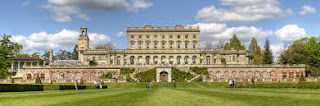
At the center of things was the estate of Cliveden, then controlled by Astor family, a long time powerhouse within the Anglo-American Establishment. It had been the British wing of the Astor family that had done so much to launch the Round Table movement that spawned the Council on Foreign Relations (CFR) and the Royal Institute of International Affairs around the time of the First World War. During the build up to the Second World War Cliveden had served as meeting ground for members of this network that supported appeasement with Nazi Germany. This circle became known as the "Cliveden Set."

Cliveden
By the early 1960s the social circle surrounding Cliveden was even more curious, as were the activities taking place there. As to the latter, it would appear that Ward (among others) was providing girls for orgies with occultic undertones. Ward himself was reputed to have an interest in the occult and he would hardly have been the only one. The Astor family itself, and especially the American wing, had developed quite an interest in esoteric and fringe topics by this time. Their circle would come to include J. Paul Getty Jr., eventual patron of Crowleyite and cult filmmaker Kenneth Anger, and William Mellon Hitchcock, heir of the powerful and intelligence-connected Mellon family of Pittsburgh. Shortly after his time at Cliveden Hitchcock became the patron of LSD guru Timothy Leary and eventually the financier for the Brotherhood of Eternal Love, the largest LSD smuggling network in the world by the end of the 1960s.

In other words, this circle appears to have had an enormous influence on the American counterculture that would emerge by the late 1960s, bankrolling several of its key cultural foundations. Even more ominously are the longstanding rumors that Mary Ann DeGrimston, a co-founder of the infamous Process Church of the Final Judgment, was one of the girls Ward procured for this circle. Another curious tie to the Process, not mentioned in this series previously, is that in the wake of Lord Astor's death in 1966 Cliveden was turned over to Stanford University on a 21-year lease reportedly to improve Anglo-American relations. As I'm sure many of you are aware, Stanford would play a crucial role in Maury Terry's highly controversial account of the Process. But I'm getting ahead of myself. Let us return to the Profumo affair, specifically Thomas Corbally's role in it.


Honey Trapping a President

As was noted at the end of the sixth installment, Corbally appears to have learned of the Ward ring in '61 and sought to befriend Ward not long afterwards. By 1962 the two men had reportedly become quite close. When rumblings of the affair began to emerge in 1963, Corbally, along with future LSD baron William Mellon Hitchcock, appear to have been dispatched by US Ambassador to the UK David Bruce (who had married into the Mellon family) to get to the bottom of things. In some accounts, it was Bruce himself (using information dug up by Corbally and Hitchcock) to first confirm the affair to UK Prime Minister Harold Macmillan.

However Bruce, who like Corbally had served in the OSS during WWII, did not appear to pass along what he learned to Washington at the time. When news of the affair broke in June of 1963, the Kennedy White House seems to have gone into a panic. For all sakes and purposes, it appears that Bruce, Corbally and Hitchcock were running a private intelligence operation the Kennedy White House was totally unaware of. This came at time when Attorney General Robert Kennedy was at war with Roy Cohn and his patron, FBI Director J. Edgar Hoover. And that is where things stood as I left off.

The panic the Kennedy White House was feeling almost surely derived from the fact that hints were being dropped that JFK himself had been ensnared in this ring and that Hoover was the one leaking this particular entrapment to the press.
"Hoover's sexual dirt on the Kennedys began to surface in late June 1963, after the President's 'peace speech' at American University with its appeal, 'Let us reexamine our attitude towards the Cold War.' On June 20, the United States and the Soviet Union signed an agreement establishing a 'hot line' between the Kremlin and White House. A week later, there was a flurry of veiled hints linking the President to the Profumo story, such as the Drew Pearson-Jack Anderson column for June 29: 'Britishers who read American criticisms of Profumo throwback to question "What high American official was involved with Marilyn Monroe?" '
"On the same day, in a front-page story, the Hearst paper in New York, the Journal-American, linked the Christine Keeler-Stephen Ward sex ring itself to a 'high U.S. aide,' 'one of the biggest names in American politics.' Back in 1960, after his election but before his inauguration, the President had slept with two members of the ring, including Mariella Novotny (a former stripper in London's Club Pigalle)."
(Deep Politics and the Death of JFK, Peter Dale Scott, pgs. 228-229)
J. Edgar Hoover
These trysts appear to have occurred in New York City in December of 1960. Mariella Novotny ended up in New York City as a result of a sex party she had attended earlier that year. It was at this particular party where she first met Stephen Ward and was shortly thereafter asked to travel to NYC to effectively work as an upscale prostitute. It is interesting to note that the party that brought Ward and Novotny together and paved the way for her time in NYC was thrown by American oilman, filmmaker and A & P supermarket heir Huntington Hartford.

Curiously, a year or so prior to this faithful party, Hartford began to invest heavily in a certain island in the Bahamas.
"....Between 1959 and 1965 the eccentric heir poured $28,000,000 into Hog's 685 acres, renaming the island Paradise. Whatever its name, it was proving to be a financial catastrophe: removed from the Nassau mainland by four hundred yards of water, the island was an awkward place to visit and, once you got there, there wasn't much to do the couldn't be done better somewhere else. What the island needed was a tourist attraction – gambling – and a bridge connect it with Nassau proper. Hartford, however, was in no position to obtain permission for either...
"While Groves and Lansky prospered a few miles to the north, Hartford watched in horror as his own investment, bolstered by additional millions, withered in value until the multimillionaire found himself without the cash to continue. Accordingly, he sought a buyer, and found one in the Mary Carter Paint Company."
(Spooks, Jim Hougan, pgs. 380-381)
Huntington Hartford
Yes dear reader, that would be the same Mary Carter Paint Company that eventually became Resorts International. In other words, Huntington Hartford was the man who developed Paradise Island prior to Resorts moving in to launch their infamous casino there. Hartford would retain a stake in the island and, as Hougan later notes, became a shareholder in Resorts.

Thus, Ward's social circle included two future shareholders in Resorts --Hartford and William Mellon Hitchcock --the gaming interest that Trump eventually became CEO of 1987. And here they are in the early 1960s involved in a sex ring being managed MI5 and unknown American partners targeting powerful political figures in the US and UK, including JFK. But moving along.

The other woman linked to JFK in this ring was Suzy Chang. Its possible Kennedy affair with Chang had begun even earlier, during the 1960 election campaign. In some accounts Novotny's affair with Kennedy is said have resulted from her "filling in" for Chang in NYC. There is little doubt that Chang had both powerful backers and was close to several key figures in this scandal, most notably Ward and Corbally.
"This heavily censored FBI and US Immigration Service documents reveal that Chang traveled to New York in 1960 and 1961, and over the Christmas period of 1962. Earlier in 1962, she applied to get on to the Chinese visa quota for the United States. Chang's mother, who was already living in America, filed a petition to the Immigration Service on her daughter's behalf. He did so through the prestigious New York law firm of Donovan Leisure Newton & Irvine. William Donovan, who started the firm, had been the founder of the OSS, the precursor of the CIA, and the law firm had always had strong connections with the government in power.
"This was a surprisingly powerful helping hand for a minor actress. 'Someone,' a former FBI official told us, 'was protecting her ass. They wanted someone with real clout to carry the ball, to run interference for her...' Suzy Chang got on to the visa quota within a fortnight.
"A 19 July 1963 report in the Immigration Service file – soon after the flap over the Journal-American article hinting at the President's involvement in the Profumo case – reflects an extensive investigation of Chang. The report lists nine people, most of them British models, who had been linked to Chang. All the names are blanked out. Another document shows that the authorities had combed to the file on Mariella Novotny prostitution case, looking for a connection to Chang. They did not find one.
"The most suggestive document is dated well after the Profumo case, in 1965. It notes that Chang 'arrived in the US at New York via flight 701, on 22/12/63. She was the [blanked-out section in report]... she was question regarding the "Profumo affair," and alleged to be a close friend of Stephen Ward.'
"As this book went into its first edition, the authors finally traced Suzy Chang, who had taken a new name and lived on the eastern seaboard of the United States. She confirmed that she had known many celebrities, including Anthony Armstrong-Jones and key figures associated with the Profumo affair – notably Thomas Corbally, who played a leading role in alerting the American ambassador in London to looming scandal, Kennedy, and Stephen Ward."
(The Secret Worlds of Stephen Ward, Anthony Summers & Stephen Dorril, pgs. 308-309) 
William "Wild Bill" Donovan, the OSS founder whose law firm aided Chang
Earlier Summers and Dorril had also noted that William Mellon Hitchcock was chummy with Chang as well, describing her as "one of Stephen's girls" (pg. 308). As such, it would clearly seem that Corbally and Hitchcock, who shared a flat in the UK together in the early 1960s, were aware that Ward's ring had ensnared JFK in addition to various key figures among the British Tories. And both men reportedly held orgies out of their flat during this time as well, only increasing the amount of sexual blackmail material available to them.

Clearly, it would seem that Corbally and Hitchcock were running some type of honeytrap in the UK shortly before the Profumo affair was exposed. There were even rumblings from journalists at the time that this was the case:
"On 10 June, in the United States, a crack appeared in the wall of silence. The New York Daily News, reporting from London, said US officials were sure the women around Ward were 'only part of a bigger set-up with American ramifications.' It was a reference to the prostitution case, two years earlier, of Harry Towers and Mariella Novotny – the young woman who had claimed following her return to Britain, that one of the men she had had sex with was the man who was now president, John F. Kennedy. The News now further reported that there was 'an American-based organization' attempting, through vice rings, to blackmail 'influential people'.
"The London correspondent who had filed this story, Henry Maule, told labor MP George Wigg – who was still energetically collecting information – that he had been pursuing the story for many months, and had been looking especially into the activities of the wealthy American Thomas Corbally. Corbally, according to Maule, had made a practice of finding out the names of men been associated with Rice-Davies and Keeler for the purposes of blackmail. Maule also brought up Harry Towerss name, and that of another American who, he said, had left the country. His information, he told me, was coming from reliable sources."
(The Secret Worlds of Stephen Ward, Anthony Summers & Stephen Dorril, pg. 291)
Thomas Corbally
The New York Daily News' investigation into Profumo would be a brief one. Shortly after the newspaper linked Corbally publicly to the story, he threatened a million-dollar lawsuit. The story then promptly died at the Daily News, but was then taken up by the Journal-American. The Journal-American was at the time owned by the far right Hearst family, who were close to Hoover. It is believed that Hoover himself would at times use the Journal-American for leaks and this seems to be very much the case in this instance.
"He had long used the Journal-American, like other Hearst papers, to fuel fears about the Red Menace. There were even former FBI men on the paper's staff. Edgar's phone logs showed that he talked regularly with Richard Berlin, head of the Hearst conglomerate. Berlin oversaw an editorial policy of fierce opposition to the policies of the Kennedy administration.
"He and Edgar, moreover, were both close to Roy Cohn, who was acting as attorney for an American involved in the Profumo case and said by a central figure in the scandal to have 'arranged sex parties for JFK in London.' A telltale handwritten note on one of the FBI's Profumo documents reads: 'Roy Cohn has this info.' "
(Official and Confidential, Anthony Summers, pg. 309) 
The Journal-American, learning from the mistakes of the Daily News, hinted at Kennedy involvement in Profumo while leaving out Corbally or any blackmail angle. The Daily News shall make at least one other appearance is this strange saga, so do keep it in mind dear reader. For now, let us return to Corbally and allegations that he was digging up sexual blackmail material on JFK as he is almost surely the American indicated in the above quote believed who "arranged sex parties for JFK in London."

There are indications that Corbally had made other attempts to set Kennedy up with various women prior to cozying up to Stephen Ward's ring. Eamon Javers, the closet thing we have to a Corbally biographer, noted that the private detective had personally tried to talk at least one actress into sleeping with JFK in 1962, Writing on Buzzfeed, Javers noted:
"In January 1962, Corbally was in Palm Beach, Florida, hanging out with an 18-year-old actor named Nancy Czar. Czar was promoting her new beach-blanket movie Wild Guitar and newly single after a relationship with Elvis Presley.
"As Czar (now Nancy Bretzfield and living in Los Angeles) remembers it, she, Corbally, and a few friends ended up at the Kennedy compound: the Mediterranean-style mansion on North Ocean Boulevard that the rest of the country knew as the Winter White House. Czar told me that during the party Corbally tried to set her up alone with President Kennedy in the library, even as the first lady entertained guests in another room."
Nancy Czar
Czar turned Corbally down, but it would seem by the end of the year Corbally had come into contact with at least one woman who had carried on an affair with the president. Not long afterwards, the leaks to the press started in earnest.


Deep Implications

It thus seems clear that Corbally was a key figure in a blackmail ring that had targeted President Kennedy during the early 1960s. And it seems equally clear that Corbally was taking orders from his attorney, Roy Cohn. It was Cohn who had threatened that million-dollar (in some accounts, six-million dollar) lawsuit against the Daily News on Corbally's behalf and it was Roy Cohn who served as Corbally's attorney when he met with the FBI after fleeing the UK in in June of 1963.
"... It is clear, though, that the FBI was keenly interested in hearing from Thomas Corbally, the American citizen who – as reported earlier – had given information on the case to the US embassy in London. Corbally was now back in the United States, and gave information both directly to the FBI and through his attorney Roy Cohn. Much of the information he gave to Roy Cohn is still classified today."
(The Secret Worlds of Stephen Ward, Anthony Summers & Stephen Dorril, pg. 288)
Think about that for a moment dear reader --the information Corbally told Cohn regarding a sex scandal in the UK was so sensitive that its still classified over a half century later. Clearly, Cohn was in possession of some truly bombshell revelations. And such information likely couldn't have come at a better time.

Roy Cohn
As was noted in the prior installment, RFK had brought the full force of the Justice Department to bare against Cohn during the early 1960s. RFK was effectively in a stealth civil war with Cohn and his longtime patron, J. Edgar Hoover. Hoover, being aware of JFK's indiscretions with Judith Campbell and Marilyn Monroe, was already somewhat protected, but Cohn does not appear to have had an insurance policy until Profumo. What's more, Profumo would have been far more damaging to JFK than affairs with either Campbell or Monroe. Soviet and British intelligence were also at work in Profumo in addition to the hints of occultism and the fact that many of the women used in this ring were barely legal (and in some cases, still minors when they started). Profumo was essentially full blown Eyes Wide Shut and could have easily brought down both governments in the US and the UK.

But in addition to Kennedy, it is likely Cohn and his allies in the American far right saw it as an opportunity for some house cleaning across the Atlantic. At the time the British Conservative Party, as was indicated in part five of this series, was still heavily influenced by Lord Astor and other Round Table fellow travelers. It would seem that Profumo took out many globalists and paved the way for a much more conservative approach from the Tories that became evident by the early 1970s with the launch of the far right Monday Club. As was noted before here, many Tories used the Monday Club to forge ties with Le Cercle and other components of the Fascist International. This transformation would ultimately result in Brexit decades later.

Profumo then provided much needed ammunition to Roy Cohn in his war with RFK while also paving the way for a firm nationalist component in a major political party in a crucial US alley. This was no small feet for Cohn, and several crucial players in the Profumo affair would end up launching Resorts International by the end of the decade, that mysterious gaming interest that would solidify Donald Trump as a major player by the mid-1980s. As such, Profumo was clearly a pivotal event of 20th century deep politics even though it remains shockingly under examined by most alternative researchers.

But in addition to the deep politics, there's also the curious figures in Ward's ring such as the Astor family, William Mellon Hitchcock, Paul Getty Jr. and possibly even Mary Ann DeGrimston that would play such key roles in launching the 1960s counterculture and New Age movements just a few years later. These elements would once again aide Cohn in the late 1970s and early 1980s during a series of shocking murders that unfolded across the United States --murders that appear to have been the work of a well connected and well funded cult. In the next installment we shall consider such things. Stay tuned dear reader.