Showing posts with label Los Zetas. Show all posts

Tuesday, May 15, 2012

Latin American High Weirdness: 49 Headless Bodies Along a Highway


Just when you think the so-called 'War on Drugs' couldn't get much more out of hand reports out of Mexico brings us yet another outrage. It comes in the form of 49 headless corpses found along a federal highway near the industrial mecca that is Monterrey. This is truly grizzly even for a country that's suffered over 50,000 deaths since President Felipe Calderon set out to eradicate the notorious cartels that have plagued the country for decades. Calderon totally militarized Mexico's battle against the cartels, much to the delight of the United States. The 49 headless bodies recently discovered near Monterrey is as fine a testament to the effectiveness of Calderon's efforts, and the overall War on Drugs, as one is likely to find. MSNBC reports:
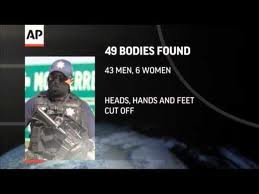
"Suspected drug gang killers dumped 49 headless bodies on a highway near Mexico's northern city of Monterrey in one of the country's worst atrocities in recent years. 
"The mutilated corpses of 43 men and 6 women, whose hands and feet had also been cut off, were found in a pile on a highway in the municipality of Cadereyta Jimenez in the early hours of Sunday, officials from the state of Nuevo Leon said... 
"Domene said the brutal Zetas drug gang claimed responsibility for the murders in a message found at the scene. 
"The massacre was the latest in a string of mass slayings that have convulsed Mexico in recent months, many of them in the north of the country, where the Zetas have waged a war against rival groups for control of smuggling routes." 
I've already covered the notorious Los Zetas outfit a bit before here, so I shall be brief. This 'gang' or cartel was founded by an elite Mexican military unit that was likely trained at Fort Bragg, home of the US Army's Psychological Warfare Center, by US Special Forces. Al Jazeera reports:
"Some of the cartel's initial members were elite Mexican troops, trained in the early 1990s by America's 7th Special Forces Group or 'snake eaters' at Ft. Bragg, North Carolina, a former US special operations commander has told Al Jazeera...
Their US training was designed to prepare them for counter-insurgency and, ironically, counter-narcotics operations, although Deare says they were not taught the most advanced commando techniques available at Ft. Bragg. 
"Military forces from around the world train at Ft. Bragg, so there is nothing unique about Mexican operatives learning counter-insurgency tactics at the facility. However, critics say the specific skills learned by the Zetas primed them for careers as contract killers and drug dealers."


In this case the decapitations were likely done to hinder the process of identification (the hands of most victims were also removed) but the trend of decapitating victims has become more and more regular among Mexican drug cartels of late. Regular readers of this blog know that I've written of the occult significance of decapitation on numerous occasions, most notably here. In brief, skull cults comprise the oldest religions as yet discovered --they even predate human beings, as the Neanderthals even displaying elements of skull worship. The act of decapitation is closely related to the traditions of these skull cults, and a tradition that continued to thrive as late as Roman times.
"In various primitive religions, decapitation derived from ritual and belief. Since the head as the home of the spirit, it needed to be preserved or destroyed, according to whether it belonged to a friend or to an enemy.  
"The Celts in the British Isles as well as on the continent used to cut off the heads of the enemies whom they had killed in single combat. This custom had a religious basis for, if the god of medicine, Dian Cecht, were to be believed, restoration to life or cure were possible so long as the essential organs --brain, spinal marrow and cerebral membrane --were intact. The heads thus cut off were kept as battle trophies and, whole or in part, treated for this purpose. One Irish literary source mentions tongues and another brains mixed with clay and rolled into balls for games. Livy records that after the Cisalpine Gauls defeated the consul Postumius, his skull was carried with high ceremony to their chief temple, mounted in precious metal and used as a ritual chalice.  
"Similar customs are recorded all over the world, from the celebrated shrunken skulls of the Jivaro Indians of Ecuador to the skull-sculptures of the Pacific. The Bamum of Cameroon, it may be observed, cut off the heads of enemies killed in battle, but only preserved the lower jaws of these trophies. Among various uses to which they were put was to decorate the rims of the Calabashes used ceremonially to serve palm-wine at the court of Fumban."
(Dictionary of Symbols, Jean Chevalier & Alain Gheerbrant, pg. 281)
Decapitation was also used heavily by the Aztecs in various fashions. Decapitation also plays a major role in the Sirius tradition. In occult circles Sirius is sometimes referred to as the 'Headless One.' For more on Sirius' links to decapitation, check here.

Another curious aspect of the headless bodies recently discovered near Monterrey are the tattoos some of the corpses displayed. MSNBC notes:
"Domene said some had tattoos of Santa Muerte, or 'Holy Death' a female skeletal grim reaper venerated by both gangs and some broader, non-criminal sections of Mexican society. The corpses were taken to Monterrey and authorities said they would perform DNA tests. Thousands of Mexico's drug war victims have never been identified."

Santa Muerte is in fact one of the fastest growing cults in Mexico. The Times states:
"The personage is Mexico's idolatrous form of the Grim Reaper: a skeleton — sometimes male, sometimes female — covered in a white, black or red cape, carrying a scythe, or a globe. For decades, thousands in some of Mexico's poorest neighborhoods have prayed to Santa Muerte for life-saving miracles. Or death to enemies. Mexican authorities have linked Santa Muerte's devotees to prostitution, drugs, kidnappings and homicides. The country's Catholic church has deemed Santa Muerte's followers devil-worshiping cultists. Now Santa Muerte has followed the thousands of Mexicans who've come to the U.S., where it is presenting a new challenge for American Catholic officials struggling with an increasingly multicultural population. 

"Santa Muerte's precise origins are a matter of debate. Some experts say its roots lie with Aztec spiritual rituals that mixed with Catholicism during Spanish colonial rule. What is clear, however, is that Santa Muerte developed a large following only in the last quarter century among Mexicans who had become disillusioned with the dominant Church and, in particular, the ability of established Catholic saints to deliver them from poverty. Residents of crime-tossed neighborhoods like Mexico City's Tepito began revering Santa Muerte more than Jesus Christ, experts say. Some of its devotees eventually split from the Catholic church and began vying for control of Catholic buildings. That's when Mexico's Catholic church declared it a cult."
Naturally Santa Muerte has a saint's day. Unsurprisingly, it falls on November first, the date of the Mexican Day of the Dead. In fact, numerous cultures the world over have traditions of a day of the dead on November first. In Christian Europe it is currently celebrated as All Souls on November second, but the date was likely changed by the Catholic Church.
"Perhaps we may go a step further and explain in like manner the origin of the feast of All Saints on the first of November. For the analogy of similar customs elsewhere would lead us to suppose that the old Celtic festival of the dead was held on the Celtic New Year's Day, that is, on the first, not the second, of November. May not then the institution of the feast of All Saints on that day have been the first attempt of the Church to give a colour of Christianity to the ancient heathen rite by substituting the saints for the souls of the dead as the true objects of worship?"
(The Golden Bough, James Frazer, pg. 385)
the modern Day of the Dead
Eventually the Church gave in and instituted All Souls Day for the worship of the dead, but placed it on the second of November to distance it from the ancient pagan customs upon which it was based. And yet the ancient tradition of the Day of the Dead on the first of November still prevails. In fact, it's seemingly stronger than ever.

The figure of Santa Muerte is clearly influenced by the European Grim Reaper figure. In some traditions, such as in Poland, death is even portrayed as a skeletal female figure. The association of a skeletal figure with the afterlife likely stretches back to antiquity.
"In Classical antiquity, if we are to believe Apuleius, impressions or statues of skeletons were commonly used in magical practices. These skeletons were regarded as images of Mercury (Hermes), the god who was the conductor of souls and enjoyed the privilege of being able to go down to and return from the Underworld. This use may be seen as an attempt symbolically to identify the god with death, so that the practitioner might share the same privilege of escaping from the Underworld as did the god; or, in an opposite sense, of dooming a given individual to death and leading him or her to the Underworld."
(Dictionary of Symbols, Jean Chevalier & Alain Gheerbrant, pg. 887)
This association of Mercury, who was also the god of magic, with a skeletal figure seems to have been merged with the figure of Death from the Book of Revelation and the Jewish tradition of the Angel of Death, Samael, in the Middle Ages. Samael, which literally means 'blind idiot,' was also the name of the Demiurge in some Gnostic traditions.


But back to the 49 headless bodies. Of course one can't consider occult overtones in Mexican murders without coming back to legendary cult leader, drug dealer, and serial killer Adolfo Constanzo, of whom I've written much more here, here, and here. Constanzo, whose birthday was November first, operated out of Matamoros, located in the state of Tamaulipas. Tamaulipas is right next to the state of Nuevo Leon, where the 49 headless bodies were recently discovered.


By the late 1980s Constanzo had built up a fiercely devoted cult spread across Mexico that frequently overlapped with his drug trafficking activities. Upon Constanzo's death in 1989 and the capture and/or death of many key members of Constasnzo's cult, Mexican authorities believed that the following built around Constanzo had been eliminated. Constanzo's followers seemed far less certain of this claim.
"The first hint that the cult might not have died with Constanzo came from Martin Quintana's sister, Teresa, as she babbled to the Mexican police three weeks before the shootout. 
"She told them that Mara, Constanzo's first madrina, was not dead after all, but had moved to Guadalajara. Martin had said Mara ran boutiques for Constanzo there, but Mara confided to Teresa that she really was a witch, in the same religion as Constanzo. 
"According to Teresa Quintana, Mara originally came from Veracruz, Mexico's center for witchcraft, with magical roots as deep as those in Salem, Massachusetts. Every year, a witch convention is held in Veracruz, where spells are traded and magic is compared in dark and private ceremonies... 
"Mara is not accused of any crimes, but police wanted to question her. They could not find her. Nor could police locate Damian the transvestite or Francisco the real estate speculator. 
"Weeks later, when Omar was arrested, he too would speak of others who practiced black magic and sacrifice --sister groups of Constanzo's. He knew no details, though. Then Sara said something very similar at one of the big press conferences. 'I don't think that the religion will end with us, because it has a lot of people in it,' she said. 'They have found a temple in Monterrey that isn't even related to us. It will continue.'"
(Buried Secrets, Edward Humes, pgs. 403-404)
Thus, evidence of occult activity was already present around Monterrey in Constanzo's era. What's more, the former employers (and now rivals) of Los Zetas, the Gulf Cartel, have been the primary criminal syndicate in the Matamoros area since the late 1970s. In an earlier blog I speculated that the Gulf Cartel and Constanzo had to have at least been aware of each other. Now I'm relatively certain that Constanzo was an employee of this outfit.


Constanzo would break into the Matamoros drug scene with the aid of a corrupt law enforcement officer, one Salvador Garcia, who was a member of Constanzo's cult. Garcia would put Constanzo in contact with the Hernandez family, a vassal of the Gulf Cartel, which at the time was led by Juan Nepomuceno Guerra and his nephew Juan Garcia Abrego.
"Salvador worked for the corrupt comandante of the federal police in Matamoros, Guillermo Perez --who, in 1989, would become a fugitive, with five million dollars of dirty money left behind in his desk. In 1988, however, Perez was still making a fortune on drugs, with no one to challenge him. 
"Perez, in turn, was a hireling of the notorious Juan Garcia Abrego Mexican drug-trafficking organization, the largest criminal gang in the Rio Grande Valley, the de facto government of Matamoros. Perez had grown rich stealing millions of dollars' worth of drugs seized from small-time traffickers, locking them up, then reselling the dope for the gang. Only members of the mob organization and those who paid protection money to it were safe from Perez. This same ruthless crime organization Perez worked for --and by extension, Salvador worked for --also had employed Elio's murdered brother Saul Hernandez..."
(ibid, pg. 171)


Saul, the head of the Hernandez family before Constanzo had signed up, was gunned down outside of a Matamoros nightclub called Piedras Negras, which was owned by Juan N. Guerra, the actual godfather of Matamoros (a title that would later be applied to Constanzo) and founder of the Gulf Cartel. The individual Saul Hernadez was with when he was murdered, Tomas Morlet, is an interesting figure as well.
"Saul's companion on the evening of January 7, Tomas Morlet, had been a comandante in the Federal Security Directorate, a Mexican police agency so corrupt the government eliminated it in 1985 for routinely giving police badges to drug traffickers, among other illegalities. It had been created with the assistance of the CIA. As part of that organization, Morlet had been a powerful figure in Mexican law enforcement, once assigned to maintain security for Secretary of State Henry Kissinger and, later, the exiled Shah of Iran. Morlet's official downfall came in 1986, when Mexican prosecutors accused him of murdering Kiki Camarena, the DEA agent tortured and killed in Guadalajara in 1985. Morlet was released a few days after his arrest 'fr lack of evidence,' and began a new career as a drug trafficker, feared and hated by many, yet still largely untouchable."
(ibid, pgs. 172-173)
With these kinds of credentials, it's likely Morlet had rubbed shoulders with the CIA or another branch of the US Intelligence community at some point in his career. His death would be consistent with how CIA asset are 'retired.' The 'Kiki' Camarena killing likely sealed his fate. This is but once instance where the CIA has popped in the Constanzo killings. More on the CIA connections can be found here. But I digress.

Camarena

Anyway, the Gulf Cartel was quite excited by the addition of Constanzo to the Hernandez family, as leadership skills had been badly lacking since Saul went down in a hail of bullets.
"At the same time, the Matamoros mob had its own use for Constanzo. It had lost a valuable and reliable trafficker in Saul Hernandez and a vacuum had been created, an enticing avenue for rival smugglers with none of Saul's loyalty. Constanzo was ready to fill the void, too. He let it be known via Salvador that he would provide the brains the Hernandez gang sorely lacked, while at the same time pushing out the rival traffickers who had settled like carrion birds around Saul Hernandez's corpse."
(ibid, pg. 174)
Now that I've established Constanzo's links to the Gulf Cartel, the question becomes did the gang adopt Constanzo's religious practices to some extent or other? Could the veneration that Los Zetas, former employees of the Gulf Cartel, has for the Santa Muerte be evidence of this? Did they possibly pick it up from the Gulf Cartel, who the after-mentioned MSNBC article implies also venerate that Santa Muerte? And if so, does the worship of Santa Muerte go back to Constanzo?

In my books on ole Adolfo I have no mention of Santa Muerte among the deities his cult worshiped, but the books were written at a time when Santeria and Palo Mayombe were just beginning to gain mainstream exposure. Very little was known about the Santa Muerte cult, which has only rose to prominence in the past decade or so. However, amongst the pictures appearing in Edward Humes' Buried Secrets book, there is are images of occult paraphernalia seized from the homes of Constanzo's followers after the arrests. One object is clearly a statue of the Santa Muerte, indicating it was used in the rituals of Constanzo's cult. How important the Santa Muerte was to Constanzo's religion is impossible to say, however. The Santa Muerte could have been adopted by Los Zetas and the Gulf Cartel from a different branch of Mexican occult circles.

religious paraphernalia found among Constanzo's followers

What then are we to make of the seeming reemergence of a death/skull cult in twenty-first century Mexico? If anything, it seems as those the barbaric US War on Drugs, which has spurred over 50,000 deaths in Mexico since authorities embraced the drug war mantle, is gradually reducing human beings to their most primitive instincts. Mexico, as well as several other Latin American countries, is now being destabilized by paramilitary-like crime syndicate made rich by misguided (some would say barbaric) US drug laws. That the US likely gave military training to some of these outfits is just another end result of militarizing the national drug policy.

I can't help but be reminded of the film Apocalypse Now, which I've chronicled before here. In the film the character of Willard, a US. soldier, travels up river to assassinate an AWOL colonel named Kurtz during the backdrop of the Vietnam War. As Willard travels further and further up river he seems to also be traveling back in time. By the time he reaches Kurtz's compound in Cambodia he has seemingly reached the dawn of civilization itself, with Kurtz in the role of the priest-king offering human sacrifices to replenish the land. For years I took the devolution of Now's final chapter as a metaphor for the effects US imperialism has had on the Third World, yet here we see such events actually playing out in modern Mexico, including Kurtz's obsession with decapitation.

This is truly chilling.


Sunday, April 24, 2011

Darwin's Head


In recent months the media has really begun to play up the decapitations administered by the Mexican drug cartels. Naturally, this has lead to a series of puff pieces trying to explain this phenomenon. And as may be imagined, these pieces are great press for the 'War on Terror.' Let us consider one such work:

"The preferred form of cruelty by drug cartel henchmen is to capture enemies and behead them, a once-shocking act that...


"Decapitations by drug cartels in Mexico first began in 2006, and that year armed thugs swaggered onto the white tile dance floor of the Sol y Sombra discotheque in Uruapan, a town in Michoacan state, and dumped five heads from plastic garbage bags.


"The blood-curdling act shocked Mexico, and evoked images of Islamic terrorism half a world away.


"'These guys are copying the methods of al Qaida (terrorists),' said Jorge Chabat, a criminal justice expert at the Center for Research and Teaching of Economics in Mexico City. He said the Mexican drug lords saw Internet video of beheadings of hostages captured by Muslim extremists in Iraq and Pakistan, and adopted the tactic themselves, down to the posting of video on the internet.


"Experts suggest that the drug gangs have several motives. First, they seek to use beheadings to cow the citizenry from squealing on them and to pressure local authorities to collaborate. Second, the gangs try to out-macho each other with greater acts of macabre violence, frightening rivals in a murderous spiral.


"The only hitch is that all the drug gangs have taken up beheadings."


While it is certainly true that the beheading can be used as an act of terror, this technique is far, far older than al Qaida and other 'Islamo-fascists.' In fact, it has quite a rich tradition in Mexico and the American southwest decades before the 'War on Terror' became a rallying cry. Consider the plight of Prohibition-era, Taos, New Mexico-based gangster Arthur R Manby.
"Manby was an odd amalgram of cultivated English gentleman, secret society adept, and vicious robber baron. Upon arriving in the Southwest in the 1880s, he became involved in a nonstop round of mine swindles and petty shakedowns. He graduated from these to a gigantic and still not completely understood attempt to get legal title to most of the land of present day Taos County, apparently in collusion with shadowy international financial forces in New York and London.


"Manby moved in a homicidal haze where somebody or other seems to have ordered 'Off with his head!' oftener than the Red Queen in Through the Looking Glass. His trail was littered with the decapitated heads of opponents and former associates. But in his semideranged old age, he seems to have lost control of the secret society that he had set up as his private terrorist and rub-out squad. His own decayed body (some said it was not his body) was found locked inside his house in the summer of 1929. It was decapitated. There was a half-chopped-away head sitting in the next room, but nobody was really sure if it was Manby's or not."
(Weird America, William Grimstad, pgs. 148-149)


While Aztec human sacrifices are primarily known for removing the hearts or skins of the victims, beheading was also a key feature of several major festivals. Case in point, Toxcatl, one of the main festivals in which a young man who had been impersonating the god Tezcatlipoca was sacrificed to this being. The grizzly end of this custom went something like this:


"Like the Mexican temples in general, it was built in the form of a pyramid; and as the young man ascended the stairs he broke at every step one of the flutes on which he had played in the days of his glory. On reaching the summit he was seized and held down by the priests on his back upon a block of stone, while one of them cut open his breast, thrust his hand into the the wound, and wrenched out his heart held it up in sacrifice to the sun. The body of the dead god was not, like the bodies of common victims, sent rolling down the steps of the temple, but was carried down to the foot, where the head was cut off and spitted on a pike. Such was the regular end of the man who personated the greatest god of the Mexican pantheon."
(The Golden Bough, James Frazer, pg. 609) 


Aside from festivals, decapitations featured in the ritualistic ballgames of Mesoamerica. From Wikipedia:

"The association between human sacrifice and the ballgame appears rather late in the archaeological record, no earlier than the Classic era.[52] The association was particularly strong within the Classic Veracruz and the Maya cultures, where the most explicit depictions of human sacrifice can be seen on the ballcourt panels – for example at El Tajin (850-1100 CE)[53] and at Chichen Itza (900-1200 CE) – as well as on the well-known decapitated ballplayer stelae from the Classic Veracruz site of Aparicio (700-900 CE). The Postclassic Maya religious and quasi-historical narrative, the Popol Vuh, also links human sacrifice with the ballgame (see below).

"Captives were often shown in Maya art, and it is assumed that these captives were sacrificed after losing a rigged ritual ballgame.[54] Rather than nearly nude and sometimes battered captives, however, the ballcourts at El Tajin and Chichen Itza show the sacrifice of practiced ballplayers, perhaps the captain of a team.[55] Decapitation is particularly associated with the ballgame – severed heads are featured in much Late Classic ballgame art and appear repeatedly in the Popol Vuh. With the Aztec version of the game, the skulls of losing teammembers were even placed in a 'skull rack' besides the field, and their blood was offered as 'food for the gods'.[1] There has even been speculation that the heads and skulls were used as balls.[56]"


Women were not spared from this good stuff either. Consider the festival dedicated to Xilonen, the goddess of the young maize. Here a young woman impersonated the corn goddess and met a similar fate to her male counterparts that impersonated gods:


"Another shook a rattle before the doomed woman as she mounted up the steps of the temple of Cinteotl, the Goddess of the Maize. On reaching the summit she was seized by a priest, who threw her on his back, while the sacrificer severed her head from her body, tore out her heart, and threw it in a saucer. When this sacrifice had been performed in honour of Xilonen, the Goddess of the Young Maize, the people were free to eat the green ears of maize and the bread that was baked of it. No one would have dared to eat of these things before the sacrifice."
(The Golden Bough, James Frazer, pgs. 614-615)
Decapitations and corn have an especially long history that goes beyond Mesoamerica. Consider the tradition of Lityerses in ancient Greece:
"...Lityerses was a bastard son of Midas, King of Phyygia, and dwelt at Calaenae. He used to reap corn, and had an enormous appetite. When a stranger happened to enter the cornfield or to pass by it, Lityerses gave him plenty to eat and drink, then took him to the corn-field on the banks of the Maender and compelled him to reap along with him. Lastly, it was his custom to wrap the stranger in a sheaf, cut off his head  with a sickle, and carry away his body, swatched in the corn stalks. But at last Hercules undertook to reap with him, cut off his head with the sickle, and threw his body into the river. As Hercules is reported to have slain Lityerses in the same way that Lityerses slew others (as Theseus treated Sinis and Sciron), we may infer that Lityerses used to throw the bodies of his victims into the river."
(The Golden Bough, James Frazer, pg. 436


The severed head, and the closely related skull, are symbols that go back to the very earliest rituals of human beings -Many of the earliest ritualized forms of worship are skull cults. In fact, the fixation with the head may even predate human beings.


"We have already viewed the earliest unmistakable archaeological evidence of man's religious thought, in the burials and bear sanctuaries of Homo neanderthalensis. We now add, to complete the picture, the observation that a number of the Neanderthal skulls found at Krapina and Ehringsdorf provide evidence also of his ritual cannibalism. They had been opened in a certain interesting way. Furthermore, every one of the unearthed skulls of Neanderthal's Javanese contemporary, Solo Man (Ngangdong Man), had also been opened. And finally, when skulls opened by the modern headhunters of Borneo fro the purpose of lapping up the brains are compared with those of Solo and Neanderthal -the skulls having served, handily, as the bowls for their own contents -they are found to have been opened in precisely the same way.


"Remarkable indeed -we might observe in passing -how far cultural patterns can survive beyond the periods of the races among whom they first appear!


"What rites were associated with the early headhunt we do not know; but that its spirit was comparable to the head-worship of the bear is likely -particularly in view of the fact that at the five-chambered grotto of Guattari near San Felice Circeo, on the coast of Italy, some eighty miles southeast of Rome, a Neanderthal skull was recently discovered that had been treated much like the skull of a sacrificed bear. The head having been removed, a hole had been tapped in it for the removal of the brain; the remains of sacrificed animals were preserved in receptacles round about the grotto, and the skull itself, placed on the floor of the cave, was surrounded by a circle of stones."
(The Masks of God Primitive Mythology, Joseph Campbell, pg. 373)


Clearly the removal of the head is a very primitive impulse indeed. So, why is it appearing now on a wide scale in Mexico? Is this something that is being instigated by the Cryptocracy, or is the zeitgeist simply taking over? In pondering these questions, I can't help but be reminded of a stellar episode from the final season of Chris Carter's Millennium called "Darwin's Eye." In brief, the episode concerns an escaped mental patient who leaves a trail of decapitated bodies in her wake. Throughout the episode the audience is kept guessing as to whether the girl in question is the murderer, whether a shadowy organization is framing her, or whether she's been programmed to carry out her bloody deeds. Along the way we learn that she had a military father involved in espionage work who also happened to molest his daughter. Yet the show concludes with indications that all these things were simple coincidences.


The female beheader's voice over narration at the beginning of the show is priceless:

"Ok so this is how life is supposed to be. Over millions of years we move forward, we evolve, in a series of tiny incremental steps. And each tiny step is a tiny improvement. It has to be. Survival of the fittest, that's what it's about. If you don't move on, you end.  Or, you're ended. So, we start with the primal ooze, and we end up with Mozart – Hitler – me. Which explains everything. And explains nothing. Because not everything evolves. Some things just happen. Like the eye, even Darwin worried about the eye. The iris, lens, retina. How could any of those things evolve in isolation? How could they be useful on their own? So how did the eye happen? How? Accident, it just happened. We don't know how, we don't know. One minute we're blind, next minute we see. Like the dinosaurs are lords of the earth for millions of years, then a big damn rock hits the Yucatan peninsula, and they're gone. Ended.  One minute we're here. The next minute, we're gone. Accidents happen. That's life. But what I want to know, what I want to know, is what makes the accidents happen."
The show perfectly captures the uncertainty of its opening monologue. How could a waffle-like woman manage to cleanly decapitate several men over the course of the episode without a struggle? Why did her childhood perfectly mirror Monarch programming despite conclusions that the abuse she suffered 'just happened.' And why did this woman perfectly recreate ritualized beheadings when supposedly they had no deep meaning to her?  

As previously noted, "Darwin's Eye" offers three possible conclusions to the killing spree: the girl is simply insane and tapping into a primitive instinct with decapitations, she was framed by an outside organization, or she was programmed. But what if all three are true? Is such a combination what 'makes accidents happen' as the opening monologue ponders? 


An image the killer made on her wall at the hospital

And if so, is something similar at work in Mexico at present? A decapitation has so much meaning, yet it exists at such a primitive level of our consciousness. Perhaps a slight nudge is all that's necessary to instigate full on ritual. 

Saturday, October 16, 2010

The Head That Keeps Giving


I was busy for most of the week on the prior post but I simply must comment again on the situation emerging over the severed head of a Mexican investigator searching for the body of a dead American jet skier. A few days ago the US authorities provided us with many LOL-inspiring quotes:

Texas Gov. Rick Perry said the death of the investigator was a message from gangsters for investigators to "stay out of their territory."

"I think their attempt is to intimidate law enforcement, no matter who they are or where they are," Perry told The Associated Press.

The beheading "is taking a page out of al-Qaida's playbook that these drug cartels have been doing for about the last three or four years now, trying to come up with the most grotesque form of murder they can to intimidate authorities and to intimidate the citizens of Mexico," former FBI profiler and NBC News analyst Clint Van Zandt said on TODAY.
The thing is, al-Qaida's 'playbook' comes from the same place as Los Zetas, namely from America's vast black opts establishment. Much as al-Qaida received much of its early training from the US, so to did the Zetas:

Deputy Attorney General José Luis Santiago Vasconcelos said in a recent interview that most of the original members of the Zetas, many of whom had received training at the United States School of the Americas when they were in the Mexican military
But this is only scratching the surface. As we've alluded to in a previous post, ritual decapitation has a very long history in the Americas as it has in many other ancient civilization ruled by a certain type of priesthood. In Mexico itself decapitation rituals held a special place of significance to the Aztecs. While many people associate Aztec human sacrifice with the removal of the heart and the flaying of human skin for a ceremonial wardrobe (both of which happened quite frequently) decapitation was much assuredly represented in their practices. According to James Frazer in The Golden Bough, decapitation was often performed when a victim was supposed to be representing a god, such as at the festivals dedicated to Toxcatl and Tezcatlipoca.

Regarding Toxcatl festival, Frazer notes:

On reaching the summit he was seized and held down by the priests on his back upon a block of stone, while one of them cut open his breast, thrust his hand into the wound, and wrenching out his heart held it up in sacrifice to the sun. The body of the dead god was not, like the bodies of common victims, sent rolling down the steps of the temple, but was carried down to the foot, where the head was cut off and spitted on a pike. Such was the regular end of the man who personated the greatest god of the Mexican pantheon. 
The Golden Bough, pg. 609
The Aztecs were hardly the only high indigenous civilization in the Americas to hold severed heads in great reverence. The Nazca civilization of what is now Peru, and who built the remarkable ley line-centric Nazca Lines, greatly coveted what are known as 'trophy heads':

The Nazca civilization, which flourished in Peru between the first century B.C. and the fifth century A.D. and slid into oblivion by the time the Inca Empire rose to dominate the Andes, is mostly known for carving in the desert hundreds of geometric lines and images of animals and birds that are best viewed from the air.

Less well known is that these ancient people boasted the largest collection of human heads in the Andes region of South America.

Carefully prepared, the lips sewed with long cactus spines, all heads featured a hole in the center of the forehead so that a carrying rope could be inserted.
Hanged and suspended from these woven cords, the heads were long believed to be war trophies.

But recent analysis of the diet-related substances found in the teeth of some heads unearthed in 1925, reveals that the Nazca built their collection not from foreign enemies slain in battles, but from their own people.
Freemasonry also has quite the obsession with the decapitation ritual, using it to symbolize the ninth degree in the Scottish rite.


From what I have been able to discern, the sleeping man being beheaded in the above image is supposed to represent the Old World while the beheader is the New Order. In Masonry John the Baptist, who was himself beheaded, is used as a typical example of this -the beheading of John represents as passing over to a higher plan of existence that Christ supposedly represented as in theory the Old World Order would be to the New World Order. As I noted in prior post, it was supposedly customary to slay a wizard by beheading as well. In theory this would both undo the wizard's prior workings while passing on his powers to the beheader.

So, if we take the decapitation ritual as a symbol of the New World Order, we can certainly discern an interesting message Los Zetas is sending to the US populace on behalf of their masters. As such, I doubt MSNBC or Fox will be reporting upon it.  

Monday, October 11, 2010

Mass Graves Return to Tamaulipas

More tragedy strikes the Mexican border, namely the discovery of a mass grave containing some 70 bodies discovered about a hundred miles south of Brownsville, Texas.

Apparently these poor bastards were aliens from the central Americas that were rounded up by one of the Mexican cartels, Los Zetas, and were offered their lives in exchange for becoming assassins. Presumably the ones who ended up in the grave said 'thanks but no thanks.'

For those of you that are familiar with David McGowan's work on serial murders, assassins and cults, this will immediately raise red flags. Another ranch in the state of Tamaulipas, this one located outside of Matamoros, was discovered with a mass grave in the late 1980s, This one belonged to notorious serial murderer, drug dealer and cult leader Adolfo Constanzo.


Here some 20 victims were murdered in ritualistic fashion. Los Zetas, the organization responsible for the present mass grave, started off as a part of the Gulf Cartel. They were ex-Mexican special forces that had possibly been trained at the School of Americas, a US based training facility run by the DoD for the purposes of training Latin American military and policemen. The Gulf Cartel has been active in Tamaulipas since the early 70s and a major player since the late 70s. It's quite likely Constanzo, who was sometimes known as the Godfather of Matamoros and reportedly had connections stretching all the way from Mexico City to Chicago, was involved with the Gulf Cartel in some way while running drugs through their territory.

Other mass graves have found along the Tex-Mex border. Ciudad Juarez is an especially nasty place for them. In 1999 another ranch provided the location for a mass grave, this one only a few miles from the El Paso border. Initially it was believed between 100-300 bodies would be unearthed until the American authorities took over. Then the number dropped to just nine. Even more interesting, the ranch was, according to McGowan, located at almost the exact spot infamous American serial killer Henry Lee Lucas said was the location of a ranch run by a Satanic cult known as the Hand of Death, and used to train their assassins.


More ranches, more mass graves, more tales of assassins with ties to the US military.... Coincidence?