As some of you may be aware, Twin Peaks and The X-Files are my all time favorite shows. As a child of the 90s, I was lured into The X-Files debut in 1993 while still in elementary school. Twin Peaks was already off the air by then, but I became obsessed with the show several years later after viewing Fire Walk With Me, a film version of Twin Peaks that came out in 1992. In particular, the sequence involving David Bowie totally blew my mind and remains one of my favorite scenes in film to this day.
While still in middle school, I tracked down a VHS set of the original run of Twin Peaks (sans the pilot), solidifying my obsession. From there on Twin Peaks became like an old friend, a place I could always comfortably escape to when the real world became to dull. My obsession with Twin Peaks never quite became a daily ritual as The X-Files did (I watched an episode or two of The X-Files before I went to bed every night for well over a decade) but it was always by my preferred escape from the daily grind.
Needless to say, when the returns of The X-Files and Twin Peaks were announced a few years ago, I was stoked in a way I hadn't been for Hollywood products in years. While I may have lost my faith in Tinseltown years ago, not so much in Chris Carter or David Lynch.
While The X-Files revival had its faults, possibly its biggest hindrance was a lack of episodes. Six hours of material just wasn't enough to appease the different type of fans the original run produced, who tend to prefer either monster-of-the-week eps or the "mytharc" ones. The X-Files revival tried to tackle both, unleashing two mytharc-centric episodes, one pure monster-of-the-week episode (penned by the great Darin Morgan no less) and three episodes that fell somewhere in between. While the individual episodes, especially the mytharc ones, were strong, the overall narrative felt somewhat disjointed as Carter and company tried to satisfy both sets of fans on a limited run. Hopefully the next season, which will expand to ten episodes, will manage a better balancing act.

Twin Peaks returns with eighteen hours of new footage and seemingly little interest in meeting fan expectations (or at least those of the critics). The new series comes off as a natural extension of the widely panned (at the time of its release) Fire Walk With Me, with the weirdness being upped another half dozen notches or so for good measure. No doubt individuals hoping Lynch would return to the pilot and fist season of Twin Peaks have been greatly disappointed, but they should have known better anyway.
Fire Walk With Me set the template for the rest of David Lynch's career and since then his films (with the exception of the cash-in The Straight Story) have only become and weirder and less concerned with linear storytelling. In that sense, Twin Peaks: The Return is exactly what the fans should have been expecting.
 |
| David Lynch |
Ah, but that is the exact prism that is needed. A big part of the appeal Twin Peaks has held for me over the years is how it presents the supernatural. When the show began to delve heavily into such netherworlds during the second season it was widely lambasted for loosing the plot. But supernatural fingerprints were always all over the series.
What upset most viewers was how incomprehensible it all was. Special Agent Dale Cooper (Kyle MacLachlan) received messages from the beyond that were so enigmatic that it frequently took weeks for them to begin making any kind of sense, if at all. And the behavior of denzies of the Black Lodge was so strange, with their backwards language and curious phrases ("Let's rock!") that most were simply left dumbfounded.

But for anyone whose ever read the supernatural musings of Charles Fort or John Keel, or similar theories concerning UFOs put forth by Jacques Vallee or has even been following the great Christopher Knowles' examination of the psychodrama played out by Jeff Buckley and Elizabeth Fraser, one realizes that Twin Peaks has put forth the most accurate take on the Other Side ever aired on television. And certainly it would have few rivals among film as well.
Simply put, the Other Side speaks in a language that we do not entirely understand and works on a schedule that may well be inconceivable to the human mind.
David Lynch and Mark Frost understand this implicitly and have gone to great lengths to capture this high strangeness on the Twin Peaks revival. And they are absolutely blowing my mind. I'm sure many of you out there are feeling the same way as well.
And while its far to early to attempt some type of broad analysis of the new season with only eight episodes having been aired at the time of this writing, I would like to note a few points that are of interest to me and which I think regular readers will find compelling as well. Warning: this will be extremely SPOILER heavy. Also, I am writing with the assumption that the reader is familiar with both the new season as well as the original run of Twin Peaks and the mythology surrounding. If not, you may find yourself lost throughout this post.
So, with those disclaimers out of the way, let us begin.
The Numbers
Certain numbers appear to have significance to the story line and appear at certain key points in the new season. In several instances, Cooper is told specific numbers by elements of the Other Side that latter have some type of significance. In other cases, these numbers have simply appeared in the background or are uttered by random characters, but seem to appear more than once in the series. Here are a few such examples:
253: Before leaving the Black Lodge, the Arm mentions 253 to Cooper. Later on it is revealed that 2: 53 is the time Cooper's doppelganger was scheduled to return to the Black Lodge.

315: 315 was the number of Cooper's old hotel room at the Great Northern Hotel, the key to which he still has when he returns to our world. When Cooper is forced out of the Black Lodge by Arm's doppelganger, he eventually falls into a room in a vast compound overlooking an Abyss. Awaiting him in the room are an eyeless woman and what appears to be a giant electrical socket with the number 15. Cooper later leaves this room with the eyeless woman and walks out onto what appears to be some type of box floating in space. On the box is some type of generator/container the curiously resembles the fabled Die Glocke, better known as the Nazi Bell.
The eyeless woman flips a switch on the Bell, then appears to be electrocuted. Her body floats off into space as Cooper looks on. He then heads back down, only to find himself in a slightly different room with a different woman (this one listed as "American Girl" in the credits). There is another giant electrical socket here as well with the number 3 by it. Cooper transforms into a kind of vapor and floats into the socket, which takes him back to our world at 2:53 in Las Vegas.


430: During one of the first scenes in the first episode Cooper is told by the Giant (Carel Struycken) to remember 430, along with Richard and Linda and "kill tow birds with one stone." Later Richard Horne (Eamon Farren), a resident of Twin Peaks, kills a small child with a truck. A Twin Peaks deputy tracks down the owner of the truck, who agrees to meet the deputy again at 4:30 to discuss the the murder. The truck owner does not make the meeting.

Deadly 6: The child struck by Richard dies near a power pole with the numbers 324810, and below these numbers a giant 6 in a circle. In episode two Cooper's doppelganger killed a young woman in a hotel room numbered 6.
Lucky 7: If 6 seems to be linked to death in the show, 7 may have a connection with life and luck. After evil Cooper kills the woman in hotel room #6, he goes over to room #7 and appears poised to sleep with another woman (i.e. he gets lucky) there under his sway. Later, (in episode 7 no less) an assassin likely hired by evil Cooper attempts to kill the real Cooper in front of the business where Dougie Jones, the golem created by evil Cooper to take his place in the Black Lodge, worked. The name of the company? Lucky 7 Insurance and it proves to be so as the real Cooper easily disarms the assassin with aid of the Black Lodge.

315: 315 was the number of Cooper's old hotel room at the Great Northern Hotel, the key to which he still has when he returns to our world. When Cooper is forced out of the Black Lodge by Arm's doppelganger, he eventually falls into a room in a vast compound overlooking an Abyss. Awaiting him in the room are an eyeless woman and what appears to be a giant electrical socket with the number 15. Cooper later leaves this room with the eyeless woman and walks out onto what appears to be some type of box floating in space. On the box is some type of generator/container the curiously resembles the fabled Die Glocke, better known as the Nazi Bell.
The eyeless woman flips a switch on the Bell, then appears to be electrocuted. Her body floats off into space as Cooper looks on. He then heads back down, only to find himself in a slightly different room with a different woman (this one listed as "American Girl" in the credits). There is another giant electrical socket here as well with the number 3 by it. Cooper transforms into a kind of vapor and floats into the socket, which takes him back to our world at 2:53 in Las Vegas.
430: During one of the first scenes in the first episode Cooper is told by the Giant (Carel Struycken) to remember 430, along with Richard and Linda and "kill tow birds with one stone." Later Richard Horne (Eamon Farren), a resident of Twin Peaks, kills a small child with a truck. A Twin Peaks deputy tracks down the owner of the truck, who agrees to meet the deputy again at 4:30 to discuss the the murder. The truck owner does not make the meeting.
Deadly 6: The child struck by Richard dies near a power pole with the numbers 324810, and below these numbers a giant 6 in a circle. In episode two Cooper's doppelganger killed a young woman in a hotel room numbered 6.
Lucky 7: If 6 seems to be linked to death in the show, 7 may have a connection with life and luck. After evil Cooper kills the woman in hotel room #6, he goes over to room #7 and appears poised to sleep with another woman (i.e. he gets lucky) there under his sway. Later, (in episode 7 no less) an assassin likely hired by evil Cooper attempts to kill the real Cooper in front of the business where Dougie Jones, the golem created by evil Cooper to take his place in the Black Lodge, worked. The name of the company? Lucky 7 Insurance and it proves to be so as the real Cooper easily disarms the assassin with aid of the Black Lodge.
First Peoples
Much like Kubrick's adaptation of The Shining, the specter of First Peoples is draped all over Twin Peaks. Of course, it was always present in the form of the character of Deputy Hawk (Michael Horse), the Native American artwork of the Great Northern and the mythos surrounding Owl Cave. With The Return, these elements are once again present, and even more amplified. The search for the real Cooper on the Twin Peaks end is set in motion by a phone call from the Log Lady (Catherine E. Coulson) to the now Deputy Chief Hawk informing him that a clue was missing in the death of Laura Palmer (Sheryl Lee) related to his heritage.

Meanwhile in South Dakota, a new murder mystery seems to be unfolding in the small town of Buckhorn. And like Twin Peaks, it seems to have its origins in a Native American settlement. In the first shot of Buckhorn Lynch lingers on what appears to be a giant Indian Mound in the middle of the town. As I've noted before here, Indian Mounds have frequently be linked to hot spots of high weirdness.
Gordon Cole's Office
There appear to be some tantalizing clues in the office of FBI Regional Bureau Chief Gordon Cole (played by Lynch), Cooper's former boss, in the pictures hanging on his wall. One picture is of the legendary novelist Franz Kafka, whose surreal, often nightmarish work, dealt with bureaucracy run amok in which protagonists often found themselves subjected to complex, bizarre and illogical predicaments beyond their control. The real Cooper's situation may not be quite "Kafkaesque," but the world Lynch invokes in Twin Peaks has more than a few overlaps with Kafka's works.
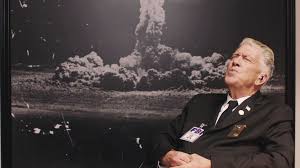
Another compelling image is of a mushroom cloud, presumably from the Trinity Site. As we saw in episode 8, the most recent one as of this writing, Lynch seemed to indicate that the evil personified by the Black Lodge entered into our world as a result of the splitting of the atom.
This is a compelling notion at the cutting edge of research into high weirdness. The great Christopher Knowles has speculated that the Trinity test also opened a gateway into our world that allowed something not entirely friendly to enter. It is no coincidence that the modern UFO era, with the Kenneth Arnold sighting and Roswell, began in earnest less than two years later.
1947 also witnessed the official beginning of the various Pentagon/CIA "behavior modification" experiments that included Projects CHATTER, Pelican, BLUEBIRD, ARTICHOKE, MKULTRA and MKOFTEN, among others. While these projects are generally believed to have been chiefly concerned with mind control, the reality is that they were equally obsessed with UFOs, psi and other strange phenomenon. Project STARGATE, the Pentagon remote viewing project, had its origins in BLUEBIRD/ARTICHOKE (as was noted before here), for instance. And of course by the early 1950s ARTICHOKE scientist Andrija Puharich claimed to have channeled "The Nine" (noted before here and here), an alleged extraterrestrial intelligence that existed out of time and space.
Some may object to this interpretation as things like UFOs have been little mentioned in the show itself (though the beloved character of Major Garland Briggs [Don S. Davis] had worked on Blue Book, as well as Cooper's old partner, the psychotic Windom Earle [Kenneth Welsh]), but readers of The Secret History of Twin Peaks will not be so quick to dismiss such notions. The book delves heavily into Ufology, addressing the Kenneth Arnold sighting, Roswell, Maury Island and Fred Lee Crisman, Projects Sign, Grudge and Blue Book, Majestic 12 and even the long-speculated upon connections Jack Parsons and Aleister Crowley had to the phenomenon, ending up with a Keel/Vallee-esque take on the subject. It even even recasts a minor character from the original series, newspaper editor Dougie Milford, as a kind of budding Fox Mulder who spent years chasing UFOs for the US intelligence community before being reassigned to Twin Peaks. Clearly author Mark Frost is very well versed in this subject and I would not be surprised if the topic eventually crops up in the new season. But back to the matter at hand.
A third picture seen in Gordon's office is also pregnant with symbolism: that of an ear of corn. In The Golden Bough, James George Frazer links corn to various myths of dying-and-resurrecting deities.
Was the picture of corn then potentially a hint of things to come? If so, it would likely revolve around the relationship between Cooper and Laura Palmer, who appear to have been magically wed at the end of Fire Walk With Me. In The Return it is Laura who appears in the Black Lodge to tell Cooper that he can leave. Shortly thereafter Laura is suddenly taken from the Black Lodge in a sinister fashion. Later Leland Palmer (Ray Wise), Laura's father and killer, tells Cooper to find Laura before he leaves the Black Lodge.
In leaving the Black Lodge, Cooper seemingly goes through his own descent into the underworld, or likely in this case the Abyss, where he ends up at the above mentioned compound with the electrical outlet portals. Episode 8 seems to indicate that this is the home of the Giant. Curiously Enki, the Sumerian deity of fresh waters and one of their chief deities, was said to live above the Abzu (roughly the Sumerian equivalent of the Abyss).

In fact, such a concept --a portal to another dimension --has become increasingly popular of late. The runaway hit Stranger Things also dealt with such a concept as did fellow Netflix production The OA. There have of course long been rumors, mainly relating to the Montauk mythos, that the deep state did in fact open such a portal. These developments certainly make for some interesting speculations.
 |
| Franz Kafka |
This is a compelling notion at the cutting edge of research into high weirdness. The great Christopher Knowles has speculated that the Trinity test also opened a gateway into our world that allowed something not entirely friendly to enter. It is no coincidence that the modern UFO era, with the Kenneth Arnold sighting and Roswell, began in earnest less than two years later.
1947 also witnessed the official beginning of the various Pentagon/CIA "behavior modification" experiments that included Projects CHATTER, Pelican, BLUEBIRD, ARTICHOKE, MKULTRA and MKOFTEN, among others. While these projects are generally believed to have been chiefly concerned with mind control, the reality is that they were equally obsessed with UFOs, psi and other strange phenomenon. Project STARGATE, the Pentagon remote viewing project, had its origins in BLUEBIRD/ARTICHOKE (as was noted before here), for instance. And of course by the early 1950s ARTICHOKE scientist Andrija Puharich claimed to have channeled "The Nine" (noted before here and here), an alleged extraterrestrial intelligence that existed out of time and space.
Some may object to this interpretation as things like UFOs have been little mentioned in the show itself (though the beloved character of Major Garland Briggs [Don S. Davis] had worked on Blue Book, as well as Cooper's old partner, the psychotic Windom Earle [Kenneth Welsh]), but readers of The Secret History of Twin Peaks will not be so quick to dismiss such notions. The book delves heavily into Ufology, addressing the Kenneth Arnold sighting, Roswell, Maury Island and Fred Lee Crisman, Projects Sign, Grudge and Blue Book, Majestic 12 and even the long-speculated upon connections Jack Parsons and Aleister Crowley had to the phenomenon, ending up with a Keel/Vallee-esque take on the subject. It even even recasts a minor character from the original series, newspaper editor Dougie Milford, as a kind of budding Fox Mulder who spent years chasing UFOs for the US intelligence community before being reassigned to Twin Peaks. Clearly author Mark Frost is very well versed in this subject and I would not be surprised if the topic eventually crops up in the new season. But back to the matter at hand.
 |
| Dougie Milford (Tony Jay) |
"Dionysus was not the only Greek deity whose tragic story and ritual appear to reflect the decay and revival of vegetation. In another form and with a different application the old tale reappears in the myth of Demeter and Persephone. Substantially their myth is identical with the Syrian one of Aphrodite (Astarte) and Adonis, the Phrygian one of Cybele and Attis, and the Egyptian one of Isis and Osiris. In the Greek fable, as in its Asiatic and Egyptian counterparts, a goddess mourns the loss of a loved one, who personifies the vegetation, more especially the corn, which dies in winter to revive in spring; only whereas the Oriental imagination figured the loved and lost one as a dead lover or a dead husband lamented by his leman or his wife, Greek fancy embodied the same idea in the tenderer and purer form of dead daughter bewailed by his sorrowing mother."
(The Golden Bough, James George Frazer, pg. 405)
 |
| the picture of corn in Cole's office |
In leaving the Black Lodge, Cooper seemingly goes through his own descent into the underworld, or likely in this case the Abyss, where he ends up at the above mentioned compound with the electrical outlet portals. Episode 8 seems to indicate that this is the home of the Giant. Curiously Enki, the Sumerian deity of fresh waters and one of their chief deities, was said to live above the Abzu (roughly the Sumerian equivalent of the Abyss).
Deep Private Hang Outs
In the first two episodes much is made of glass box under constant video surveillance from all angles in a New York skyscraper. The large room the box is housed in is under 24 hour security detail with an employee tasked with staying in the room with the box at all times to observe it and reload the cameras.
Eventually the private guards mysteriously disappear and the steward allows a very curious young woman into the room with him. Things soon turn sexual, and while they are distracted a shadowy figure appears in the box. It soon breaks out and literally tears apart the couple. Earlier Cooper had appeared in the box what the steward was out of the room.
All the information we've learned about the box thus far indicates it and the room are owned by a shadowy billionaire who was conducting some type of experiment with it. Here there are shades of the National Institute of Discovery Science (NIDS), a research organization dedicated to exploring fringe science. It was founded by the mysterious billionaire Robert Bigelow and staffed with a host of officials such as Colonel John Alexander (addressed before here and here), Hal Puthoff and Edgar Mitchell (noted before here) long linked to deep state forays into UFOs, psi and the like.
At one point Bigelow acquired the infamous Skinwalker ranch for the NIDS, where it conducted a host of experiments on the bizarre phenomena long reported in and near the ranch. There has long been speculation that the research done at the Skinwalker ranch and other field work conducted by the NIDS were a continuation, in the deep private, of work begun in deep state projects such as ARTICHOKE and STARGATE.
It is interesting to note that both Robert Bigelow and his NIDS are/were based out of Las Vegas. Bigelow built his fortune on real estate there before moving into the aerospace industry, space exploration and fringe science. Of course, a good chunk of The Return has been set in Las Vegas, with the real Cooper assuming the life of golem Dougie Jones there after returning from the Black Lodge. I would not be surprised if the mysterious billionaire behind the glass box turns out to reside in Las Vegas and turns up in the story line there eventually.
On that note, it is worth mentioning the Las Vegas chapter of the Association of Former Intelligence Officers (AFOI) that operates out of Nellis Air Force Base. The AFOI brings together many key black ops figures from various branches of the US intelligence community and is believed to wield enormous power behind the scenes in the CIA, DIA and the like. The Las Vegas chapter of the AFOI has many members long linked to fringe topics --that above-mentioned Colonel John Alexander, longtime Area 51 employee and some time Coast to Coast AM guest T.D. Barnes and the infamous Colonel Michael Aquino (noted before here). More information on the AFOI and its Las Vegas chapter can be found here.
As such, Las Vegas is far more apt location for Twin Peaks than it may initially seem. It will be most interesting to see if Lynch and conspiracy buff Mark Frost will further explore the city's deep background.
 |
| the shadowy Robert Bigelow |
On that note, it is worth mentioning the Las Vegas chapter of the Association of Former Intelligence Officers (AFOI) that operates out of Nellis Air Force Base. The AFOI brings together many key black ops figures from various branches of the US intelligence community and is believed to wield enormous power behind the scenes in the CIA, DIA and the like. The Las Vegas chapter of the AFOI has many members long linked to fringe topics --that above-mentioned Colonel John Alexander, longtime Area 51 employee and some time Coast to Coast AM guest T.D. Barnes and the infamous Colonel Michael Aquino (noted before here). More information on the AFOI and its Las Vegas chapter can be found here.
As such, Las Vegas is far more apt location for Twin Peaks than it may initially seem. It will be most interesting to see if Lynch and conspiracy buff Mark Frost will further explore the city's deep background.
But let us return to the glass box for a moment? Ufologist Grant Cameron recently indicated that the Twin Peaks subplot has eerie parallels to reports of a portal being opened between dimensions.
"He stated that Aliyah Malik Pandolfi had talked to Trump. She is the wife of... Ron Pandolfi. All of this briefing had to do with a portal that would play a role in disclosure...
"Sounds like a crazy idea except for two things.
"First, Smith is very close to Pandolfi who is closely tied to whatever the government knows about UFOs, and Smith has reported things from Pandolfi that later turned out to be true.
"Second, at the same time Smith was saying this, I got an independent Facebook message from Adrian Boniardi in Hollywood who thought there was going to be a gradual disclosure leak of information about UFOs. The leak connected to a new TV show called Counterpart, and had to do with the portal. The coincidence and timing were overwhelming. Boniardi wrote:
More drip? Keep an eye on this show when it comes up sometime this year. It promises to be very interesting of the kind of 'Fringe'.
I've worked on it these last couple of days and the storyline seems interesting.
'A U.N. (United Nations) employee discover that in the place where he works at (somewhere in Germany) they're hiding an inter-dimensional portal.'
"As synchronicity would have it, someone recently brought to my attention that Twin Peaks (2017) features a portal into an alternative dimension, with the portal being kept under guard at a New York City skyscraper owned by mysterious billionaire."
(Managing Magic: The Government's UFO Disclosure Plan, Grant Cameron, pgs. 256-257)
In fact, such a concept --a portal to another dimension --has become increasingly popular of late. The runaway hit Stranger Things also dealt with such a concept as did fellow Netflix production The OA. There have of course long been rumors, mainly relating to the Montauk mythos, that the deep state did in fact open such a portal. These developments certainly make for some interesting speculations.
Dimensions and Universes
And that brings me to my own outlandish theory concerning the new season of Twin Peaks: What if it takes place, at least in part, in a different dimension than the original series and the film?
I ask this speculative question due to what initially seemed like simple continuity errors on the part of Lynch and Frost. Specifically, I'm thinking of much of what went down episode 6 relating to Carl Rodd (Henry Dean Stanton), a returning character, but one who only appeared in Fire Walk With Me.
In FWWM, it was clearly established that Rodd was resident of Deer Meadow, Oregon and managed the Fat Trout Motor Home there. An FBI agent, Chester Desmond (Chris Isaak) was sent there to investigate the death of Teresa Banks (Pamela Gidley), the first victim of BOB/Leland. Banks kept her trailer at the Fat Trout. Also located there is the electrical pole with the numbers 324810 and a circled 6 on it.
Seemingly the same exact electrical pole that turns up in Twin Peaks, Washington over 25 years later at in intersection where the magician MIKE had confronted Leland/BOB and Laura Palmer in FWWM and where Richard ultimately kills a child in the new season.
Further muddying the waters is the issue of Fat Trout Trailer Park, also of Oregon in FWWM. In The Return its referred to as the New Fat Trout Trailer Park, leading many fans to assume Carl had simply moved it at some point. But The Secret History of Twin Peaks, written by series co-creator and the co-writer of the new season Mark Frost, tells a different story.

But FWWM clearly established that Rodd was living in Oregon in 1987 when Teresa Banks' murder occurred and yet here it is alleged that he was already living in Twin Peaks at that time. Mark Frost was only an executive producer on FWWM so its possible he was not overly familiar with the story line, but given how obsessive fans of the show are, it seems odd that such a glaring continuity error would be left in, especially sense it appears Rodd and the Fat Trout will play a key role in the new season as well (the other individual mentioned by the Giant, Linda, is apparently a resident of the Fat Trout).
Ah, but Rodd and the Fat Trout are not the only continuity error in Secret History either relating to the Teresa Banks saga either. In fact, Frost relocates the entire town of Deer Meadow from Oregon to Washington state, near Twin Peaks no less.
Nor is the story line of FWWM all that is altered as I've noted some changes in the book go back to the original show, which Frost was deeply involved in. For instance, the time frame of Big Ed (Everett McGill) and Nadine's (Wendy Robie) courtship is dramatically changed while Audrey's (Sherilyn Finn) motives behind being in the bank at the time of explosion also appear to have been changed.

Was all of this just sloppy work by Frost? But what of the electrical pole, which the viewers were clearly meant to notice, being transferred from Deer Meadow (of either Oregon or Washington) to Twin Peaks? I'm getting the sense that Lynch and Frost are subtly indicating that the world of the new season is slightly different than that of the original series and especially FWWM.
An even stronger indication of this possibility is dropped at the end of episode 7. Twin Peaks fans on Moviepilot made a startling observation about the final scene of this episode:
It seems hard to believe that this was some type of continuity error as well. This sequence, along with the bizarre appearance of the electrical pole in Twin Peaks, strongly indicates to me that things are not quite as they seem in the current Twin Peaks universe. Is it possible then that the new season is set in a different dimension or universe? Certainly doppelgangers are well established in the Twin Peaks universe by now, but are they limited to characters? Are there doppelgangers universes as well? To my mind, this is certainly a possibility worth considering at this point.
And with that I shall wrap things up for now. If I have some more thoughts as the series progresses, I'll be sure to weigh in again. Until then or next time, stay tuned dear reader.

In FWWM, it was clearly established that Rodd was resident of Deer Meadow, Oregon and managed the Fat Trout Motor Home there. An FBI agent, Chester Desmond (Chris Isaak) was sent there to investigate the death of Teresa Banks (Pamela Gidley), the first victim of BOB/Leland. Banks kept her trailer at the Fat Trout. Also located there is the electrical pole with the numbers 324810 and a circled 6 on it.
Seemingly the same exact electrical pole that turns up in Twin Peaks, Washington over 25 years later at in intersection where the magician MIKE had confronted Leland/BOB and Laura Palmer in FWWM and where Richard ultimately kills a child in the new season.
 |
| the well traveled electrical pole |
"In the early 1980s Rodd returned to his hometown for the first time in nearly 30 years and took up residence outside Twin Peaks in a brand-new trailer park. He eventually became the manager of this park, and part owner as well. He quietly gained a reputation there and in the rest of the community as a sensitive, caring and, despite his meager means, generous soul. He lives there in the park to this day."
(The Secret History of Twin Peaks, Mark Frost, pg. 146)
But FWWM clearly established that Rodd was living in Oregon in 1987 when Teresa Banks' murder occurred and yet here it is alleged that he was already living in Twin Peaks at that time. Mark Frost was only an executive producer on FWWM so its possible he was not overly familiar with the story line, but given how obsessive fans of the show are, it seems odd that such a glaring continuity error would be left in, especially sense it appears Rodd and the Fat Trout will play a key role in the new season as well (the other individual mentioned by the Giant, Linda, is apparently a resident of the Fat Trout).
Ah, but Rodd and the Fat Trout are not the only continuity error in Secret History either relating to the Teresa Banks saga either. In fact, Frost relocates the entire town of Deer Meadow from Oregon to Washington state, near Twin Peaks no less.
Nor is the story line of FWWM all that is altered as I've noted some changes in the book go back to the original show, which Frost was deeply involved in. For instance, the time frame of Big Ed (Everett McGill) and Nadine's (Wendy Robie) courtship is dramatically changed while Audrey's (Sherilyn Finn) motives behind being in the bank at the time of explosion also appear to have been changed.
Was all of this just sloppy work by Frost? But what of the electrical pole, which the viewers were clearly meant to notice, being transferred from Deer Meadow (of either Oregon or Washington) to Twin Peaks? I'm getting the sense that Lynch and Frost are subtly indicating that the world of the new season is slightly different than that of the original series and especially FWWM.
An even stronger indication of this possibility is dropped at the end of episode 7. Twin Peaks fans on Moviepilot made a startling observation about the final scene of this episode:
"Ready for the most mind-boggling thing you might have missed? At the very end of the episode we find ourselves in the Double R Diner instead of at our usual gig at the Roadhouse. It seems like a pretty average scene: People are sitting around enjoying their coffee and cherry pie, Norma's at a booth crunching numbers, Shelly's pouring refills, and Heidi is giggling. Then a man runs into the diner and frantically yells, 'Anybody seen Billy?' (btw, the man is credited as Bing and is played by Lynch's son Riley, who was also in the band Trouble in Episode 5).
"But this is where it gets really weird. Eagle-eyed Redditor EricMee13 pointed out that after Bing's exchange, the scene completely changes. Just look at the before and after photos above. After Bing leaves, Shelly turns around at looks a bit confused, before shaking it off and going back to work. But was she confused because of Bing's question, or was she noticing the changed clientele? This is certainly no editing fluke, but whether or not Lynch is trying to convey just a general sense of unease or something more sinister remains to be seen."An accompanying picture clearly shows that the patrons of the Double R are different than the ones who had been eating prior to the entrance of "Bing" (played by one of Lynch's sons):
 |
| Before (top) and after (bottom) Bing |
And with that I shall wrap things up for now. If I have some more thoughts as the series progresses, I'll be sure to weigh in again. Until then or next time, stay tuned dear reader.