Showing posts with label High Weirdness. Show all posts

Friday, March 15, 2024

The Fortean Mysteries in LA


It is my great pleasure to announce my upcoming appearance at Los Angeles' Philosophical Research Society --yes, the same outfit founded by Manly P. Hall. And I've got the perfect subject for this engagement: the original Fortean Society. 

While often overlooked, the Forteans had a considerable presence in Los Angeles. They rubbed elbows with early Hollywood and surrealist circles, providing an intriguing lineage to later movements such as the Discordians. But more importantly, they laid the foundation for the most esoteric interpretation of the UFO phenomena. 


And they did it nearly a year before the famous Kenneth Arnold sighting. It took almost a quarter century before folks like Jacques Vallee and John Keel embraced the metaphysical implications of the phenomena as the Forteans had. 

If you're in the LA area, please consider dropping by. I've got a great presentation planned and the venue is first rate. PRS is worth the price of admission alone, but you also get all kinds of Fortean LA madness. I call that a bargain. 

I'll be making the scene on April 24, 2024 --which is a Wednesday. The presentation starts at 7 pm pst. Tickets are available here.

Sunday, July 10, 2022

A Deep Dive Into the Georgia Guidestones


As I'm sure many of you are well aware by now, the infamous 
Georgia Guidestones done got blown up on July 6, 2022. This is a significant event no doubt, especially in the context of the wars currently playing out in Heaven and Earth. As such, there's a lot of rejoicing in certain quarters. 

But there's problem: the Georgia Guidestones are not what people think they are. The conventional narrative --that they were erected by a cabal of UN-backed, Rosicrucian Rockefeller shills has no basis in reality. The actual source of the funding for the Guidestones could not be further from those circles. And that's just scratching the surface.

The real secret of the Georgia Guidestones is that they are one of the greatest psyops and instances of fourth generation warfare of the Cold War-era. The intention was never to create a monument to globalism, but an egregore that feed off extremism. And based on recent events, whatever forces surrounding that monument are all grown up now. And ready to stretch their wings. 

On July 17, join myself, Occult Fan (alias Nathan Lee Foster Miller) and the legend, J. Michael "Doc Future" Bennet, for The Farm's latest Zoom party. There we will present what will be the deepest of all dives into the Guidestones and will surely be the most contrarian take of them all. Doc Future has done much to solve this mystery with his groundbreaking documentary Dark Clouds Over Elberton: The True Story of the Georgia Guidestones, which I highly recommend everyone watch as precursor to event. 

So, if you're interested in knowing the true origins of the Guidestones, their likely purpose, and what all of this means, be sure to sign up for The Farm's All Access Patreon prior to the 17th. The presentation kicks off at 9:23 pm est and will run till at least 11:23 pm est. Participants will have a chance to ask questions and so forth. It's going to be a great time kids, don't miss out.


Monday, June 13, 2022

Dispatches from Occult Cincinnati (and Beyond) Part III


Note: This is part of a series of articles I've written chronicling my recent travels for The Farm's Patreon. Dispatches from Dandyland (Somerset, KY) and Weird Wisconsin can be found there along with the entire first Cincinnati dispatch. A preview is available on this blog here. Finally, my traveling companions and I recounted our experiences in Cincy for The Farm recently. That interview can be found here and here. Part two is available in its entirety here. 

The third and final day of my occult exploration of Cincinnati and the surrounding area unfolded over the course of May Day or Beltane, depending upon your mileage. It was a kind of holiday weekend for my traveling companions and myself. We started to descend upon Cincinnati that Thursday, but it wasn't until Friday that every member of the party was present, and the adventure really began. With May Day/Beltane falling on Sunday, this meant that Walpurgis Night would unfold after sunset on Saturday. For those of you unaware, Walpurgis Night, along with Halloween, are considered the two principal Witches' Sabbaths. They're also the major cross-quarter days. For more on the pagan significance of these dates, see the second installment in this series.

When the topic of activities for Walpurgis Night came, there was one obvious choice to my mind: the storied Spring Grove Cemetery. Describing this place as an architectural marvel is a gross understatement. It's reportedly the nation's third largest cemetery, weighing in at 733 acres. It was first established in 1844 by the Cincinnati Horticultural Society. From the beginning, the group had ambitious designs for the cemetery. At the time, the so-called "Garden" or "Rural" Cemetery movement had taken off in Europe and the US. As the name implies, the location of Spring Grove was abundant in both its name sakes and seen as ideal for a garden. 


The Occult Architect

The initial architect wasn't quite up to the task, however, and in 1855 a replacement was brought in. He was a Prussian who went by the name of Adolph Strauch. At the age of 16, Strauch ventured to Vienna and apprenticed for six years at the Hapsburg imperial gardens at Laxenburg and Schönbrunn Palace. it was there that he was "discovered" by a mysterious Cincinnati businessman named Robert B. Bowler. Bowler had married into the Pendleton family by way of the daughter of Nathaniel Greene Pendleton. 

The Pendletons are part of America's old guard aristocracy, which I addressed in part one of this series. Patriarch Nathaniel Pendleton Sr. was an aide-de-camp to General Nathaniel Greene during the Revolutionary War and later became an early US Senator. Inevitably, he was an original, hereditary member of the Society of Cincinnati, that mysterious body from which the city was named after. The Pendleton clan would remain prominent well into the 20th century, spawning such notables as Francis Key Pendleton and Nathalie Schenck Laimbeer (a great-granddaughter of Nathaniel G. Pendleton). 

Nathaniel Sr.

It was no doubt a major coup for Bowler to marry into the Pendleton clan during that particular time and place. They were arguably at the height of their prowess during the mid-19th century. His brother-in-law, George Hunt Pendleton, had married into the family of Francis Scott Key and was about to embark upon a successful, Ohio-based, political career. Unsurprisingly, Bowler became a highly successful businessman in the Cincinnati area. This positioned him to embark upon an especially illustrious family estate. 

In 1850, Bowler convinced Adolph Strauch to relocate to Cincinnati and work on his family estate. It became known as Mount Storm and was by all accounts a wonder to behold. Designed as an old English country estate, it featured marble columns, a conservatory, and a Corinthian-style pergola, which was fubbed the "Temple of Love." By 1912, the estate was owned by the city after both Bowler and his son, Robert Jr., died prematurely. Despite having hosted Edward, Prince of Wales, at one point, the city opted to raze the structure in 1917. The reason given is that it had become a "trysting" place for young lovers. Others argued that it stood in the way of "progress," even though the spot has never been anything other than a park ever since. Given the family connections and some of the curious architecture, its easy to wonder if something beyond mere trysts were unfolding at Mount Storm. 

As for Strauch, his work on the Bowler estate made him an immediate sensation in the Cincinnati area. After working on a few other private estates in the area, he landed the gig he will forever be remembered for: Spring Grove. After becoming the cemetery's superintendent in 1855, he transformed it into what has been described as "the prototype of the lawn cemetery." Indeed, Strauch would later lend his talents to other famed cemeteries, such as Chicago's Oak Woods Cemetery, Detroit's Woodmere Cemetery; and Buffalo's Forest Lawn Cemetery. 

Strauch

Spring Grove remained Strauch's masterpiece, and seemingly the work closest to his heart. It's where he opted to be buried, after all. And he's in good company: the founder of Kroger's is there, along with the namesakes behind Procter & Gamble; Salmon P. Chase, the Ohio political giant who eventually became the Chief Justice of the US Supreme Court; and numerous members of the Taft dynasty, including Skull and Bones co-founder Alphonso. 

Alphonso is not the only founder of a fraternity residing in Spring Grove either. Isaac M. Jordan, a successful businessman who served one term in the US House of Representatives, co-founded Sigma Chi, one of the largest fraternities in North America. Well into the 1970s, pledges were required to sneak into Spring Grove and record the inscription on Jordan's tomb.

At least two members of the Pendleton family, Nathaniel G. and H., reside in Spring Grove as well. Keep in mind the family's patronage of Strauch by way of Bowler as well as their hereditary place in the Society of Cincinnati. In the first installment in this series, I noted another original member of interest here: the famed architect Pierre Charles L'Enfant. As I'm sure many reading this are aware, L'Enfant is widely credited with the occult lay out of DC. While his role in Freemsonry has been widely remarked upon, the Frenchman was quite active in the Society of Cincinnati also, being a founding member and designing the group's first emblem. 

***

For the rest of this article, head on over to The Farm's Official Patreon.

And if that's not reason to sign up, remember All Access patrons have got The Farm's monthly Zoom Party is coming up on Friday, June 17, starting at 9:23 pm est and running till 11:23 pm est. 

For this outing, I'll be joined by Occult Fan, alias Nathan Lee Miller Foster!!! Nathan Lee is the host of the Six of Swords podcast and the blog Occult Fan He and I are taking a deep dive into a topic closely related to this post, namely Evil Clowns. Everything from the Piep Piper to Insane Clown Posse is on the table. Where does this archetype come from, what does it mean, and why has it gone viral in the twenty-first century? Sign up and find out. 

Monday, May 23, 2022

Dispatches from Occult Cincinnati (and Elsewhere) Part II


Note: This is part of a series of articles I've written chronicling my recent travels for The Farm's Patreon. Dispatches from Dandyland (Somerset, KY) and Weird Wisconsin can be found there along with the entire first Cincinnati dispatch. A preview is available on this blog here. Finally, my traveling companions and I recounted our experiences in Cincy for The Farm recently. That interview can be found here and here. Look for part three in this series to appear on The Farm's Patreon in the near future. 

Day two of our exploration of occult Cincinnati and the surrounding area kicked off on the morning of April 30th. It was most apt for our destinations that day, being Walpurgis Night. In the occult calendar, eight major points of interest are the quarter and cross-quarter dates. The quarter days refer to four solar events that have long been observed as holidays on European calendars: Midwinter and Midsummer (the former was typically celebrated between December 21 and 25th while the later normally fell on June 23-24); and the spring and fall equinox (which are normally celebrated around March and September 20th, respectively). 

The cross-quarter dates fall in between these solar markers. In many traditions, they are seen as more significant than the quarter dates. Traditionally, Walpurgis Night and May Day (which followed the next day) were celebrated as Beltane during the Pagan era. The other cross-quarter dates are February 1 (Imbolc or Candlemas), August 1 (Lammas), and of course, November 1 (Samhain or Halloween). The nights preceding these dates (especially Walpurgis and Halloween) were seen as especially magical, a time when the veils between worlds was supposedly at its thinnest. 

As you may have surmised from the first part, Cincinnati is certainly a choice location for such festivities. And to be sure, we had an especially mystical spot tapped to spend the evening at: Spring Grove Cemetary. it's a remarkable location that's attracted its fair share of strange denizens over the years, to be sure.

It was not to be, however. Spring Grove is open deep into the evenings, but only after April 30, when it's summer schedule starts. For Walpurgis Eve, it closes up early. No doubt, vandalism caused by teenage metalheads and the like is a concern. I witnessed these sickening spectacles for years at Cassadaga's own mysterious cemetery (which, in a lot of ways, is like a scaled down version of Spring Grove...). But given the connections Cincinnati's founders have to secret orders and the amount of them buried in Spring Grove, its easy to make sensational speculations as to why else the cemetery is closed for Walpurgis Eve. But I will refrain from doing so. 

Spring Grove would have to wait till May Day. Fortunately, there were no shortage of strange sites to explore in and around Cincinnati for Walpurgis. And we already had one selected for that morning: the Great Serpent Mound. 


For myself and other members of our party, this was a major bucket list event. Long time readers of this blog will recall that the Great Serpent Mound was one of the first subjects I ever wrote about here. I've continued to revisit the Mounds of Appalachia ever since (see, for instance, here). Having grown up in this area, it's a subject close to my heart. I've been surrounded by these Mounds my whole life. They seem to follow me everywhere I venture. 

As for the Great Serpent Mound, it did not disappoint. For those of you unfamiliar with this site, here's a rundown: This particular structure is located in the midst of the Ohio Valley, which encompasses all of Kentucky and Tennessee; most of West Virginia and Indiana; slivers of Illinois, New York state, and Pennsylvania; as well most of Ohio. While Native American mounds have been found all over the southeast of the present United States, and deep into the Mid-West and Great Lakes area, this particular region is arguably unsurpassed in terms of both the numbers and scale of the Mounds found here.


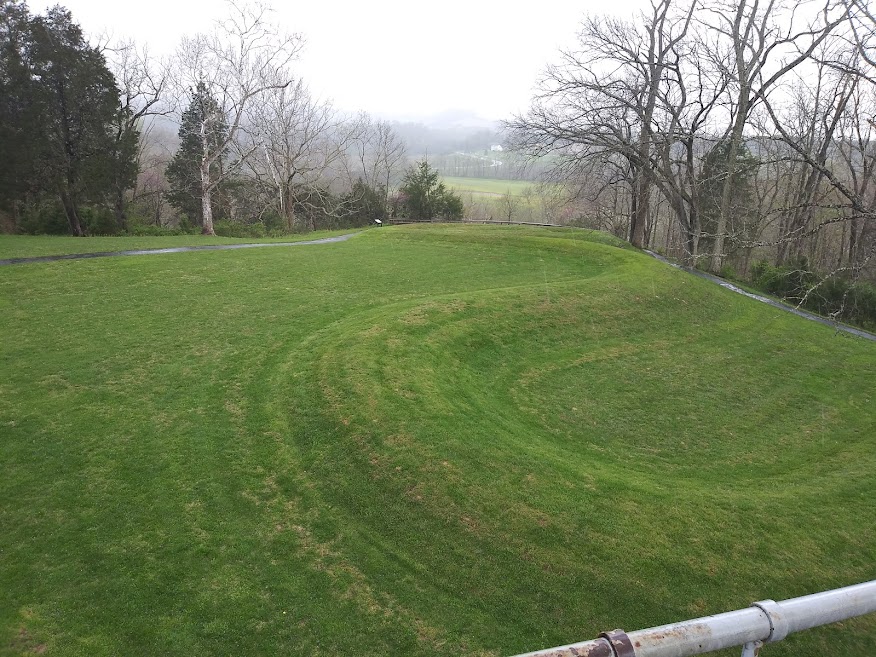
The Ohio Valley's crown jewel is unquestionable the Great Serpent Mound. It's located in Ohio's Adams County in the midst of the Serpent Mound crater. Yes, the effigy is within a crater left by meteorite roughly 300 million years ago. It's been speculated that the impact contributed to the alien landscape of the area. I can attest to its odd geographical features. This placing is all the more interesting in light of the Mound's astronomical alignments, which I'll get to in a moment. And the fact that the full scope of the Mound can only be gauged from the air...

the Serpent Mound crater

Stretching out at 1,348 feet in length and up to 25 feet in width (it varies between being 3 and 9 feet high at different parts), the Mound is believed to be the largest serpent effigy in the world. And predictably for a monolith of such grandeur, there is much debate as to who built it. 


Contrast that aerial shot of the Serpent Mound to the ones I took of either side of it with my phone from the park's observation tower. 

Early archaeologists credited to the Adena civilization. More recently, its been chalked up to the Fort Ancient culture. It's linkage to the latter is problematic, however. Radioactive dating placed construction of the Mound around  1070 AD, at a time when the Fort Ancient civilization inhabited this region. But the samples used may have been faulty. Layers of earth were added to the earthwork from the surrounding area towards the end of the 19th century. Thus, the samples used may not have originated from Mound's origins. Finally, the sacred geometry of the site is more in keeping with the Hopewell civilization, according to William F. Romain in The Mysteries of the Hopewell. Romain certainly makes a compelling case. 

The astronomical alignment of the Serpent Mound is justly celebrated. Its frankly nothing short of remarkable to view it in person. The megalith is aligned to True North plus/minus 10 minutes of arc. This alignment stretches from the tip of the serpent's tail to the triangular space of its head. The oval-to-head area of the serpent is aligned with the summer solstice sunset. Further, the serpent's body convolutions are believed to have astronomical significance. Romain believes they are aligned to at least six lunar azimuths. Others speculate that the three main curves point towards the sunrises of all four solstice and equinox.

The Hopewell civilization had a reputation for astronomy. The Adena and Fort Ancient civilizations were also fascinated by it, but not seemingly to the extent as the Hopewell. The Great Serpent Mound is also aligned to the Moon's midpoint in addition to the other links to the lunar body. This is in keeping with other Hopewell earth works, which were commonly aligned to the moon. 

Further, the Hopewell were one of many indigenous cultures that employed "charnel houses." The Native American version was quite different from the European structures, similar to crypts, which they are named after. The indigenous ones crop up all across the Southeast, appearing along the Atlantic coast from Virginia to Florida; around the Gulf and to the lower Mississippi Valley; and as far north as the Ohio Valley and westward till at least Oklahoma. They were used for mortuary services, usually cremation. Typically, they were burned down with body, despite the effort it took to construct them. In virtually all cases, they were aligned with the moon. 

The association of the moon in several Mound building civilizations will be of interest when we get into the next installment in this series. But, in brief: Among those tribes from this region, a belief existed that the Otherworld was a mirror image of our own. An identical twin even, but in reverse. Thus, while the sun is the primary life-giving body in this world, the moon would take on that function in the Other. 

Unsurprisingly, Hopewell magicians employed tools similar to their European counterparts. Their remains are commonly found with a thin sheet or two of mica. In sheet form, this mineral provides a naturally occurring reflective surface. A mirror, in other words. The prevalence of the mica sheets among the Hopewell remains led William Romain to conclude that they were used to access the Otherworld, in much the same way European magicians employed mirrors for the purposes of scrying. This is the basis for the fortune teller's crystal ball trope and it would seem the Hopewell had their own variation. 

a Hopewell mica sheet

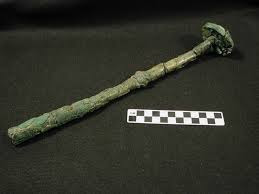
There is also ample evidence the Hopewell ventured into altered states of consciousness via entheogens as part of their rituals. Their shamans possessed magical wands that in some cases were in the shape of Amanita mushroom, one of the psychedelic variety. Mound City appears to have an entire effigy modeled upon the caps of the Amanita.

Nor is evidence of altered states limited to the mushroom effigies. Ceremonial pipes are a common feature of Hopewell earthworks as well. A particular type of tobacco, Nicotiana rustic, was smoked in these pipes. This tobacco is much stronger than what is used for modern cigarettes. The nicotine content can be up to five times higher. There are indications that excessive use of Nicotiana rustic can induce altered states. 


So, these sits may have constituted a proverbial witches brew of astronomy, magic mirrors, and psychedelics. But, to what purpose? If you happened to catch my interview with Fortan researcher Joshua Cutchins, we made a very compelling case for these set-ups constituting a kind of astral magick. 

Another interesting aspect of the Great Serpent Mound is its presence atop a hill/plateau. There's a trail that leads down to a creek that runs alongside the plateau. It's a strangely beautiful area. I was unaware that I was in a crater left by a meteorite at the time, which makes the landscape all the more remarkable. 


It was a magical day on any number of levels, but nothing better personified that than the fairy ring we noted on the way up to Serpent Mound. It was located just a mile or so from the Serpent Mound, and was across the street from a farmhouse with a small effigy mound in its front yard. Inevitably, we stopped for a closer look on the way back. For me, this was especially striking, given the remarkable fairy garden in Milwaukee a few days earlier. Much like the Mounds, the fey seemingly turned into an unintended traveling companion of mine for these journeys. 


From there, we made our way back to Cincinnati. Along the way, we stopped in the suburb of Fairfield, OH, so that we could partake of an entirely different effigy, one firmly rooted in American consumerism: Jungle Jim's International Market. While nominally a grocery store, the place has more the feel of Ripley's Believe It or Not. "Theme park" is a common description used, and not unjustly, considering the bizarre statues, music and animatronics on display. This isn't to say groceries are neglected --in fact, it may have the most impressive international selection I've ever seen. It's probably the size of a Cosco's or two --the international section mind you, not the entire store. But regardless of how one choses to classify it, the combination of ambition and kitsch is as quintessentially American as it gets.


As I noted at the beginning, we had planned to wrap the day up at Spring Grove Cemetery for Walpurgis Night. After being denied entry, we made our way to Eden Park. While not quite Spring Grove, it was a nonetheless satisfactory conclusion to the day. As should come as little surprise at this point, the park is littered with a host of strange structures. 


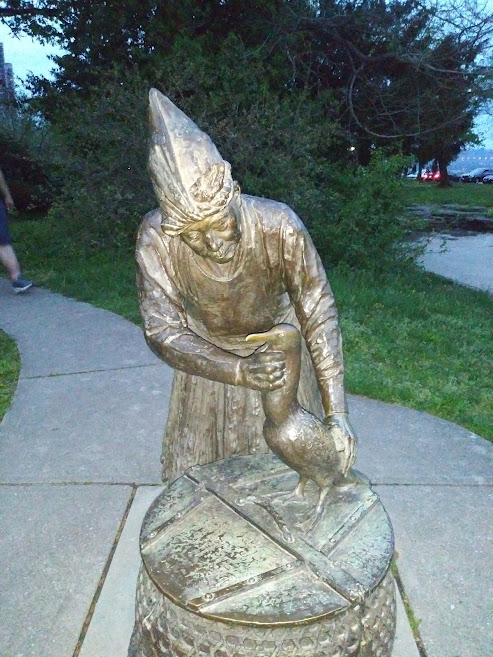
Not entirely sure on this one....

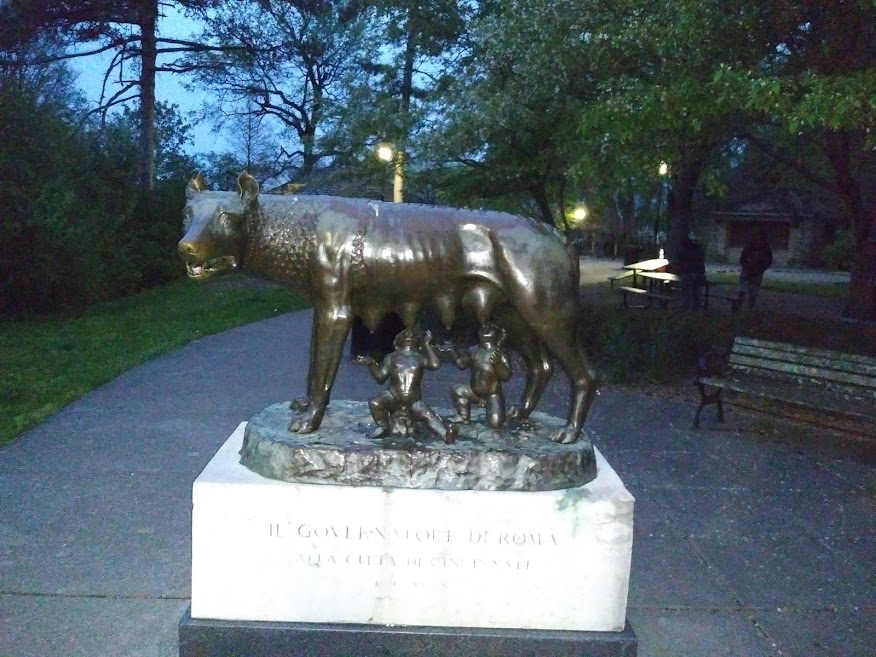
Easily the most notorious is the replica of the Capitoline Wolf Statue. Mussolini commissioned the statue and gifted it to Cincinnati in 1931. It's certainly apt for the most Roman of American cities. It depicts the she-wolf that suckled Romulus and Remus, the mythological twins believed to have founded ancient Rome. It certainly occupies a choice place in Cincinnati, overlooking the Ohio River and the city proper. Of course, my companions and I couldn't resist having a bit of fun with it. 


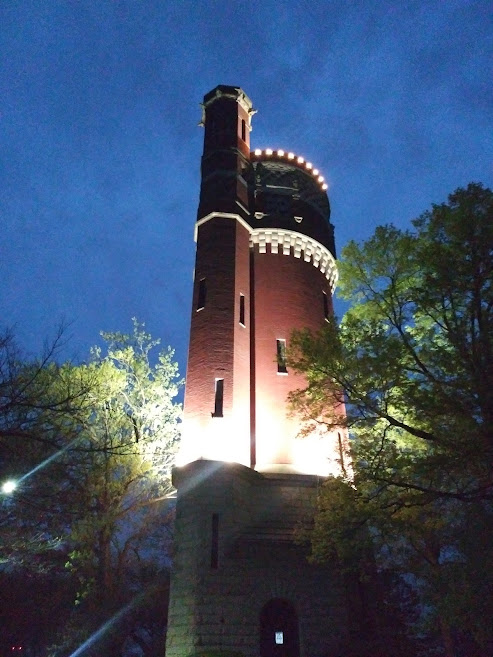
The most striking thing we encountered was the "Eden Park Standpipe." As you can see, this structure is more in keeping with a Gothic tower than a conventional standpipe. This thing was eerie and even featured a bat or two that had taken of residency. They fit in well with the standpipe's gargoyles. The bats threatened to descend upon us at a few points, but an uneasy truce was maintained. 

I couldn't help but be reminded of the final incarnation of Phillip Jeffries while standing in the presence of the standpipe. The structure apparently now services as a "communications facility" for the city of Cincinnati. Predictably, there's virtually nothing online about what this consists of. 


And so concluded day two in Cincinnati. After being denied the Spring Grove Cemetery for Walpurgis, it was at the top of the list for Beltane. Not only did we get to spend several hours at the graveyard on that Sunday, but we had some unexpected adventures in Covington, KY. It was there that I was once again struck by the hidden side of America, the one hinted at by strange monuments, their locations and the other curiosities. But it's certainly an America the likes of Michael Bertiaux and the Bate Cabal are familiar with. I'll explore these things and more in the final installment of this series. Until then, stay tuned dear readers.

Wednesday, December 1, 2021

Dispatches from Occult Moundsville


First off, apologies for the lack of new content on this blog. It's been a busy year for Recluse. In addition to hosting the weekly podcast The Farm, I'm also finishing up on my third book. The latter has proven to be quite a task, already totaling well over 100k words. Hopefully, I'll be dropping something truly epic early next year. There are some other projects that I've been working on this past year that will hopefully come to light in early 2022 as well. Again guys, sorry for the lack of content, but I promise I've been staying busy. 

On that note, let's move on to the housekeeping. As I'm sure many of you are aware by now, The Farm has its own subscriber's section, with exclusive guests and content. Appearing in the latest installment is the great Fortean researcher (and fellow Strange Realities speaker) Joshua Cutchin. He has appeared on many radio shows/podcasts, including Coast to Coast AM, Radio Misterioso, Gralien Report, Mysterious Universe and Where Did the Road Go. He has been a guest on the History Channel show Ancient Aliens and is the author of four books. They include A TrojanFeast: The Food and Drink Offerings of Aliens, Faeries, and Sasquatch; The Brimstone Deceit: An In-Depth Examination of Supernatural Scents, Otherworldly Odors, & Monstrous Miasmas; Thieves in the Night: A Brief History of Supernatural Child Abductions; and Where the Footprints End: High Strangeness and the Bigfoot Phenomenon, Volume I & II, with the great Timothy Renner.

In this wide ranging discussion, Josh and I use the mysterious Mound Builders of North American as a starting point. We get into the various traditions explaining them, allegations of both giant and pygmy skeletons found within the Mounds, and the general high weirdness surrounding the structures. This leads us to the concept of "Window Areas" and ley lines.

Ohio's legendary Great Serpent Mound

From there, we tackle the stellar orientation these structures frequently possess and their harmonic vibrations. Then we come to a subject that has long fascinated me: the ritual and symbolic significance of decapitation. Inevitably, UFOs and entheogens are mentioned frequently in this encounter, along with my own personal knowledge of Moundsville, WV, and New Smyrna Beach, FL. Besides mounds, those two locations have some other interesting curiosities. 

And remember, this is just the latest addition to the ever-growing roster of exclusive subscriber shows. Prior guests include Diana Walsh-Pasulka, Richard B. Spence, Christopher Knowles, Russ Baker, Douglas Valentine, Robert Guffey, Adam Gorightly,  Russ Bellant, Greg Bishop, Walter Bosley, Andre Gagne, J. Michael "Doc Future" Bennett, Erica Lukes, and so many more. Up next is the return of Gordon White to The Farm for an epic parapolitical dive. 


A Blast from the Past

Another nice thing about my discussion with Josh is that it provides me with an excuse to revisit a bit of VISUP history. Native American mounds have long fascinated me. I've lived near the remnants of Mound Builder civilizations for much of my life, first in Appalachia, then in Florida, and once more Appalachia. As such, they were one of the first subjects I approached when this blog was launched in 2010. The first installment in my "New World?" series was completely centered around mounds, and was either the second or third thing I wrote for VISUP. It actually appeared online prior to VISUP moving to Blogger in October 2010. 

I'd be lying if I didn't admit to being embarrassed by this piece now. Those were the days when it seemed like my well-thumbed copy Sinister Forces Book I provided a clear road map to all things. Hopefully I've grown as a researcher since those bygone days.


I'm still fascinated by the Mound Builders, and even more so by one of the strangest locales (which is say something...) in West "By God" Virginia. That would be Moundsville. I first visited Moundsville towards the end of the '00s, after reading Levenda's opus. It was certainly an experience, and immediately came to mind in terms of odd places I could chronicle for this blog. So, I set out to reacquaint myself with Moundsville and its curious attractions during early November 2021. 

The day I set out was an apt one: November 2. In Catholicism, this is All Soul's Day, a time to remember the departed. In Mexico, it's also a part of the famed Day of the Dead celebration. And to be sure, death loomed over the entire outing. The day before (November 1, Day of the Dead proper and, fittingly, All Saints' Day) I published a personally significant podcast on The Farm: a requiem for Ed Coffman, alias "Don Diligent." Longtime readers of this blog may recognize the name. Ed/Don was a regular commentator and an occasional collaborator. This post was partially based upon his groundbreaking research, for instance. To say nothing of the invaluable contributions Ed made to The Farm. 

Ed was one of the amazing people I've been blessed to encounter during my eleven years running this thing. And he was the only member of the "WACL Crew" whom I did not get to meet in person, much to my eternal regret. We tried to make it happen twice this past summer, but it just wasn't meant to be. 

So, death was in the air by the time I arrived in Moundsville. And it wasn't just from the holiday or my thoughts of Ed. The two locations I was intent upon visiting were also steeped in it.


The first location up for consideration was the legendary Grave Creek Mound, one of the largest native mounds still standing in the entire United States. During it's heyday, the mound stood at 69 feet (it's still 62 in its present incarnation) high with a base diameter of 295 feet. It was composed of 60,000 tons of Earth and is believed to have been built around 200 BC. It is generally credited to the Adena, possibly the most mysterious of the Mound Builder cultures.  


Despite many of the documented curiosities surrounding this culture, embellishments still persist. Levenda claims in Sinister Forces Book I that the Adena were abnormally tall, with men occasionally topping seven foot and women routinely over six foot. This is contradicted by the scholarly account presented by William S. Webb and Charles E. Snow in The Adena People. Per Webb and Snow, the average height for men was 5'6 while women were typically 5'2. This doesn't seem to suggest the women were routinely over six foot. In fairness, Webb and Snow write that the denizens of the Hopewell culture that superseded the Adena one were on average taller. Perhaps Levenda was confused? But he certainly isn't the only one to make such claims:


The museum next to Grave Creek Mound from which this display derives is quite impressive and completely free to the public. It also has a lot of random stuff thrown in that is completely unrelated to the Adena, Mound Builders, or Grave Creek Mound. At least one display was quite synchronistic to yours truly: 


On The Farm, we've been looking at one time Democratic vice-president nominee, New Age guru, and population reduction advocate Barbara Marx Hubbard. She'll also be turning up in my forthcoming book. Hubbard, despite her later ties to the Democratic party, came from a staunch Republican family. Her father, Louis Marx, was a hardline anti-communist and friend of longtime FBI capo J. Edgar Hoover. 

Louis Marx was a wealthy man, having made his fortune in the toy racket. The above display is celebrating his contributions to said industry. Every Christmas, Hoover's top underlinings at the FBI could expect Louis to shower them with free "samples" of his most popular products. Why this display ended up in a museum dedicated to a Native American Mound in northern West Virginia is anyone's guess, but it certainly reinforced the rightness of the trip in my mind. 

Of course, if you're talking Grave Creek Mound, one inevitably has to address the stone/tablet allegedly found within the structure. The mound was initially excavated in 1838, the same year Joseph Smith "returned" the golden plates that contained the Book of Mormon to an angel. I mention Joseph Smith here, because he supposedly found those golden plates originally near Palmyra, New York, which was reputed to possess Adena mounds at one point. Evidence of the Adena east of Pennsylvania is scarce, but there do appear to have been mounds there. Regardless, this was the heyday of archeological forgery concerning the mounds. Smith didn't cash in, but others surely did. 

Joseph Smith

Moundsville was first established by the Tomlinson family towards the end of the eighteenth century. For two generations, the family had avoided tampering with the Grave Creek Mound. But Abelard Tomlinson, a grandson of Moundsville's founder, decided to break with family precedent. He procured $2,500 from a Wheeling physician named James W. Clemens to excavate the site. Adjusted for inflation, that's nearly $75k in 2021 dollars. Not a modest sum of money, in other words, hence Tomlinson and Clemens were not doing this out of a love for history. Rather, they hoped to establish a museum next to the mound. 

And build a museum they did. It was right at the base of Grave Creek Mound, a rotunda carved into the side. It was haphazardly constructed, leaking not just water into the museum, but a white mass of animal and human fat from the burials in the mound. Lighting was provided by candles while a giant Native American skeleton loomed over the whole affair. It was overwhelming described as "morbid." 

Clearly, what was needed was an attraction. While Tomlinson and Clemens expected to find gold and jewels within the mound, only simple artifacts emerged. Save for one. 


Levenda describes the Grave Creek tablet inscriptions as possessing Phoenician characteristics, sometimes dubbed "Punic" (a Semitic language associated with ancient Carthage), that was common in Spain some 2000 years before the tablet's discovery. Further, Levenda claims at the time of the tablet's discovery, the script had not yet been deciphered. 

Elsewhere Jason Colavito, writing in The Mound Builder Myths, alleges that James Clemens himself forged the tablet. Further, Colavito makes a compelling case that Clemens lifted the script from a 1752 work by Luis Jose Velazquez de Velasco, Marques de Valdeflores entitled "An Essay on the Alphabet of Unknown Letters." Clemens even appears to have transcribed several of the errors the Marques made in the original text. 


Carbon dating would go a long way towards resolving this controversy. But that's not an option as the original tablet apparently disappeared off the face of the Earth after the original Grave Creek museum was shuttered in 1844. It was last known to have been in the possession of archaeologist Edwin Hamilton Davis before being lost to the sands of times. That Davis did not feel compelled to do more to preserve such a potentially groundbreaking discovery is telling. 

Another interesting point Colavito raises in The Mound Builder Myths is that six plates, allegedly containing Chinese characteristics, was "discovered" in 1843 near Kinderhook, Illinois, at a local mound. These plates were then dispatched to Joseph Smith for translation. Smith began the process of translating the plates, but soon lost interest. It was for the best, as the plates were later revealed to be a hoax designed to expose Smith as a fraud. 

Controversy over the historical legitimacy of Mormonism was raging at a time when the Grave Creek tablet was unearthed. It seemingly upheld the Book of Mormon's claims of contact between the New World and the Near East from ancient times. If Tomlinson and Clemens were deliberately perpetuating a hoax, did they have a specific audience in mind? To his credit, Smith doesn't appear to have taken the bait. 


Atop modern day Grave Creek Mound, there is a modest obelisk. Fittingly, there are signs that it has been adopted as a pilgrimage site for the dead. In this case, the contemporary tradition of "pennies from heaven" seems to be the basis:


Yes, I left my own penny for Ed. 


On the Dark End of the Street...

As impressive as Grave Creek Mound is, the structure on the opposite side of the street gives it a real run for its money. The West Virginia Penitentiary was originally constructed in 1863, in the midst of the American Civil War. The prison was actually built by it's future inhabitants as the war raged. 


The prison's legendary Gothic revival-style architecture was inspired by the design of Illinois State Prison at Joilet. The design was chosen for the stated purpose of conveying "to the mind a cheerless blank indicative of the misery which awaits the unhappy being who enters within its walls." In other words, the very architecture was selected for its ability to induce terror in the inmates. 

If that wasn't enough, West Virginia conducted it's state executions at the prison for decades. Nearly a hundred men were put to death there between 1899 and 1958. For much of that time, hanging was the preferred means of execution. Public executions were still conducted at the prison until 1931. They were only stopped after a mishap led to a prisoner being decapitated by his hangman's noose in front of the crowd. Later, the electric chair was used to carry out executions during the 1950s. The chair used at Moundsville was dubbed "Old Sparky" and was built by one of the inmates. In total, nearly a thousand people are known to have died on the prison grounds, but records prior to the 1930s are missing. 


Old Sparky wasn't the only contribution the inmates made to the otherworldly design of the prison. One inmate, a former truck driver convicted of murdering his wife, provided some of the more striking works of art present in the prison. The prison cafeteria was considered to be one of the finest eating establishments in the area and open to the public at large. Guests could enjoy some of the compositions of said inmate, who was colorblind, over their lunch:


Unicorns actually appear regularly throughout the prison, courtesy of the same artists

A self-portrait...

For reasons that should be obvious, the Moundsville prison has been a recurring staple in American pop culture over the years. Moundsville native and novelist Davis Grubb featured it in several of his works, most notably Fools Parade and The Night of the Hunter. Both of these novels were later adapted into films. The Night of the Hunter in particular is a stone cold film noir classic that captures the eerie vibe of the prison and town. 


It has also appeared regularly on paranormal shows, including MTV's Fear and the Travel Channel's Most Terrifying Places in America. When not appearing as itself, it frequently stands in for other prisons. Most recently it was used to depict the legendary Shawshank State Prison from the fiction of Stephen King in the TV series Castle Rock. It also turns up in Mindhunter and even the video game Fallout 76.

The Moundsville pen standing in for Shawshank in Castle Rock

Nor is pop culture the Moundsville prison's only claim to fame. Another was cult leader Charles Manson. It has long been claimed that Manson's mother, Kathleen Maddox, served time at the Moundsville prison and that he visited her there as a child. I have not been able to definitively confirm this, though Manson did spend part of his wayward childhood near the prison and several unidentified relatives did serve time there. In that Foul Year of Our Lord 1983, Manson even requested a transfer there. For some strange reason, it was declined. 

A bizarre synchronicity in all of this are the similarities to the final assault in Night of the Hunter and Manson family's creepy-crawly activities. For those you who have not seen or read Hunter (*SPOLILERS*) the Robert Mitchum character, a serial killer masquerading as a preacher, tracks the children of a woman he's murdered to an isolated farm house. There, with only a old woman to protect them, the inhabitants try to survive a night of Mitchum's various attempts to breach the house. One is left with the distinct impression Charlie was a fan. 


Nor was Manson the only figure with parapolitical significance who found themselves in the orbit of Moundsville and its prison. Moundsville is fifteen minutes south of Wheeling, WV. It was there, on February 9, 1950, that Senator Joseph McCarthy delivered his infamous "enemies within" speech, brandishing a list of suspected Communists in the State Department for the first time. This marked the onset of McCarthyism and the nation's Second Red Scare. Donald J. Trump's future political mentor, the mobbed-up attorney Roy Cohn, first rose to prominence as McCarthy's chief council during this era. It is quite fitting this chain of events would begin less than ten miles from the Moundsville prison, if I do say so. It further contributed to the haunting of this nation by various sinister forces. 

Cohn (left) and McCarthy (right).
Cohn and McCarthy were both protĂ©gĂ©s of Louis Marx's pal, J. Edgar Hoover 

Would you be surprised to learn that the Moundsville prison has reputation for being one of the most haunted spots in this nation dear reader? Probably not. One of the earliest images of a purported "Shadow person" was also snapped at the prison during 2004.


Besides the horrendous conditions of the prison, was there possibly something else at play? 


located in the Warden's quarters..

At the edge of 17...


Probably just a coincidence. 

Regardless, one single street in Moundsville, WV has managed to capture the national mind in a striking way. Whether you realized it not, this tiny town in West Virginia has been molding the popular culture in subtle way for decades now. It first haunted us in Night of the Hunter and now it's become a stand-in for Shawshank. But there is no escape from the prison in twenty-first century America.  

Was that always the point? Were the builders fully aware of what they were unleashing when this monstrosity was constructed next to an important Native American ritual center? I suspect so. For those musings and other sinister implications at Moundsville and similar sites across the nation, be sure to check out my interview with Josh.