Welcome to the second installment in my examination of the
Imaginos cycle of legendary rock producer, manager and lyricist
Sandy "Memphis Sam" Pearlman. Pearlman, who recently
shed his mortal coil on July 26 of 2016, is best known for his decades-spanning association with
Blue Oyster Cult. Pearlman was a co-founder of BOC all the way back in 1967 when the group was still known as Soft White Underbelly and would remain the group's manager until 1995. He was also a frequent producer and lyricist for the group during their peak years.
BOC was hardly Pearlman's only contributions to rock 'n' roll. As was noted in the
first installment, Pearlman played a rather large if unacknowledged role in the development of
punk and
heavy metal. He was the early manager and producer for the
proto-punk outfit
The Dictators and had had dealings with
Patti Smith in the New York music scene for years (Smith wrote the lyrics to several BOC songs and was even considered as a possible vocalist for a time). He would also produce
The Clash's landmark
Give 'Em Enough Rope, their first American breakthrough.
But it is heavy metal for which Pearlman will be most remembered for. In addition to BOC, Pearlman also managed
Black Sabbath during the early 1980s in the midst of their
Ronnie James Dio-fueled revival. He also nearly signed the pioneering doom metal outfit
Pentagram, but singer Bobby Liebling sabotaged this courtship during the recording of a demo. But moving along.
The Obsidian Gaze
As I was wrapping up with the
first installment, I noted Pearlman's occult vision of Blue Oyster Cult. This revolved around a series of poems Pearlman had written during the mid-1960s entitled
The Soft Doctrines of Imaginos. This series of poems would serve as the basis for the lyrics of numerous Blue Oyster Cult songs over the years. But it was not until 1988, with the release of
Imaginos, that this concept was fully revealed to the public. Fans had of course been aware for years that certain characters and themes seemed to appear time and again in BOC songs, but
Imaginos made it clear that a kind of story arc lay behind these references. And this story arc was deeply inspired by occult and metaphysical works as well as conspiratorial interpretations of modern history. Consider the basic premise of
Imaginos that was outlined in the album's linear notes:
"THE BACKGROUND: 'Out beyond the Europe's rim the Spaniards met the Indians.' This, then, is the original encounter, the deep background of the Imaginos saga, the table upon which the whole myth unfolds. To the Spaniards, agents of a Catholic Sovereign, the New World was no place of grace. To the Spaniards, the first Europeans to find a New World, what they found was not good. It was anti-genesis, anti-Eden, seat of evil, pit of darkness. All the shinning silver of Mexico and all its bright, bright gold, herein became no luminous mirror of delight, but, rather, a mirror of blackness. The priests in the expeditions could imagine no place worse than this place, albeit new, visibly in the thrall of invisible spirits. All the shinning silver of Mexico and all its bright, bright gold, becomes, when striven for beyond all limit, that which is beyond limit.
"On the luminous surface of a noble metal, corruptible by no agent of this world, the Spaniards could read no reason to turn back now. Even then, it had become to late. In the mirror of blackness, where no light can shine and no image collects, the Spaniards discovered for themselves an image of the self without limit: the invention of all new things, the invention of genocide; all things are permitted. For hundreds of years, all the gold in the world came from the New World. Melted and re-melted, incorruptible, but soft, its luminosity circulated throughout Europe: the seduction of the Old World by the New World --innocence corrupts experience. The destruction of Spanish power was accomplished by the England of Elizabeth. Her occult adviser a Dr. John Dee. He spoke, he said, with invisible spirits and in his possession was a magic mirror of black volcanic glass, obsidian. It was fashioned in Mexico."
Pearlman had a very keen interest in
alchemy that is apparent from BOC's first album and in laying out the background of the Imaginos cycle he uses alchemical phrases ("noble metal") in describing the gold of the New World. Much more will be said on Pearlman's lyrical use of alchemy in just a moment.
The phrase "all things are permitted" is a variation of the second half of a rather infamous quote that goes "Nothing is true, everything is permitted." These words are typically attributed to
Hassan-i Sabbah, the legendary
Nizari missionary he founded the mountain stronghold known as
Alamut. His followers are typically referred to as
Hashshashins or "Assassins." The above phrase almost surely was not uttered by Hassan, however, and was
likely a modern adaption from a phrase in a Dostoevsky novel. This expression was popularized by
William S. Burroughs, who attributed it to Hassan, during the
1960s counterculture and it is likely from this source that Pearlman adapted the "all things are permitted" line.
 |
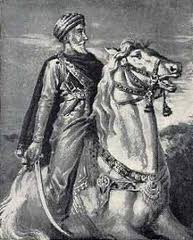
| Hassan-i Sabbah |
Even more interesting are the references to
Elizabethan mage
John Dee and his
obsidian mirror. Here's a bit more information:
"... Indeed, one of the famous shew stones of the Elizabethan magician and spy, John Dee, was of Aztec obsidian brought back from the New World by Spanish conquistadors. The Aztecs used the obsidian shew stone in an identical fashion to that used by Dee (and, alter, Joseph Smith), as a kind of crystal ball. To the Aztecs, the obsidian mirror was sacred to the god Tezcatlipoca, the 'god of the smoking mirror,' who would reveal to them the will of heaven. Tezcatlipoca was identified with the constellation Ursa Major, thus tying together astronomy with religion and divination in a pattern familiar to all students of ancient civilizations. The astronomical alignments of many of the Adena mound sites is further evidence of this persistent occult theorem. Joseph Smith, of course, used shew stones in much the same way as the Aztecs and John Dee. Indeed, John Dee himself was a scientific advisor to English expeditions to the New World, and a close friend of Sir Walter Raleigh, them man who introduced tobacco and many other curiosities to England from the New World. Elizabethan magician and spy, Dee also became convinced that a Welsh prince had 'discovered' America centuries before Columbus."
(Sinister Forces Book I. Peter Levenda, pgs. 53-54)
 |
| John Dee |
Pearlman apparently never got the last memo, but he surely seems to have made the connection between
astronomy, religion and
divination. One of the most revered songs in the Imaginos cycle is "
Astronomy," first recorded for 1974's landmark
Secret Treaties album, in which the Dog star
Sirius is referenced. But more on that latter.
Pearlman is thus able to link the Imaginos cycle to alchemy, the mythology surrounding the Nizari and the shew stone of Dr. John Dee (whom countless conspiracy theories revolve around) in two paragraphs outlining the "deep background" of the story line. It probably goes without saying, but Pearlman clearly had numerous obscure sources that went well beyond the
weird fiction of
Robert Chambers and
H.P. Lovecraft (his love of these two authors was addressed in
part one) decades before the rise of the Internet. While the Imaginos cycle, with its centuries spanning narrative of secret societies controlled by nonhuman intelligence driving the development of modern history, certainly bares a heavy influence from these sources, many of the themes and concept revealed therein were deeply steeped in the occult.
 |
| H.P. Lovecraft |
With this in mind, I would like to know examine BOC's "Black & White trilogy" (the first three albums, the
self-titled debut,
Tyranny and Mutations and
Secret Treaties, so-named for their striking black and white artwork). It was these works, along with the
Imaginos album, where Pearlman's influence was most pronounced. As such, the Imaginos cycle is referenced frequently throughout these classic works. Indeed, Pearlman appears to have been urging the group to do
The Soft Doctrines of Imaginos as a full on concept album since at least the early 1970s.
"Pearlman had hoped to adapt the Imaginos story into a Blue Oyster Cult album as far back as 1972, at which time he and Albert Bouchard (and, to a lesser extent, other BOC members) had begun to write songs around the narrative. But the band's increasing resistance to recording Pearlman's lyrics --as he puts its, 'They had realized the potential delight of publishing income, and were no longer interested in being the mouthpiece for my musings on the backstory of the creation of the universe' --put the project on hold, although individual Imaginos songs appeared on early BOC albums."
(Imaginos CD booklet, Scott Schinder)
While the group later became resistant to the concept, in the early years it formed the basis of what BOC was supposed to be. In fact, the group's name itself was derived from the Imaginos cycle.
"I asked Joe [Bouchard, longtime BOC bassist --Recluse] about one of the more enduring mysteries with respect to the band, the name 'Blue Oyster Cult.' 'The true story is that Sandy wrote a poem (The Secret Doctrines of The Imaginos) that was part of the Imaginos song cycle. I guess he wrote it back when he was going to graduate school, Brown University. He had dreamt up this whole Imaginos thing, and that was one of the songs. So it;s nothing to do with the anagram story.' "
(Agents of Fortune, Martin Popoff, pg. 15)
Joe Bouchard's above claim that Pearlman received his
Master's from
Brown University is most interesting. I've been unable to find confirmation of this any other source, with most simply noting that Pearlman received his B.A. from the
State University of New York at Stony Brook, with no mention of a Master's from any university. But Joe Bouchard has
insisted in other interviews that Pearlman received a Masters from Brown. It seems a bit surprising that Bouchard may have confused a New York state school with the Ivy League Brown. Or perhaps Pearlman had told Bouchard he had received his Masters from Brown, but had been lying.
If this is accurate, however, it would further reinforce Pearlman's connection to two early BOC staples: Nazism and H.P. Lovecraft (noted in
part one). As for the latter, Lovecraft is thought to have used Brown as the basis for his fictitious
Miskatonic University that appears frequently in his weird fiction, especially the
Chthulu cycle. Miskatonic was renowned for its collection of occult texts, most notably the
Necronomicon. Lovecraft himself had dreamed of attending Brown, located in his home town of
Providence, Rhode Island.
As for Nazism, Brown would educate several individuals linked to far right causes during the late 1930s and early 1940s:
"Remember that this trio at Brown University in Providence Rhode Island during the late 1930's and the early 1940's, E. Howard Hunt, George Lincoln Rockwell, and Vonsiatsky, as either degree seeking students or in the case of 'Annie' Vonsiatsky, as a special student taking English for non-native speakers of the language. The Vonsiatsky legend lives on at Brown where he used to go in the late 1930's driving his Pierce Arrow convertible down the Putman Pike, dressed in Nazi regalia to attend Ivy League football games..."
(JFK -The Final Solution, John Bevilaqua)
Anastasy "Annie" Vonsiatsky was a notorious
White Russian fascist whom was very active in the American fascist underground in the lead up to World War II while
George Lincoln Rockwell was the founder of the
American Nazi Party (curiously, the American Nazi Party used the
Pagans MC as bodyguards for a time in the 1960s). And
E. Howard Hunt was of course one of the infamous
Watergate "Plumbers." Whether Pearlman was aware of this curious side of Brown is unknown, however. But moving along.
Blue Oyster Cult: Background
BOC's classic self-titled debut dropped in 1972, after nearly a half decade of the band vying for a record deal. At this point in time, the band was still transitioning from their psychedelic Soft White Underbelly days to the sinister heavy rock that would define their early sound. Shades of
The Doors,
The Electric Prunes and the
13th Floor Elevators frequently rear their head amid the band's post-
Killer biker boogie, lending the album a druggy atmosphere that the band was never quite able to capture again. There were certainly far heavier albums available to the public at large by 1972, but few if any sounded this eerie or down right evil.
Acid rock,
hard rock and "heavy metal" of course first began emerging around 1968. This was a crucial period in the counter-culture. Increasingly
acid and
cannabis were passe as the good vibrations of the
Summer of Love began to give away to the paranoia that would define the late 1960s and early 1970s. This paranoia was increasingly fueled by the cheap
heroin and
amphetamines that were flooding the streets at this time as
Vietnam raged on. The former was very much being driven by far right cliques and their backers in the US intelligence community (as noted before
here and
here). Pop culture adapted accordingly: Beginning in the mid-1960s the United States began to be flooded with a series of Satanic-themed and ultra-violent horror films, i.e.
Rosemary's Baby and
Night of the Living Dead. This trend would continue well into the 1970s.
Chris Knowles has done a fantastic job of chronicling these developments
here and
here.
And music of course began to become heavier and louder. And quite possibly no band better captured the
zeitgeist of these changes unfolding in the real world and pop culture than BOC.
But before getting to the sounds contained within the record, a word should be said about the debut album's striking cover art work. The great
Julian Cope has referred to it
as "mysterious monochrome sacred geometry." It is highly debatable if the cover was deliberately trying to evoke
sacred geometry, but it certainly appears to hint at something truly sinister --perhaps some type of
Panopticon on a prison planet overseen by ancient alien gods enthralled by a religion older than time itself.
One is tempted to credit Pearlman for this imagery, but he in fact had little to do with the cover or the group's mysterious symbol, first prominently displayed on the debut. He did, however discover the artist who conceived of the classic rock 'n' roll images.
"Who better to graphically depict such a curious record than clearly bonkers school chum Bill Gawlik? Sandy retells the story of the enigmatic draftsman: 'Gawlik had gone to the Rhode Island School of Design, and he had left there and transferred to Stony Brook. He was living in the dorms, and I had ran into to him, quite literally, on the day when he was unfurling the huge scroll on which he had all of his architectural designs. He was sort of like Albert Spencer of H Quad at Stony Brook. You know, Speer was commissioned by Hitler to design all of future Europe. Bill Gawlik was designing all of future America, although he was not being commissioned by Hitler or anyone else. So a lot of the cover art really is on those original scrolls, which were so long that they would go the entire length of the building. It was like 4:00 in the morning when we were unfurling these things, and anybody who was up and moving around at 4:00 in the morning didn't seem to mind (laughs). Anyway, that's where I first ran into the stuff.'
" 'He was sort of eccentric to say the least,' continues Sandy. 'He lived alone in a little garret when he got out of Stony Brook on 14th Street above a children's clothing store that catered to Hispanics. His neighbor across the hall, I believe, was Wayne County, or one or another of those Warholoids or something like that, some person who was famous at The Factory not for 15 minutes, maybe for years. He was a cab driver; that's how he paid his bills when he left Stony Brooks. When Taxi Driver came out, I really thought Scorsese must have ridden around with Bill Gawlik, you know, talked to him and got the idea for the film from him! So all of these things came out of his stint at Rhode Island School of Design. He was probably there when the Talking Heads were there. It was about the same time. Now you should understand, since there's no such thing as coincidence, the Rhode Island School of Design is located at the historic district of Providence, Rhode Island. Just down the hill from what they call the RISD hill, where the school is, is the intersection of Benefit and Angell Street where Lovecraft lived. So you can sort of roll down the hill, or sled down on a snowy day, and you would arrive at H.P. Lovecraft central. I don't know if he knew this. I was talking to some people from Providence the other day, and we were talking about all that. But yeah, there's something there.' "
(Agents of Fortune, Martin Popoff, pgs. 20-21)
The Lovecraft connection again --as was noted in the
first installment, Pearlman spent part of his youth in "
Lovecraft Country." There are no indications that Gawlik had an interest in the occult, but his brief tenure in the BOC orbit was a curious one, to say the least. Certainly it seems that the development of the band's iconic logo was something of a mystical experience for Gawlik. But before getting to that, here's a bit more background on the logo:
"Another important Gawlik contribution to saga Of the Cult is the mesmerizing, all-pervading logo, the cross with dot and hook, the inverted question mark, symbol of Saturn, the sign of Chronos or Kronos (Greek) or Cronus (in Webster's)... who really knows for sure? It apparently appeared on Gawlik's architecture school Master's thesis.
" 'That was a gift,' says Buck [Dharma, BOC vocalist/guitarist --Recluse]. 'I think the graphic of the first album cover pretty much sprung whole from Gawlik's mind. As for the logo, that was a great gift. We can't take credit for creating it. It was Gawlik's thing. That came fully realised into our lap.' Bolle assigns credit to Allen Lanier for the two dots, or 'umlauts' above the 'O' in Oyster, to add mystery, a flair of the European, or the 'Ger-magic,' as Lenny Kaye's liner note to the reissue of the debut album attest.
"But mystery surrounds the exact origins of the band's distinct logo. 'This is another sort of Sandy Pearlman-ism,' says Bolle. 'He would make up a lot of long stories to build up the image. So I thought he was just making this up, that was an ancient alchemistic symbol for heavy metal. I thought, that would be perfect; how appropriate, it's got to be a made-up story. So about ten years later, after all the albums came out, somebody had this book of symbols, and there's this symbol for white lead that looks very similar to this symbol, except it's got a sharper point on the hook. So it's actually there and it's true. So some of the other connotations are a bit more dubious, like Saturn or Kronos or Chaos or energy. But anything that would fit into that bag would be good. But the actual symbol was done by Gawlik, who was a friend of Sandy's at school. So who knows what they talked about back in the dorm?...'
"Joe recalls specifically the invention of the band's iconoclastic logo as a mystical experience, at least for its shadowy creator... 'He spent a lot of time on it, several weeks, and he had pasted it on the wall in our living room. He would stare at it for hours and hours, and he was so concerned about getting the curve of the logo just right. I remember him debating how that should go for a long time. I wasn't really in on when he was doing the album, but I remember him actually working on the album cover in our living room for weeks on end. It seemed like he was really obsessed with getting the logo just right...' "
(Agents of Fortune, Martin Popoff, pgs. 22-23)
Certainly it seems the creation of the Cult and their first album almost has the feel of a working with its occult allusions and art work and symbol that appears to have been quasi-channeled. The music inside nearly manages to match the high strangeness surrounding the album. Lyrically, the album hints at an underbelly consisting of secret societies, demonic biker gangs, the occult meeting the technocratic and the sinister potential of rock 'n' roll.
Blue Oyster Cult: A Side
Things kick off with the classic "
Transmaniacon MC." "MC" is a commonly used abbreviation for "motorcycle club" that is commonly used by "
one-percenters." "Transmaniacon" appears to be a combination of three words --"trans", "maniac" and "con." "Trans" is typically short for "transition" while maniac needs no explanation. "Con" can be an abbreviation for a host of words --"confidence," "conservative," "conference," "convict," and so on. Con can also be used to describe a swindle, and is linked to the expression "confidence man" (usually shortened to "con man"). Given that the song is about a secret society at the heart of a motorcycle gang, I suspect conference or possibly convict is likely what con is standing in for. Thus, we have something like transitioning maniac conference, a rather apt description for the counterculture by 1969.
It is also likely that Pearlman intended "Transmaniacon" to be a play on "transmutation," a word with much significance in alchemy.
"In many places, and especially in the Far East, gold was believed to be the offspring of Earth. The ancient ideogram, kin, suggests Earth-born nuggets. Gold was held to be either the product, after long gestation, of an embryo or else the result of the perfecting of base metals. It was the child of Nature's desires. Alchemy was restricted to completing or accelerating the natural process of transmutation: it did not originate fresh matter. Naturally the aim of true alchemists was not to obtain precious metal for, although Nagarjuna maintained that clay might be transmuted into gold, Sri Ramakrishna was well aware that gold and clay are one and the same. The Chinese symbolic colour for gold is white, not yellow, the latter corresponding with Earth. Transmutation is a form of redemption. Changing lead into gold, Angelus Silesius would say, is transforming man into God through God. Such were the mystical objectives of spiritual alchemy."
(Dictionary of Symbols, Jean Chevalier & Alain Gheerbrant, pg. 440)
As was noted above, gold plays a key role in the Imaginos cycle, both the physical variety discovered in the
New World and the spiritual variety hinted at in Imaginos' journey. This may have been a deliberate hint on Pearlman's part for what was for many the first song they heard by BOC. Transmutation's association with redemption is also interesting in light of the final track on the self-titled debut being named "
Redeemed" and featuring ample occult references. Thus, the album seemingly comes full circle like an
ouroboros. But back to "Transmaniacon MC."
Of it, the great Julian Cope
raves:
"Clothed in a hand-finished cover of mysterious monochrome sacred geometry, the first album BLUE OYSTER CULT opens with a whooping on-the-hoof battle cry which, from bar one, sets out the band’s vindictive vagabond stall most eloquently. ‘Transmaniacon MC’ is an itinerant and un-righteous inverted 13th Floor Elevators hotrod howl, as though the commentary of lyricist Tommy Hall had been achieved whilst still in his pre-psychedelicized White Supremacist state. Indeed, the Pearlman lyric technique is veritably the Anti-Tommy, being executed with the same violent lashings of pedantry and excessive elocution that Malcolm McDowell would dish out a coupla years later in the movie version of A CLOCKWORK ORANGE. Herein, they really nailed Sandy Pearlman’s vision of mystery, myth and darkness. Take a gander at these malevolent openers:
" 'With Satan's hog no pig at all, and the weather getting dry, We're heading south from Altamont in a cold-blooded travelled trance, So clear the road my bully boys and let some thunder pass, We're pain, we're steel, a plot of knives, We're Transmaniacon MC.'
"The exquisite interplay between each of the guitarists creates a kind of high-amped road poetry, in which each bike takes it in turn to set the pace, gears shifting and rhythms increasing, some falling back as others engage the throttle.
" 'And surely we did offer up behind that stage at dawn Beers and barracuda, reds and monocaine Pure nectar of antipathy behind that stage at dawn To those who would resign their souls To Transmaniacon MC.
" 'Cry the cable, cry the word, unknown terror's here And won't you try this tasty snack, behind the scenes or but the back Which was the stage at Altamont, my humble boys of listless power: We're pain, we're steel, a plot of knives, We're Transmaniacon MC.'
"If anyone ever found a better description for an errant motorcycle club than that penultimate line (“We’re pain, we’re steel, a plot of knives”), then clue me druids, ‘cause for me they nailed that fucker shut..."
Indeed. And truly, this is as fine a statement of purpose as any lead off track on a debut album out there. With its menacing, post-psychedelic, proto-metal groove and conspiratorial lyrics hinting at sinister forces behind one of the pivotal events of the 1960s (more on that later), BOC laid the foundation for their classic "Black & White" trinity. It was a fine opening salvo, the significance of which Pearlman was well aware of:
"The inaugural track of the band's first record was set to the tone of Blue Oyster Cult's terrain for many years to come, 'Transmaniacon MC' supercharged with many of the themes to which the band would return gyre-like over time. It was a good song,' says Sandy. 'It was certainly highly distilled. But that had originally been written for a kind of book I was writing called The History of Los Angeles, which was going to be a history of Los Angeles music, which got partially published in one of the Jonathan Eisen anthologies. I had created a paranoid explanation for a conspiracy theory, or a proto-conspiracy theory explanation for the events at Altamont. This was to be like the drinking song, or club song, or whatever, the Mickey Mouse song of the people who were really responsible for Altamont, who were indeed the Transmaniacon MC, the club at the secret core at the heart of the Angels. So there's that, that's their life.'
"Altamont was of course, the true-life rock festival which is forever etched in time as the evil underbelly of Woodstock. Headlined by the Rolling Stones, things turned ugly when a concertgoer was beaten and knifed to death in the crowded section right in front of Mick and the boys, by one of the Hells Angels, the legendary motorcycle club who were hired by the Stones as security for the gig. It is said that a bounty still exists on Mick's head for distancing himself from the Angels and indeed any responsibility for the killing after the incident. It is also alleged that a few attempted hits have been made on Jagger. So Sandy's lyric dug beneath the incident (which was basically a spontaneous, mob-psychographic brawl turned serious), positing that some sort of planning had taken place by a secret inner sanctum of the club, as some sort of conspiracy to kill rock 'n' roll, or conversely strengthen it through the cachet of evil. The band's musical soundtrack reinforced the story splendidly, mixing a sort of smothered, paranoid, skirmished sort of rhythm with the darker sounds of '60s icons like Jefferson Airplane and The Doors. Also worming its way through the track is the palpable 'secret agent man' sort of vibe, adding to the intrigue of Sandy's tell. Sympathy for the devil, indeed."
(Agents of Fortune, Martin Popoff, pg. 25)
As hinted at above, Altamont is typically seen as the death keel of the 1960s counterculture. It was already deeply mired in a more nightmarish atmosphere, but Altamont made it clear the Summer of Love was long gone. Despite Popoff's insistence of Altamont being spontaneous, there is a highly ritualistic presentation to it, as I noted before
here.
That this song apparently has its origins in a history of LA' s music scene Pearlman was writing is most interesting as well. The late, great David McGowan persisted that the LA rock scene, centered around
Laurel Canyon, had been pure
Astroturfing sponsored
by the US intelligence community. Was Pearlman trying to hint at something even more insidious with this track?
After "Transmaniacon MC," the album stumbles. In fact, its only real weak track is the second song,
"I'm On the Lamb, But I Ain't No Sheep." This song would later appear on BOC's sophomore outing,
Tyranny and Mutations, as the classic "
The Red and Black." Thus, I shall say more on this bizarre tale of
Canadian Mounties and sadomasochism in a future installment.
Things get back on track with guitarist
Buck Dharma's somber "
Then Came the Last Days of May," a tale of a drug deal gone wrong based upon the misfortunes that befell three students that had attended Stony Brook University (Sandy Pearlman's alumni mater). From there we go onto "
Stairway to the Stars" with lyrics from Pearlman's former colleague at
Crawdaddy,
Richard Meltzer. Another fine example of the group's driving biker boogie, "Stars..." does not have any overtly esoteric references, largely focusing on the interaction of a pampered rock star with his fans. The title is curious, however.
Ziggurats and other
megaliths in the ancient world were often aligned to the stars. Priests often walked literal stairways to the stars to perform their rituals. Here a rock band on stage stands in for the apex of the ziggurat. While this is likely a coincidence, the track nonetheless fits the mystical universe Pearlman and company weave on the first album.
Things really get serious with track five, "
Before the Kiss, A Redcap," which would have closed out the original A side on vinyl. "Before the Kiss, A Redcap" was a landmark BOC song on many levels. It was one of their earliest "min-epics," songs with multiple parts that are held at reasonable song lengths (as opposed to many multi-part songs from this era that may have dragged on for over seven minutes). It also marked the first appearance of the character of "Susie," who would appear in at least three other songs over the years --"
Dominance and Submission" and "Astronomy" from
Secret Treaties ("Astronomy was also re-recorded for
Imaginos) and "
The Marshall Plan" from
Cultosaurus Erectus. "Astronomy" was directly adapted from the
Soft Doctrines poems while "Before the Kiss, A Redcap" and "Dominance and Submission" were very much inspired by it as well. Thus, Susie appears to have important to the Imaginos cycle. Of Susie,
I previously wrote:
"Dominance and Submission" features the character of 'Susie' prominently. Susie is a major enigma to BoC fans. She is referenced in several songs, but her significance has never been explained. She was a creation of Pearlman, who claimed that she was former girlfriend and later referred to her as "some mean bitch."
Her first appearance was in the song "Before the Kiss a Redcap," which appeared on BoC's self-titled debut. The lyrics to this song were supposedly inspired by real events that occurred at a biker bar called Conry's in Long Island where BoC was the house band for a time (the title apparently comes from an incident at Conry's when a biker stuck out his tongue, featuring a barbiturate at the tip, and asked Pearlman if he wanted a kiss). Susie also appears in another song on Secret Treaties, the breathtaking album closer "Astronomy." "Astronomy" was one of the poems from Pearlman's The Secret Doctrines of Imaginos, of which I've written more on in the prior installment in this series.
Whether Susie is actually meant to represent a real person is impossible to tell. The name Susie does have a strange link to Crowleyian sex magic, however. Susie is another variation on Susan, a name that apparently has its origins in the Middle Egyptian word "ssn," meaning lotus flower. Crowley and his disciples regularly used the lotus as a symbol for the vagina.
"The flower-strewn yoni of the woman participating in the mystical worship of the Chakras is symbolized by the lotus of 8. 16. 32 or 64 petals (the number of petals indicates the nature of the rite performed), and is emblematic of the First Flow-er or Ritu...
"The symbolic correspondences are as follows:
"Rtu=Blood (red, black)=Rite=the first Rite performed when a girl attains puberty and becomes the Flow-er. The Flower=Lotus=Yoni=the Cremation Ground where desire is finally extinguished, i.e. satisfied. Satisfied because, as Crowley observes: 'a perfect organism should leave no lust; if one wants to go on, it simply shows that one has failed to collect every element of the personality, and discharge it utterly in a single explosion.' The Cremation Ground is to be compared with the Cup of Babalon, the Red or Scarlet Woman into which the Adept expresses the last drop of his blood."
(The Magical Revival, Kenneth Grant, pgs. 143)
Some may object to Susie being a metaphor for the tantric possibilities of the vagina, but the character of Susie has typically shown up in songs describing bizarre sexual acts. I already gave an example from "Before the Kiss a Redcap." The song "Astronomy" has been interpreted by some fans to account for this character's first lesbian experience. The song "Dominance and Submission" itself has strong undercurrents of gay S & M, as shall be addressed a bit later.
In this context, Susie could also be a stand in for Crowley's Scarlet Woman. The Scarlet Woman or Babalon was itself frequently used a metaphor for both the mystical uses of the vagina as well as the practice of sacred prostitution. In the ancient world temple prostitute were said to be able to induce altered states and consciousness with their arts.
"The hieros gamos was the ultimate expression of what is termed 'temple prostitution', where a man visited a priestess in order to receive gnosis --to experience the divine for himself through the act of lovemaking... Moreover, this temple servant is, unlike the secular prostitute, acknowledged to be in control of both the situation and the man who visits her, and both of them receive benefits in terms of physical, spiritual and magical empowerment. The body of the priestess had become... literally and metaphorically a gateway to the gods."
(The Templar Revelation, Lynn Picknett & Clive Prince, pg. 257)
Finally, Susie (at least in this song) could also be seen as a metaphor for the vibrant rock scene that was currently unfolding across the United States, hence "Each night the covers were unfolded." I tend to lean more toward this explanation, for reasons that shall be explained in a bit...
 |
| Sandy Pearlman never explained why Susie was "some mean bitch" or why she appeared in several of his songs |
I wrote those paragraphs over four years ago now. Unfortunately, I have no additional information to provide concerning Susie at this point. Despite seemingly having some significance to the Imaginos song cycle, no one with the band, least of Pearlman has yet to offer a truly compelling explanation of her.
But back to "Before the Kiss..." Lyrically, this track sticks to Pearlman's fetish for bikers and secret societies.
"The album's next track was one of those slightly Sabbath send-ups, containing much of Albert's stated jazziness, but fraught with doom tones, not to mention the sinister clown music break that adds splendidly to the record's enigma. Lyrically, Sandy taps into a rich amalgam of personal interests, weaving a tale with links to the other tunes from all eras of the BOC catalogue, a strong sense of magic, bikers and intrigue pervading the scene.
" ' "Before the Kiss" is another of your pre-classic conspiracy theory takes on the way things work,' pontificates Pearlman. 'I posited that there was a secret organization called The Motif of the Rose, sort of like those French or Belgian fascist organizations, something right wing. So they sort of ran this place, this bar on Long Island called Conry's Bar, where Blue Oyster Cult actually used to play all the time. They would induct people into their cult by transferring a drug from the tip of their tongues extending and retracting and the redcap before the kiss. So the drug was the redcap. They delivered this pill, and then you're made humanoid.' Curiously, Eric [Bloom, BOC's frontman ---Recluse] has stated something resembling this story actually happened, to Sandy himself, in the Corny's Bar washroom, at the hands --or tongue --of a burly biker. Also of note: the line about the gin glowing in the dark refers to another incident where a scuffle broke out in Conry's, and a gin and tonic was spilled onto Sandy's table, where it proceeded to glow in the dark.
"Albert [Bouchard, BOC's drummer --Recluse] has said that there were in fact a Conry's East and Conry's West, both having closed down some 20 years ago. Blue Oyster Cult were the house band at Conry's West for several months in 1969-'70, and had played Conry's East on New Year's Eve, 1970-'71, playing an 'Auld Lange Syne'/'In-A-Gadda-Da-Vida' medley at midnight."
(Agents of Fortune, Martin Popoff, pgs. 27-28)
There's a lot to take in here. For one, the locations of the Conry's bars is ripe with some compelling
twilight language. Previously, of it I
had written:
... BoC was famously the house band for a biker bar named Conry's, located along the Hempstead Turnpike, a road that stretches all the way from Queens Village to the Suffolk County town of Babylon. Historically, the major motorcycle club along the East Coast was an outfit known as the Pagans (though they've apparently lost some territory to the Hell's Angels in the North East in recent years). The Pagans were long considered one of the 'Big 4' among motorcycle clubs, along with the Angels, the Bandidos and the Outlaws. The Pagans have apparently always had a heavy presence in Long Island. According to this website, the Pagans have generally kept their headquarters in Long Island, alternating between Suffolk and Nassau counties.
 |
| Another early version of BOC was the Stalk-Forrest Group |
Apparently both Conry's were located on either ends of the
Hempstead Turnpike, leading from
Queens to
Babylon. Throw in the possible presence of the Pagans MC and one is left with some rather occulted naming, It is interesting to note that Bobby Liebling, the frontman for Pentagram (whom Pearlman nearly signed in 1975, as noted in the
prior installment),
alleged that his first band had started out playing as the house band for the Pagans in the mid-1960s. Liebling would have been eleven at the time of these events and is known to embellish things greatly, so the credibility of this claim is highly suspect. But moving along.
Pearlman paints an image of Long Island awash in sinister secret societies masquerading as agents of the counterculture is hardly without merit. The great Christopher Knowles has recently done a superb job of outlining the
rumblings of cult active in and around New York City during this era and beyond. This included one especially notorious cult that has long fascinated conspiracy theorists, as I noted before
here and which will be dealt with further in a future installment.
Pearlman's comments about the cult depicted in "Before the Kiss...", the "Motif of the Rose," and his likening it to "those French or Belgian fascist organizations" is quite striking as well. This blog has already dealt with the
fascist underground in Belgium as well as its
links to the highly secretive Le Cercle clique, a group with
origins in French
synarchist secret societies.
Many of these groups were part of what is commonly referred to as
Operation Gladio, a highly secretive US-NATO project that has long been linked to far right terrorism. Was Pearlman hinting at its US counterpart with this fascist cult within a motorcycle gang on the fringes of the increasingly violent counterculture?
And with that I shall wrap things up for now. With the next installment I'll knock out the self-titled's B side and head on to the rest of the Black and White trilogy. Stay tuned dear reader.


.png)