
Welcome to the third installment in my examination of the Imaginos cycle from recently departed rock producer/manager/lyricist Sandy "Memphis Sam" Pearlman. Pearlman is primarily known for work with the pioneering metal band Blue Oyster Cult, whom he had co-founded as Soft White Underbelly in 1967. After briefly considering being the group's frontman, Pearlman opted for a behind-the-scenes role as their manager and producer. Pearlman's vision, however, continued to dominate the band throughout their early years.
Pearlman's vision revolved around a series of poems he wrote in the 1966-'67 period known as The Soft Doctrines of Imaginos. While H.P. Lovecraft and Robert Chambers are often cited as Pearlman's chief inspiration, the producer clearly had a keen interest in alchemy, conspiracy theories and Ufology, all of which were heavily incorporated into the Soft Doctrines.
As was noted in the first installment, over the years Soft Doctrines became a kind of Necronomicon or King in Yellow for BOC. Various poems from the Imaginos cycle were turned into full fledged BOC songs while tracks not directly using the Soft Doctrines poems were still inspired by them. As such, certain themes and characters would appear time and again on BOC albums for almost two decades, but especially during the "Black and White" trilogy (their first three albums: the self-titled, Tyranny and Mutation and Secret Treaties). This led many BOC fans to speculate that there was a common source that tied together many of the group's most revered songs.
It was not until the release of Imaginos in 1988 that that source was finally revealed to the general public, however. Here parts of Soft Doctrines were done as a full on concept album, with the previously recorded "Astronomy" and "Subhuman" (renamed "Blue Oyster Cult" on Imaginos) reappearing on this album. Imaginos proved to be a major commercial flop, but with the rise of the Internet many fans were not only able to discover this compelling latter period BOC work, but to also finally understand the sources that inspired Pearlman to write it.

With the second installment I gave an overview of some the strands (the Nizari, alchemy, John Dee, etc) that inspired the "deep background" of Imaginos. From there, I began to focus in on the "Black and White" trilogy, the series of albums most concerned with the Imaginos cycle prior to the release of the album with the same name. As I was wrapping up, I had just finished examining the A side of the self-titled debut, and found ample references to biker gangs driven by mystical secret societies with sinister plans for rock 'n' roll (whom Pearlman alleged were based-upon Belgian and French fascist organizations).
Blue Oyster Cult: Side B
Let us then pick up where I left off, with the self-titled's B side. It begins with two moody, non-Pearlman tracks ("Screams" and "She's as Beautiful as a Foot") that are not stellar in and of themselves, but which further add to atmosphere and zietgeist of the album. Heavy rock emerged around 1968 out of the ashes of psychedelia and acid rock. As cannabis and LSD gave way to speed and heroin, music became heavier and more paranoid. "Screams" and "... Foot" perfectly capture this transition. Had either song been recorded a few years earlier, they would have been done as full on psychedelic arrangements. But the paranoia of the early 1970s looms large on these tracks, giving both a sinister, proto-goth edge.
From here Side B marches on to the fan favorite "Cities on Flame With Rock and Roll," the first thing BOC had resembling a hit single. The band members have all freely acknowledged that the main riff from this track was lifted wholesale from Black Sabbath's "The Wizard." King Crimson's "21st Century Schizoid Man" has also been cited as an influence, but clearly not the extent of Black Sabbath.

Despite the blatant plagiarism, the sinister arrangement and Pearlman's rabble rousing lyrics lift the song to unexpected heights. What emerges is a kind of call to arms, but for whom is left rather ambiguous.
"In any event, the track is a heck of a heavy highlight live, with its many climatic moments, warm boogie chorus and end-jam potential. This version is of course as subdued, muddy, grey and psychedelic as the rest of the record. Look elsewhere for explosions. Lyrically, the song borrows most overtly from MC5's "Motor City's Burning", while also fitting quite snugly into Pearlman's whole idea of rock 'n' roll as a potentially fascist, evil, political, corrupting force, the song imagining a war between three thousand guitars polarized into camps of Marshalls and Fenders. This track also arcs the orbit of Sandy's whole History of Los Angeles motif, even possessing hints of Imaginos, biker themes and of course conspiracy..."
(Agents of Fortune, Martin Popoff, pg. 29)As was noted in the previous installment, Pearlman's History of Los Angeles was supposed to be an examination of LA's music scene. This is a curious topic as there was virtually no LA music scene prior to the mid-1960s (around the same time Pearlman began his examination). Then suddenly LA was overflowing with up trending groups --the Byrds, the Doors, Buffalo Springfield, the Mamas and the Papas, Frank Zappa and the Mothers, etc. This was certainly a curious development.
"All these folks gathered nearly simultaneously along the narrow, winding roads of Laurel Canyon. They came from across the country --although the Washington, DC area was noticeably over-represented --as well as from Canada and England, and, in at least one case, all the way from Nazi Germany. They came even though, at the time, there was no music industry in Los Angeles. They came even though, at the time, there was no live music scene to speak of. They came though, in retrospect, there was no discernible reason for them to do so.
"It would, of course, make sense these days for an aspiring musician to venture out to Los Angeles. But in those days, the centers of the music universe were Nashville, Memphis and New York. It wasn't the industry that drew the Laurel Canyon crowd, you see, but rather the Laurel Canyon crowd that transformed Los Angeles into the epicenter of the music industry. To what then do we attribute this unprecedented gathering of future musical superstars in the hills above Los Angeles? What was it that inspired them all to head out west? Perhaps Neil Young said it best when he told an interviewer that he couldn't really say why he headed out to LA circa 1966; he and others 'were just going like Lemmings.' "
(Weird Scenes Inside the Canyon, David McGowan, pgs. 20-21)
 |
| Joni Mitchell, David Crosby and Eric Clapton hanging out in LA'S famed Laurel Canyons during the 1960s |
In fact, the hippie movement had its origins with the Beats, among others, and had originated in San Francisco. 'Frisco had a very vibrant music scene by the early 1960s, which makes the decision of so many of the artists addressed by McGowan to flock to LA during the mid-1960s all the more curious. Of course, the same could be said about Pearlman's decision to write about the LA scene rather than San Francisco's. But given his penchant for secret societies and conspiracies, perhaps Pearlman had a very specific purpose from addressing the LA scene, seemingly working his take on it into BOC's debut.
As for "Cities...," Pearlman said of it himself:
"Posited Sandy Pearlman, speaking with NME in 1974, 'The function of art in general and the reason these records are the way they are and say the things specifically is that you should provide people with transcendental models, so they'll find themselves reaching out to realms of imagination they wouldn't have ever dreamed of, and maybe some of that can seep over into the conduct of their lives. It may be calls for violence, or it may be calls for other transcendental exercises, and that's what it's all about. In "Cities on Flame with Rock and Roll" for example, I tried to write a sleazy epic, using tawdry language that would express unfocused teenage anarchistic antiauthoritarian rebellion. It's a real teenage anarchistic epic anthem. I think I succeeded lyrically, and the music the group wrote definitely succeeded.' "
(Agents of Fortune, Martin Popoff, pgs. 29-30)Pearlman's discussion of "transcendental models" is interesting in light of comments the great Christopher Knowles of The Secret Sun left on the first installment of this series concerning Pearlman's work with The Clash. Mr. Knowles wrote:
"Pearlman prepared for Give Em Enough Rope by following The Clash around on tour in the UK in 1978 and set about recreating the effect the band had onstage. Joe Strummer repeatedly made reference to a mystical phenomenon (described variously as 'the burn or 'the X-Factor') in which a spiritual force seemed to take hold amongst the band and within the audience. This is familiar to musicians in general but it's something that Pearlman worked very hard to capture in the studio..."
 |
| Sandy Pearlman (the one not wearing black) with The Clash |
Yet another possible take on "Cities..." is taking it as an allusion to the "rock 'n' roll wars" that waged throughout the 1960s. This era witnessed what was very much a grassroots and localized phenomenon being co-opted by corporate forces beginning in the mid-1960s. Whereas it was previously very easy for an emerging band to cut a record and get it played on regional stations, things had changed dramatically by the early 1970s when corporate money had managed to gain a stranglehold on the industry. This was a theme that Pearlman dealt with at length in "Dominance and Submission" from BOC's 1974 classic Secret Treaties, the last of the "Black and White" trilogy. I've already written at length on the premise before here.
"Cities on Flame..." is followed up by an even more adventurous and occulted piece, the aptly named "Workshop of the Telescope." This track featured some of Pearlman's most ambitious lyrics. Of them, he stated:
" 'Well, that song incorporates every single one of the alchemical themes,' reflects Pearlman. 'Silverfish Imperetrix is this alchemical creature of sort of like the salamander. There are these signature concepts and creatures in alchemy, embodiments of certain alchemical principals, for example the principal of transformation, which is embodied in several of these alchemical creatures, one being a salamander, which reduces everything to ash. Jung adopted this kind of analytical grid. He thought everything had to be reduced to negrito, the black state, the burnt-out state, to an ash, before it could flourish again in a new and improved, enhanced, more evolved partaking of a higher archival state or form. So Silverfish Imperetrix is a kind of alchemical creature that I thought up, as an embodiment of an alchemical format, or alchemical and transformational principles. So once you have received the wisdom of the Imperial Silverfish, your vision then is pretty much perfect, and you can see through the lives, not only the lives of appearance, but also through the lives of social structure and political formatting. So you can see through the lives of doctors and their wives. It becomes clear once you know exactly what it's about.'
".... 'The thing about "Workshop of the Telescopes," it's really what I call a gothic technology song. We understand that better now than we used to, because we've had 75 generations of technology in the last 20 years (laughs). So a lot of stuff that really isn't all that old looks gothic now. So it really was a song about gothic technology, the old plumbing and hardware kind of thing, which comes at the dawn of the age of IC, which had been invented, but nobody knew about it at the time, i.e. in '72 and '73. So it has kind of Frankenstein's laboratory techno-gothic take on how things would be transformed, and what the transformative mechanism would be. It would be brought by a technology and it would be physically intensive technology as opposed to the far west physically intense technology that we see today.' "
(Agents of Fortune, Martin Popoff, pgs. 30-31)
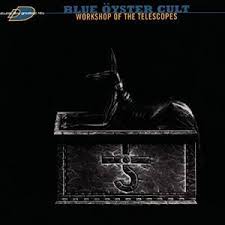 |
| "Workshop of the Telescope" was chosen as the title of BOC's most ambitious greatest hits collection |
As for the song's allusions to alchemy, they are plentiful, especially in the first verse:
By silverfish imperetrix, whose incorrupted eye
Sees through the charms of doctors and their wives
By salamander, drake, and the power that was undine
Rise to claim Saturn, ring and sky
By those who see with their eyes closed
They know me by my black telescope
The salamander is littered with alchemical significance:
"In Classical antiquity, this amphibian, a close relative of the newt, was believed to be able to live in fire without being burned up. It was identified with fire, of which it was the living manifestation...
"Alchemists regard the salamander as 'the symbol of the Red Stone... and call their incombustible sulphur by its name. The salamander, which feeds on fire, and the phoenix, which is reborn from its own ashes, are the two most common symbols of sulphur.' "
"Dictionary of Symbols, Jean Chevalier & Alain Gheerbrant, pgs. 821-822)
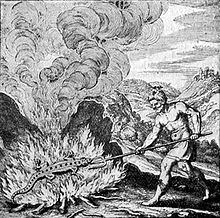 |
| alchemical depiction of a salamander |
A drake can refer to a dragon, another creature associated with red and the rubedo. An undine, by contrast, is an elemental being of water. In mythology, this creature is very similar to a mermaid. Undines are also used in alchemical writings (most famously by a Paracelsus), as is Saturn. In such a context, Saturn was associated with the nigredo:
"In Hermeticism, while mere chemists regard Saturn as lead, to philosophers Saturn was the colour black, the colour of matter after solution and putrefaction, or else of common copper, first of metals, or of Ramon Llull's azoic vitriol, which separates metals... All these are images of the office of divider, which is both an end and a beginning, the halting of one cycle and the beginning of a fresh one, the stress being laid more strongly upon the break in or slowing of development."
(Dictionary of Symbols, Jean Chevalier & Alain Gheerbrant, pg. 829)
 |
| Saturn |
The album closes with a curious choice, the folky "Redeemed." Apparently the song was originally written by singer-songwriter Harry Farcas. The band had procured the rights to the song from Farcas, and then had slightly rewritten it. Most significantly, Pearlman had changed some of the lyrics, though he kept the figure of "Sir Rastus Bear," allegedly named after Farcas's Saint Bernard. BOC guitarist Buck Dharma speculated that the lyrics may have ended up having some significance to Pearlman.
"Closing the record was a sinister, but deceptively light-hearted and small-ish tale called 'Redeemed.' Musically it's a rare sort of acoustic southern rock for this staunchly northern band. Great lyric too, but it's willfully obtuse. Buck offers a glimpse into the tune's origins. ' "Redeemed" might have been or might not have been part of Sandy's Imaginos song cycle. And when we did it, I think we were thinking about the way The Grateful Dead would do stuff around the "Uncle John's Band" era. Certainly as an album closer, it seemed like a really appropriate thing.' "
(Agents of Fortune, Martin Popoff, pg. 31)If the song is a part of the Imaginos cycle, its virtually impenetrable.On the whole ,the song seems to revolve around Sir Rastus Bear's attempt to break out on the mental prisons he's trapped in. His jailers include "Goblins of Surcease" and "Villains of wise." As was noted in the prior installment, transmutation is linked to redemption in alchemy. As opening track "Transmaniacon MC" alludes amply to transmutation, "Redeemed" makes for a fitting closing sentiment, bringing things for circle.
Tyranny and Mutation: Images and Intent
Tyranny featured another striking cover from Sandy Pearlman's old school chum, Bill Gawlik. This one implicitly hinted at the subversive powers of rock 'n' roll with its black and white image depicting a megalithic structure (possibly the one from the debut cover) with BOC's famed symbol above it surrounded by alternating black and white circles that appear to indicate a broadcast. It is as if the alien gods were channeling their sinister forces through a sacred megalith via the emerging medium of heavy metal, or something along those lines. As outlandish as this may sound, it is hardly beyond the realm of possibility. Gawlik's covers were clearly inspired on some level by sacred geometry and megaliths, especially ziggurats and pyramids. There is compelling evidence that the ancients had far more ambitious designs for these structures than the planting of crops.
The megalith on the cover of Tyranny clearly is meant to invoke a pyramid or ziggurat while the BOC symbol hovers over the top of this structure in the location rituals would typically be performed. It does not then seem a stretch to suggest that some type of channeling is implied by the cover, and given BOC's penchant for aliens as well, it could well have been intended to invoke such communications. Circles, which as noted above are regular used in sacred geometry, are present throughout the cover, as are squares. The black and white checkered floor at the bottom of the cover is a nice touch as well. Masonic lodges and temples of course frequently feature black and white checkered floors.
Gawlik is credited with naming this album as well, apparently being fond of the expression "Tyranny and mutation." This landmark album cover was part of the same lengthy "scroll" that the debut album cover also appeared on. Gawlik, who spent some time in Lovecraft country (noted in part two) really seems to have been in zone during the early 1970s. His imagery was perfect for the vision his friend Pearlman was trying to convey with the Black and White trilogy.

Despite billing themselves as America's Black Sabbath from early on, BOC in truth did not become a full fledged heavy metal band until their sophomore outing, 1973' Tyranny and Mutation. While there were still occasion traces of Soft White Underbelly's psychedelia, Mutations gleefully embraced the demonic biker boogie hinted at by some of the self-titled's more up tempo numbers (i.e. "Transmaniacon MC," "Before the Kiss, a Redcap" and "Cities on Flame With Rock 'N' Roll") whole heartedly. This was the hardest and heaviest BOC would ever rock
This new look is unveiled in spectacular fashion with opener "The Red and the Black," easily the most frenzied piece the group ever recorded. "The Red and the Black" was famously a reworking of "I'm on the Lamb But I Ain't No Sheep," from the previous year's self-titled debut. But while the original version was very bluesy, vaguely psychedelic number with multiple parts, "The Red and the Black" is reworked into hard hitting rocker designed to strike the audience like a punch to the chin.
The lyrics were the work of Pearlman and his frequent collaborator, drummer Albert Bouchard. Bouchard apparently got the idea for the song from a dream he had of fleeing theUunited States for Canada to avoid Vietnam. With Pearlman's helped, he crafted a series of lyrics nominally about a fugitive trying to escape Canada's famed Royal Mounties. The song also incorporates images of sexual sadomasochism ("I've got a whip in my hand, baby!") into the imagery it invokes.
While superficially a rather "light" composition, as far as the lyrics are concerned, the significance the band attached to the track has led more than a few fans to wander if there was more to it over the years. Some interesting theories have been put forward:

The title of Stendhal's The Red and the Black is generally believed to refer to the black of priest's robes and either the red of military uniforms or the red of Republican France. Stendhal's work is a psychological novel set in France during the Bourbon Restoration. The protagonist, a low born individual who initially seeks status via the Church, ends up in a right wing conspiracy in the days leading up to the Revolution. This work would certainly appear to appeal to Pearlman's sensibilities, bu there is no evidence he had ever read it.
The drug references for the red and black are hardly surprising either and surely would have factored into the title. Certainly it would have given them a boast amongst the bikers they most appealed too. But there may well have been a more esoteric purpose as well. One such possibility resides in alchemy. As noted above, the so-called Great Work had four stages. The first was the nigredo and the last the rubedo, the former being associated with black, the latter with red. As was noted above, the A-side to Tyranny was known as the black, while the B was the red. It could then be seen as a reference to the Great Work carried out over the album.
Another such explanation lies with the magickal system of Michael Bertiaux. Bertiaux's system, which can be roughly described as "esoteric vodoun," is vast, encompassing several other rich esoteric traditions. Here's a bit of background on Bertiaux:
One curious feature of Bertiaux's system are what he refers to as red and black "rays."
While it may seem a real stretch to link BOC's "The Red and the Black" to Bertiaux, the connection is far more possible than it may initially seem. For one, both Pearlman and Bertiaux were uber Lovecraft fans, Bertiaux being one of the first magicians to seriously study the occult implications of Lovecraft's work, along with his close associate Kenneth Grant. As was noted in the first installment, Pearlman cited Lovecraft as a major influence on his latter occult interests.
Vodun plays a significant role in the Imaginos cycle as well. Haiti specifically is given much significance in the story line unfolded on the Imaginos album. Like Bertiaux's Voudon Gnostic Workbook, Imaginos was released in 1988. Many of the lyrics, however, we written much earlier, likely around 1967. Bertiaux was still developing his system by that point, but by the early 1970s he appears to have been active in New York. While California is credited with much of the occult revival than unfolded during the 1960s, New York had quite a vibrant scene as well. Of it, I previously wrote:
Thus, Bertiaux was potentially in Pearlman's orbit by the time BOC set out to record Tyranny and Mutation. There are indications that Pearlman himself was a part of the Warlock Shoppe scene, but this researcher has yet to have found definitive confirmation that Pearlman frequented the Warlock Shoppe. Typically this revolves around Pearlman's alleged authorship of the Simon Necronomicon, a notion that he apparently denied. More compelling, however, is the possibility that Pearlman discovered the infamous Process Church of the Final Judgment through the Warlock Shoppe. This possibility shall be addressed at greater length in the next installment. But back to the matter at hand.
While it may be a long shot that BOC's "The Red and the Black" was intended as a reference to Bertiaux's gnostic vodun system, the possibility does exist. Both Pearlman and Bertiaux appear to have had ties to the New York occult scene by the early 1970s, both men had a keen interest in Lovecraft, and both men adopted an interest in vodun at some point as well. Indeed, Bertiaux's system may have had an enormous influence on the story line of the Imaginos, as shall be addressed in a future installment.
"As may be expected of cultures that placed a tremendous value on the astronomical orientation of their sacred structures, the notion of time and periodicity was inextricably linked to notions of sacred space, and both were essential to their religions. Early on, the ancients demonstrated a sure knowledge of the solstices and equinoxes. The pre-literate culture that created Stonehenge was able to arrange the massive stone circle in such a way that it could calculate the solstice sunrise. This was important to a civilization that depended on agriculture, for they could compute the seasons of planting and harvesting according to the length of the solar year, although we do not know for sure if that was the use to which Stonehenge was put. Admittedly, we can think of no other use unless the calendar was important for other reasons, such as for some unknown ritual calculations.
"In the case of the Great Pyramid at Gizeh, however, the precise astronomical and geophysical design and placement of the structure cannot have had anything to do with seasons of planting and harvesting, which were determined by the inundations of the Nile. There was obviously something much more profound taking place in the minds of the Pyramid architects, something that was also responsible for the spate of pyramid-manufacture throughout the world at roughly the same time, as discussed by Dr. Robert M. Schoch of Boston University in Voyages of the Pyramid Builders: The True Origins of the Pyramids from Lost Egypt to Ancient America, and by anthropologist William E. Romain in Mysteries of the Hopewell: Astronomers, Geometers, and Magicians of the Eastern Woodlands.
"The astronomical alignments of these monuments and the prevalence of tombs in ore near them indicates an association of sacred spaces with the 'travels' of the dead into the heavens, what Romain calls the 'azimuths of the underworld.' Romain identifies three different types of sacred geometry in use by the Hopewell peoples: the square, the circle, and the octagon. The square he believes was used by the builders of the mounds to indicate the heavens, the circle for the earth, and the octagon for the phases of the moon. While there is not enough space to go into all of Romain's calculations and other evidence, it is enough to say that he provides a compelling argument for the orientation of the various Hopewell mounds as a means of facilitating the transport of souls of the dead to the Afterlife, which, in this case as in the case of ancient China, ancient Egypt, etc., meant outer space. In other words, the Hopewell mounds (and, perhaps the Adena mounds as well) were a type of machine, a technology for extraterrestrial travel. And the travel could go both ways."
(Sinister Forces Book III, Peter Levenda, pgs. 419-420)
 |
| a reconstruction of the Great Ziggurat at Ur |
Gawlik is credited with naming this album as well, apparently being fond of the expression "Tyranny and mutation." This landmark album cover was part of the same lengthy "scroll" that the debut album cover also appeared on. Gawlik, who spent some time in Lovecraft country (noted in part two) really seems to have been in zone during the early 1970s. His imagery was perfect for the vision his friend Pearlman was trying to convey with the Black and White trilogy.
Despite billing themselves as America's Black Sabbath from early on, BOC in truth did not become a full fledged heavy metal band until their sophomore outing, 1973' Tyranny and Mutation. While there were still occasion traces of Soft White Underbelly's psychedelia, Mutations gleefully embraced the demonic biker boogie hinted at by some of the self-titled's more up tempo numbers (i.e. "Transmaniacon MC," "Before the Kiss, a Redcap" and "Cities on Flame With Rock 'N' Roll") whole heartedly. This was the hardest and heaviest BOC would ever rock
Tyranny and Mutation: The Red and the Black
This new look is unveiled in spectacular fashion with opener "The Red and the Black," easily the most frenzied piece the group ever recorded. "The Red and the Black" was famously a reworking of "I'm on the Lamb But I Ain't No Sheep," from the previous year's self-titled debut. But while the original version was very bluesy, vaguely psychedelic number with multiple parts, "The Red and the Black" is reworked into hard hitting rocker designed to strike the audience like a punch to the chin.
The lyrics were the work of Pearlman and his frequent collaborator, drummer Albert Bouchard. Bouchard apparently got the idea for the song from a dream he had of fleeing theUunited States for Canada to avoid Vietnam. With Pearlman's helped, he crafted a series of lyrics nominally about a fugitive trying to escape Canada's famed Royal Mounties. The song also incorporates images of sexual sadomasochism ("I've got a whip in my hand, baby!") into the imagery it invokes.
While superficially a rather "light" composition, as far as the lyrics are concerned, the significance the band attached to the track has led more than a few fans to wander if there was more to it over the years. Some interesting theories have been put forward:
"It is of note that the new title 'Red & The Black' borrows from a line in the original lyric, but it is also the name of a Stendhal novel, although the connection to the novel from the lyric is pretty much non-existent, none of the band members ever admitting to the influence of the book on the song. The words were also used to demarcate the sides of the original vinyl, side one being 'the black' and side two being 'the red.' Facetiously, I'd have added that while side two's tunes struggled to push the band into the red, side one's songs over the years, have helped keep them in the black! Sandy has also said that red symbolizes Quaaludes and black symbolizes methedrine."
(Agents of Fortune, Martin Popoff, pg. 36)
The title of Stendhal's The Red and the Black is generally believed to refer to the black of priest's robes and either the red of military uniforms or the red of Republican France. Stendhal's work is a psychological novel set in France during the Bourbon Restoration. The protagonist, a low born individual who initially seeks status via the Church, ends up in a right wing conspiracy in the days leading up to the Revolution. This work would certainly appear to appeal to Pearlman's sensibilities, bu there is no evidence he had ever read it.
The drug references for the red and black are hardly surprising either and surely would have factored into the title. Certainly it would have given them a boast amongst the bikers they most appealed too. But there may well have been a more esoteric purpose as well. One such possibility resides in alchemy. As noted above, the so-called Great Work had four stages. The first was the nigredo and the last the rubedo, the former being associated with black, the latter with red. As was noted above, the A-side to Tyranny was known as the black, while the B was the red. It could then be seen as a reference to the Great Work carried out over the album.
Another such explanation lies with the magickal system of Michael Bertiaux. Bertiaux's system, which can be roughly described as "esoteric vodoun," is vast, encompassing several other rich esoteric traditions. Here's a bit of background on Bertiaux:
"Bertiaux had spent some time in Haiti before embracing his own particular occult path, and became a member of a society --the Ordo Templi Orientis or OTOA --allegedly created by a mysterious and possibly non-existent Haitian occultist Lucien-Francois Jean-Maine (1869?-1960) of whom there is very little hard information. The OTOA was evidently a mixture of quasi-Masonic ritual and initiation and traditional Vodun, forming a bridge between European-style ceremonial magic traditions and the Afro-Caribbean Vodun cultus. Jean-Maine was allegedly the inheritor of an ancient Haitian occult lineage that numbers among its lineage-holders the venerable Ordre des Elus-Cohen which had a branch in Leogane, Haiti. This not the place to go into the history of Elus Cohen (or 'Elected Priests'), so suffice it to say that it was a branch of the eighteenth century Martinist order and the branch most closely connected with ritual magic. Martinism began as a Masonic-type society in pre-revolutionary France but its founder --Martinez de Pasqually --died in Haiti in 1774. Haiti at the time was a French colony. Hence the suggested French Masonic-Haitian Vodun connection.
"Bertiaux worked and expanded upon the system he inherited and brought it into line with Thelema by 1972. His Vodoun Gnostic Workbook became quite well-known for is imaginative combination of Western esotericism, Afro-Caribbean concepts and terminology, and sex magic..."
(The Dark Lord, Peter Levenda, pg. 130)
 |
| Michael Bertiaux |
" 'The Red and the Black Temple Workings are the function and structure of the Osiris-Ra Cultus of Legbha. The power of the Sun is diffused by means of the Red-Sun, or the creative power of evolutionary nature and the Black-Sun, or the occult powers immanent in the natural order. In order to develop the special magickal potencies of these two suns, it was necessary at one time to intuit the Solar Power in such an absolute way, that the hierophants of the Gnosis became one with the Red and Black Rays. In this very special act of intuition, all of the logics and metaphysics and all of the centers of the gnosis were experienced in terms of of their creative fundamentals. This act of cosmic intuition is one of the secrets given by the Gnosis to all of its hierophants and is to be understood as having been handed down from the priestly order of existence, which was in power on the planets prior to the settlement and civilization of the Earth. This powerful secret is symbolized by the ritualistic mysteries of Osirian bodywork, and by means of this work, it is possible to enter into the mysteries through these symbols, because symbols are always doors. The awakening of this power in the magickal bodies of the Afro-Zothyrian gnostics was always viewed as the supreme form of sacramental and theurgical initiation...'
"The Black and Red Rays have their basis of power in what must be understood as the lattice or conjunction of the Afro-Atlantean and Afro-Zothyrian Rays. This means that while these mysteries (for the Rays are mysteries as well as energies) are given as parts of the esoteric symbolism of the African cultures, carefully hidden away by centuries of Osirian culture, they must be electrified by occult contact with the higher levels and the lower levels of consciousness. Therefore, it was the mission of the neo-pythagorean gnostics to connect these powers with the Atlantean components of the unconscious mind as well as with the Zothyrian components of the superconscious mind..."
(The Voudon Gnostic Workbook, Michael Bertiaux, pg. 168)The "Osirian bodywork" mentioned above is symbolic of the body of the initiate. Thus, these Red and Black "rays" can be reached via his physical body, likely through tantra, yoga or some other such practice. From here they could channel the Solar energy of the red and black suns.
While it may seem a real stretch to link BOC's "The Red and the Black" to Bertiaux, the connection is far more possible than it may initially seem. For one, both Pearlman and Bertiaux were uber Lovecraft fans, Bertiaux being one of the first magicians to seriously study the occult implications of Lovecraft's work, along with his close associate Kenneth Grant. As was noted in the first installment, Pearlman cited Lovecraft as a major influence on his latter occult interests.
 |
| H.P. Lovecraft |
Pearlman, along with the rest of BoC, famously hailed from Long Island. Long Island was actually the birthplace of the modern Wicca movement in America, at least officially. It occurred in 1969 when two followers of the legendary warlock Gerald Gardner would establish a coven there.
"...Raymond and Rowen Buckland, an English couple who emigrated to the suburbia of Long Island, New York, and brought the craft with them... To celebrate the move, the couple invited journalists from the Long Island Press and Newsday to witness a genuine Halloween Witches Sabbath. Dressed in black robes trimmed with gold, the couple led the reporters to their basement, fitted out with velvet drapes, candles and the inevitable pentagram. Then, stripping out of their robes, the Bucklands invoked the spirit of the autumnal equinox sky-clad."
(Turn Off Your Mind, Gary Lachman, pgs. 243-244)
As the 1970s made the scene Long Island, specifically Brooklyn, would become one of the major hubs of New York City's budding occult scene. Much of this would initially be based around Herman Slater's Warlock Shoppe, a place that has gained some notoriety over the years. Rogue historian Peter Levenda (who has been accused of being the author of the notorious Simon Necronomicon; this accusation has also been made at Pearlman) actually knew Slater and the Warlock Shoppe from the early days:
"...I was friendly with Herman Slater, the proprietor of the store, and had known him since the days when he ran the Warlock Shoppe in Brooklyn Heights where I lived. As the fame and notoriety of his establishment grew --being covered extensively in the overseas press as well as by local newspapers and television shows --he began to attract an equally notorious clientele. The Process would hang out at the Warlock Shop, as well as the odd Satanist and witches of various denominations. The Shop is alluded to several times in Maury Terry's The Ultimate Evil as a hangout for people who knew more about the Son of Sam murders than they were telling."
The Simon Necronomicon famously had its origins with the Warlock Shoppe, with Peter Levenda (who was a customer of Slater's) involved in some capacity long disputed. This was not the only major modern grimoire to have links to the Warlock Shoppe, however. The Voudon Gnostic Workbook had originally been published by Warlock Shoppe owner Herman Slater's publishing company (dubbed the Magickal Childe, the original name of the Warlock Shoppe) in 1988. And there are indications that Bertiaux had been active in New York by the early 1970s in these circles as well.(Sinister Forces Book II, Peter Levenda, pg. 253)
Thus, Bertiaux was potentially in Pearlman's orbit by the time BOC set out to record Tyranny and Mutation. There are indications that Pearlman himself was a part of the Warlock Shoppe scene, but this researcher has yet to have found definitive confirmation that Pearlman frequented the Warlock Shoppe. Typically this revolves around Pearlman's alleged authorship of the Simon Necronomicon, a notion that he apparently denied. More compelling, however, is the possibility that Pearlman discovered the infamous Process Church of the Final Judgment through the Warlock Shoppe. This possibility shall be addressed at greater length in the next installment. But back to the matter at hand.
 |
| the Simon Necronomicon |
Tyranny and Mutation: The Rest of Side A
After Tyranny's rip-roaring opener wraps up, the group lurches into the sleazy, vaguely bluesy "OD'd On Life Itself." This track features more Pearlman lyrics, these far more esoteric than those in "The Red and the Black." The song seems to vaguely revolve around the process of initiation. This most evident in the second verse, which proclaims:

A cave as a symbol of the world was clearly alluded to by Pearlman in the final couplet of the second verse. The prior stanzas allude to this initiation involving rituals, possibly to channel a nonhuman intelligence. The second half of the third verse ("This wedding by heaven was made up in hell/With the victim as bride and life, life itself") implies that this ritual may have involved some form of a sacred marriage. The candidate begins this ritual, struggles with a daemon or something along those lines and emerges from the proverbial cave with a fresh sense of invigoration (hinted at by words spoken behind the chorus that go: "OD'd on life itself/the power of powers/And once luminous spell" ).
From there things segue way into bassist Joe Bouchard's "Hot Rails to Hell." A fan favorite, this menacing number alludes to both night time rides of New York City's subway lines as well as the murder of early BOC booking agent Phil King ("Stoned out looks from the crowd, the king will not know/On the wall it was said/The flash of his cards was sprayed with red"), allegedly over gambling debts. While another strong track on Tyranny's classic A side, this non-Pearlman number is not especially esoteric.
Side A's closer, "7 Screaming Diz-Buster" more than makes up for this. This was another hard hitting track with multiple sections that can be described as proto-thrash. A fan favorite, the bizarre and sinister lyrics have long puzzled listeners. The band themselves have only offered a few tantalizing hints:
The great Julian Cope offered up a compelling interpretation of the track:
This researcher has a different take. It is likely that this song was a part of, or inspired by, the Imaginos cycle. In the Imaginos album the Loa, spirits in the Vodun tradition, play a key role. In the album, seven specific ones are dubbed the Les Invisibles and are behind many of the intrigues that unfold over the course of the album. There are of course dozens of Loa and no type of ruling council within the tradition. It is likely Pearlman confused the tradition of the Seven African Powers, sometimes described as Orishas in Santeria, with the Loa of Vodun.
Another linkage to the Imaginos cycle are the lines: "They learned from men who'd just refrain/From glancing at a mirror's face." As was noted in the second installment, obsidian mirrors play a key role in the cycle. Historically they were used for divination purposes by a host of sources, including the Aztecs, Dr. John Dee and Joseph Smith.
Roses are mentioned in the song as well. The rose is a common alchemical symbol:
The common use of seven-petaled roses by the alchemist is of course highly compelling in the context of this song. Pearlman also makes reference to a "secret cave." As was noted above, the cave is a common symbol of initiation.
While this researcher believed that sex magick was a possible explanation for "OD'd On Life Itself," this clearly seems to be the purpose of "7 Screaming Diz-Busters." Both the penis (diz) and semen ("duster's dust") are referenced while Diz-Buster clearly seems to be describing an orgasm. The references to alchemy further reinforce this, as many modern scholars have speculated that the hidden secret of alchemy was in fact sex magick, techniques of which were stealthily hidden in their texts. The presence of the number seven is likely a reference to the Loa of the Imaginos cycle, indicating the deities being evoked. And of course the refrain of "Lucifer, the light" is a time honored celebration of hidden knowledge.
Writings appear on the wall
The curtains part and landscape fall
There, the writing's done, in blood
Like a mummy's inscription and a bat-wing tongue
Well then the mouth of the cave will open up wide
Wide as the world that's mine, it's mine, it's still mine
Caves are closely associated with initiation rituals the world over.
"As the archetype of the maternal womb, caverns feature in myths of origin, rebirth and initiation from many cultures. Under the heading 'cavern' are included 'cave' and 'grotto', although they are not precisely synonymous. It implies a place, roofed with rock or earth, at any depth in earth or mountainside, more or less dark, often lying at the end of a long passageway, and without direct daylight. Lairs of robbers or wild animals are excluded, since their significance is no more than a corruption of the symbol...
"At the start of many initiation rites, the candidate enters a cave or pit. This is 'the return to the womb', as defined by Mircea Eliade, in material form. This was especially true of the Eleusinian rites..., in which symbolic logic was strictly translated into action. Candidates were placed, bound, in the cave from which they had to escape to reach the light of day. Prior to this, in the religious ceremonies of Zoroaster, a cave represented the world..."
(Dictionary of Symbols, Jean Gheerbrant & Alain Gheerbrant, pg. 167)
A cave as a symbol of the world was clearly alluded to by Pearlman in the final couplet of the second verse. The prior stanzas allude to this initiation involving rituals, possibly to channel a nonhuman intelligence. The second half of the third verse ("This wedding by heaven was made up in hell/With the victim as bride and life, life itself") implies that this ritual may have involved some form of a sacred marriage. The candidate begins this ritual, struggles with a daemon or something along those lines and emerges from the proverbial cave with a fresh sense of invigoration (hinted at by words spoken behind the chorus that go: "OD'd on life itself/the power of powers/And once luminous spell" ).
From there things segue way into bassist Joe Bouchard's "Hot Rails to Hell." A fan favorite, this menacing number alludes to both night time rides of New York City's subway lines as well as the murder of early BOC booking agent Phil King ("Stoned out looks from the crowd, the king will not know/On the wall it was said/The flash of his cards was sprayed with red"), allegedly over gambling debts. While another strong track on Tyranny's classic A side, this non-Pearlman number is not especially esoteric.
 |
| the single version of "Hot Rails to Hell" |
"Albert has revealed that 'diz' refers to the cleft of the penis, and the 'duster's dust' refers to sperm. But the concept of diz-buster is left ambiguous. The definition of of 'something that can make one ejaculate' most plausibly applies to a reading that these seven diz-busters are evil, paranormal sex sirens, women beings without a conscious, the number seven bringing in a biblical element to the lyric as well. But this track could also be one of Sandy's biker songs, diz-buster referring to the result of a long, vibrating Harley ride (and then, mamas and old ladies joke about the orgasmic qualities of a good ride). Indeed, many lines in the song could have one believe that the diz-buster is a bike (there is a mention of cast iron, the mirror's face, rigid arms, routes, all suggesting this interpretation), especially in light of the fact that females, female pronouns, or sexual ideas are never mentioned in the song."
(Agents of Fortune, Martin Popoff, pgs. 38-39)It would be rather inaccurate to state that sexual ideas are not present in the song. And while the language does seem to deliberately employ biker images at times, this researcher believes this was done to cloud Pearlman's real meaning.
The great Julian Cope offered up a compelling interpretation of the track:
"... Side One closes with the Cult’s classic '7 Screaming Dizbusters', whose soundtrack I’ve omitted here because it straddles that weird jazz that both Zappa and Todd had a habit of shoehorning into their songs, and which The Tubes and their ilk later appropriated however inappropriate. Despite its absence here, the song is indeed a real wonder, a 7-minute long leviathan and full-on rumbustuous tale of seven itinerant horse-borne paladins and their relationship with Lucifer, or Lugh, in his pre-Christian role as the horned God of the Hunt."
 |
| Lugh |
Another linkage to the Imaginos cycle are the lines: "They learned from men who'd just refrain/From glancing at a mirror's face." As was noted in the second installment, obsidian mirrors play a key role in the cycle. Historically they were used for divination purposes by a host of sources, including the Aztecs, Dr. John Dee and Joseph Smith.
Roses are mentioned in the song as well. The rose is a common alchemical symbol:
"Whether white or red, roses were the favorite flowers of alchemists, who often entitled their treatises The Rosary of the Philosophers. White roses 'like lilies, were linked to the white stone, the objective of the first stage of the Work, while the red rose was associated with the red stone, the objective of the second stage. Most of these roses have seven petals, each petal relating either to a metal or to an operation in the Work...' A blue rose was to become the symbol of the impossible."
(Dictionary of Symbols, Jean Chevalier & Alain Gheerbrant, pg. 815)
 |
| an alchemical rose |
While this researcher believed that sex magick was a possible explanation for "OD'd On Life Itself," this clearly seems to be the purpose of "7 Screaming Diz-Busters." Both the penis (diz) and semen ("duster's dust") are referenced while Diz-Buster clearly seems to be describing an orgasm. The references to alchemy further reinforce this, as many modern scholars have speculated that the hidden secret of alchemy was in fact sex magick, techniques of which were stealthily hidden in their texts. The presence of the number seven is likely a reference to the Loa of the Imaginos cycle, indicating the deities being evoked. And of course the refrain of "Lucifer, the light" is a time honored celebration of hidden knowledge.
Tyranny and Mutation: Closer
For our purposes here, there is not much of interest of side B. While still strong, the songs on this side largely avoid esoteric themes. Opener "Baby Ice Dog" featured the first lyrics the band ever recorded by punk poetess Patti Smith while the Bouchard brothers' moody "Wings Wetted Down" features more of Joe's nightmare psychedelia. Richard Metzer, Pearlman's old colleague from Crawdaddy, contributes the much maligned "Teen Archer." A kind of preview of the arena abomination that would became staples in the late 1970s, the song is driven by a catchy riff that makes for good cock rock fun (pending one doesn't get nightmare visions of Spectres).
Pearlman finally returns to the fold with closer "Mistress of the Salmon Salt" and it unsurprisingly features a compelling set of esoteric lyrics. Drummer Albert Bouchard took a more conventional view, however, and believes the song is about a woman who disposes of dead bodies: " 'They lyrics are really bizarre, you know, the famous story of the person that kills people, or actually I don't think she kills people, but she performs a service. She would bury the murdered dead, and use them as fertilizer for her plants' " (Agents of Fortune, Martin Popoff, pgs. 40-41).

The last verse of "...Salmon Salt" lends credence to Bouchard's theory, with its references to juke joints and the Coast Guard. And this could also explain the description of the song's female lead as "Quicklime Girl." Quicklime is an actually substance that is extremely flammable when combined with water. It could theoretically be used to dissolve bodies. Curiously, it was known to ancient world and was used as a weapon by the Romans and the Chinese. Some have even speculated that it was a component of Greek fire.
The first three verses, however, hint at a more esoteric significance to the song:

As for the lady's mantle of "Mistress of the Salmon Salt," salmon has very interesting symbolism in Celtic mythology:
And with that I shall wrap things up for now. In the next installment we'll address the landmark Secret Treaties album. Stay tuned.

The last verse of "...Salmon Salt" lends credence to Bouchard's theory, with its references to juke joints and the Coast Guard. And this could also explain the description of the song's female lead as "Quicklime Girl." Quicklime is an actually substance that is extremely flammable when combined with water. It could theoretically be used to dissolve bodies. Curiously, it was known to ancient world and was used as a weapon by the Romans and the Chinese. Some have even speculated that it was a component of Greek fire.
The first three verses, however, hint at a more esoteric significance to the song:
In the garden district
Where the plants grow strong and tall
Behind the bush there lurks a girl
Who makes them strong and tall...
In the fall when plants return
By harvest time she knows the score
Ripe and ready to the eye
Yet rotten somehow to the core...
A harvest of life, a harvest of death
One body of life, one body of death
And when you've gone and choked to death
With laughter and a little step
I'll prepare the quicklime friend
For your ripe and ready grave
For your ripe and ready grave
The lyrics seem to evoke the ancient custom of human sacrifice to enhance the fertility of crops. The Huffington Post provides two compelling example of this custom:
"India has long practiced sacrificial obeisance to Mother Earth. As late as the 19th century, the Kandhs of Bengal sacrificed a person for the Earth Goddess, Tari Pennu, in order to ensure healthy crops and immunity from disease. Blood was especially important in the cultivation of turmeric, which needed it to develop its rich, red color. The Uraons of Chota Nagpur offered human sacrifices to Anna Kuari, who blesses the harvest. And the Lhota Naga of Brahmapootra severed the heads, hands and feet of their victims and planted them in the fields for fertilizer.
"Aztec hymns tell us that Tonacacihuatl, Our Lady of Substance, was once the Goddess of the Hunt, Blood and Night, but as the people grew to depend more on agriculture, She evolved into the Earth Goddess. The son of Her fertility was the corn, which was depicted as being identical with the obsidian knife which was Her symbol. These were the phallic representations of Xipe, the young god identified with the corn and the sunlight, both of which grew up and increased to maturity from the depths of the dark earth.
"Here, too, fertility, death and sacrifice are connected. The husking of the corn is perceived as the same act as the tearing out of a sacrificial victim’s heart, both accomplished with the obsidian blade. At the celebration of the broom harvest of the Earth Mother, first an older woman, and then a young girl were beheaded and their blood spread on fruit, seeds and grain to guarantee abundance."
As for the lady's mantle of "Mistress of the Salmon Salt," salmon has very interesting symbolism in Celtic mythology:
"... The salmon is of the same essential nature as the boar, in that both are creatures of sacred wisdom. Wells of knowledge recur in Irish literature overhung by hazel-or-rowan-bushes and in them live the salmon of knowledge who feed on the scarlet berries or the nuts dropping into the water. Whoever eats the flesh of these fish acquires second-sight and knowledge of all things. This is what happened to Finn as a boy. He was the pupil of a bard or file and was busy one day grilling a salmon for his master. As he turned the fish on a spit he burned his finger and sucked it. He instantly became omniscient and was given a prophetic tooth. Thereafter he had only put his thumb on his wisdom tooth and chew it to become gifted with second-sight. Salmon, again, was the food of Eithne, the allegorical figure of Ireland, after her conversion to Christianity. With the boar and the wren, the salmon was a particularly druidic creature and one of the symbols of wisdom and spiritual nourishment..."
(Dictionary of Symbols, Jean Chevalier & Alain Gheerbrant, pg. 823)Cannibalism could then be implied if the "salmon salt" is the flesh of the Quicklime Girl's consorts, which she may partly consume to gain wisdom. On the whole, however, this researcher suspects this song revolves around some type of modern cult performing ancient fertility rites. The reference to a juke joint in the final verse could even put the song in the same universe as "Before the Kiss, a Recap." Is this possibly a reference to Conry's and Pearlman's "Motif of the Rose" secret society (addressed in part two)?
And with that I shall wrap things up for now. In the next installment we'll address the landmark Secret Treaties album. Stay tuned.


