Showing posts with label decapitation. Show all posts

Sunday, December 13, 2020

Fort Bragg: Strange Deaths and Stranger Moves


Hat Tip: Denim

There have been some interesting developments concerning US special operations forces of late. As I recently noted, Trump has made some incredible moves during his (presumptive) final months in office. They included making a veteran special operator the acting Secretary of Defense; placing one of General Michael T. Flynn's cronies in charge of all special operators and military intelligence; and effectively elevating the US Special Operations Command (USSOCOM) into it's own branch of the Armed Forces. 

For all sakes and purposes, the special operations community appears to have gained total control of the Pentagon in Trump's final weeks and have taken steps to ensure they will remain a dominate force for years to come. 

All of this is especially interesting in light of recent developments at Fort Bragg. While USSOCOM is headquartered at MacDill Air Force Base in Florida, the real heart of US special operation forces resides at Fort Bragg. It is here that the Joint Special Operations Command (JSOC) is garrisoned, along with the US Army Special Forces, more commonly known as the "Green Berets." JSOC is comprised of the Delta ForceSEAL Team Six, the Intelligence Support Activity, and draws upon other units such as the US Army Rangers and the 160th Special Operations Aviation Regiment (the "Night Stalkers"). Throw in the Green Berets, and one is left with virtually all of the nation's elite forces falling under the sway of Fort Bragg. 

Which makes the rash or murders and suicides that have beset the base during 2020 all the more curious. 


A Darkness

Fort Bragg is no stranger to controversy. As I noted before here, the base was a haven for right-wing extremism during the 1990s. In 1995, three paratroopers from the elite 82nd Airborne Division (also garrisoned at Fort Bragg) were involved in the murder of an African-American couple, allegedly to earn their stripes in a neo-Nazi gang active on the base. In all, some 22 extremists were discharged from the Army as part of the fallout from the killings. Also present on the base at the time was white supremacist Wade Michael Page, who later gained infamy when he shot up a Sikh temple in 2012. General Keith Kellogg, a major national security figure throughout Trump's administration, took over command of the 82nd Airborne in 1996, the year following the skinhead flap. He had previously been the 82nd's division command for operations in 1992. 

Fort Bragg man Wade Michael Page

Interestingly, General Lloyd Austin, Biden's nomination for Secretary of Defense, had a longstanding history with the 82nd. After a few tours with the division during the 1980s, he rejoined it in 1993 and remained there until 1999. This means Austin was present for the rash of skinheads in the 82nd. It also means Kellogg was his commanding officer in the 82nd for two years. Don't expect any of that to come up in the Senate confirmation hearings, however.

General Lloyd Austin

So yeah, the Fort Bragg scene during the 1990s has has some wide reaching implications. And once again, it seems like things are getting rather strange at that particular base. Recently, one current special operator and a former one were found dead with foul play is suspected. 

The two victims are Master Sgt. William J. Lavigne of the Delta Force and veteran Timothy Dumas, whose service record is currently being kept as hazy as possible. The present story is that Dumas worked as a "property book officer" for the 7th Special Forces Group beginning in 2001. Dumas had joined the military in 1996 and did not retire until 2016. It is unknown if he was still working as a "property book officer" for the Green Berets at that time, but reportedly he was stationed at Fort Bragg for the bulk of his service. 

Timothy Dumas, a former Green Beret "property book officer."

Elsewhere, Lavigne had previously been under investigation for the murder of a Green Beret in 2018. Reportedly, Lavigne shot his fellow special operator after he came at the sergeant with a screwdriver. Needless to say, there has been much dispute over this incident. Eventually, the military ruled that the slain Green Beret's death occurred "in the line of duty." How he could have died "in the line of duty" while attacking his mate with a screwdriver has never been explained...

Msgt William Lavigne

Further muddying the waters are the allegations that the military was already investigating Lavigne and Dumas for both using and selling drugs. This has of course led to speculation that the murders were a drug deal gone wrong. Certainly, both men were staring down looming court dates for a host of charges. 

These murders come at a time when the base has already witnessed ample death of late. Over 30 soldiers assigned to the base have died this year, with about half of them from suicide. By far the most incredible of these deaths involves paratrooper Enrique Roman-Martinez. In May, Roman-Martinez went missing while camping off base. A week after his disappearance, his severed head turned up. Whether decapitation was the cause of death or not is unknown, but the death was ruled a homicide. Roman-Martinez's family has questioned the story told by the seven military members camping with the paratrooper, who apparently waited all day to report his disappearance.

Enrique Roman-Martinez

It's not just soldiers from Fort Bragg who have died under mysterious circumstances in that particular region either. There appears to be a serial killer presently active in nearby Lumberton, NC. Since 2017, five women (most of whom were Native American) have either disappeared or been murdered there. In 2017 alone, three women were found dead within four blocks of one another. 

And in case you were wondering, yes, the Fort Bragg area has acquired it's own monolith. One popped up in nearby Fayetteville earlier in the week. Of course, a monolith suddenly appearing has become rather common of late


Conclusions

Is there something significant currently playing out in Fort Bragg? Does it involve some type of gang with occult overtones that's infiltrated the special operations community? 

Before we get to carried away, it's important to note that Fort Bragg is not exactly an anomaly in terms of dead soldiers. Consider Fort Hood. Nearly 30 soldiers have turned up dead there as well, including one especially vicious murder. Nor is this a recent problem for that particular base. Fort Hood actually has a reputation as the military's most crime-ridden base

That being said, Fort Hood doesn't house the nation's most elite soldiers. Nor is it directly tied to the Special Operations Command, which certainly seems to be making a major power play during what are, in theory, Trump's final weeks in office. 

That power play continued this week as well. As I detailed at length in my first book, Strange Tales of the Parapolitical, the Bush II years witnessed JSOC largely usurping the CIA's previous monopoly on covert operations. The CIA has long relied on special operators, often retired or on "leave," to carry out its paramilitary operations on the ground, but the twenty-first century saw JSOC carrying regular covert operations with little to know CIA involvement on any level. While little remarked upon, this was unprecedented during the modern national security state. 

As the war between CIA and JSOC becomes more intense, consider brushing up on it

Now, it's looking like the CIA may no longer even have access to special operators to fill their paramilitary forces. The Pentagon has recently informed the CIA that it's considering ending the bulk of the support it provides to the latter's counterterrorism operations. Presently, the CIA has until January 5th to respond to this state of affairs. Incidentally, this is the day before the US Senate counts the Electoral College votes to decide the election. It's also the day of the Georgia Senate runoff

There are already rumblings that the move is politically motivated. But even without conspiracy theorizing, this decision will be utterly disastrous for the CIA if allowed to stand. The CIA has always been dependent on the DoD for suitable paramilitary forces, be they operating on loan from the DoD or as mercenaries, but especially since the onset of the Global War of Terror. If the DoD manages to box the CIA out from this steady supply of special operators, this will effectively be the end of the CIA as a force in covert operations. And that is huge, especially as the national security establishment reorients itself towards "Great Power struggles." 

At the onset of the Cold War, there wasn't just a pushback against the very existence of the CIA from the DoD, but also against its role in covert operations. Many preferred that the CIA remain a mere spy agency, but the freewheeling OSS Old Boys prevailed. Covert operations would be the principal means in which these United States squared off against the Soviet Union in the earlier Great Powers struggle, and granting the CIA a monopoly on such things ensured that it would remain in the driver's seat. It also ensured that the Wall Street interest behind the CIA would remain in control of the emerging deep state. 

Some seventy years later, the Pentagon and the thriving military-industrial complex behind it, seem poised to finally reverse this state of affairs. And that should tell you all you really need to know about who really runs this country in 2020. And with that, I shall sign off for now. Until next time dear readers, stay tuned. 

Friday, November 8, 2019

The Secret History of Special Operations Forces


As long time readers of this blog are well aware, Recluse has quite the obsession with what are known as special operations forces (SOFs) in these United States and simply special forces in most of the rest of the world. These elite units first began to captivate the public mind during the Second World War. This conflict witnessed the birth of the Special Air Services (SAS), the first modern special operations forces unit (including the likes of the US Army Special Forces (more commonly known as the "Green Berets" and the even more elite Delta Force), as well as the emergence of "frogmen," who served as the model for the Special Boat Services (SBS), Navy SEALS, and other such outfits.

The history of special operations forces is a murky one. Certainly, there are precedents from the ancient world such as the Praetorian or Varangian Guards. As far as modern units are concerned, their origins are often placed in various European colonial wars that unfolded during the late nineteenth and early twentieth centuries. Some of the earliest "commandos" (which are often considered the direct predecessors to modern special operations forces) were Boer forces that employed proto-guerrilla techniques as far back as the early eighteenth century.

The British fought several brutal conflicts with the Boers, climaxing with the genocidal Second Boer War (1899-1902). While the British ultimately prevailed, they had to commit a tremendous amount of forces to counter the significantly out numbered Boer forces. No doubt these experiences strongly influenced Britain's later special operations forces. Another crucial influence was no doubt the Irish Republican Army. Other noteworthy inspirations included Orde Wingate, who helped set up what became the Haganah (later the Israel Defense Force) and Lawrence of Arabia himself.

T.E. Lawrence, more commonly known as Lawrence of Arabia
Virtually everyone agrees that the modern special operations forces we all know and love (or not) emerged in earnest during the Second World War. But many of the most celebrated units, which have inspired virtually all modern SOFs, feature some very curious and aristocratic figures lurking in the background. Two such instances shall be examined over the course of this blog.


Roman Frogmen

First up is the legendary Decima Flottiglia MAS, some times known simply as X'MAS (har har). In English written accounts it is often referred to as the Tenth Light Flotilla, though this translation is a bit off. Regardless, the X'MAS was the most feared unit within the Italian Army by a large margin. Given how notoriously poor the Italian military performed under Mussolini, it is somewhat surprising that it crafted such an elite force. 

The X'MAS essentially pioneered Naval special operations. Contemporaries such as the SBS and SEALs all trace the origins back to this particular unit and its easy to see why. In three years, the X-MAS produced quite an impressive track record:
"... On many of the 10th's operations, special assault teams entered harbors riding underwater torpedo-shaped submersibles known as Chariots, and attached explosives to the hulls of Allied ships at anchor. The crack assault teams brought devastation in Crete's Suda Bay and Alexandra harbor, sinking or severely damaging several British capital ships, including the battleships Queen Elizabeth and Valiant.
"The group's most audacious coup was its campaign of sneak attacks against Allied shipping in Gibraltar. A derelict freighter, the Olterra, was seemingly abandoned off the Spanish coast. But the Olterra was a Trojan horse. Her hold served as a clandestine workshop where the frogman could repair and rearm the Chariots. Access in and out of the ship was afforded by a sliding door six feet below the waterline. All told, the Italians sank 42,000 tons of Allied ships anchored at Gibraltar; the British never discovered the secret of the freighter."
(Operatives, Spies, and Saboteurs, Patrick K. O'Donnell, pg. 131)
the insignia of the X'MAS
Things became even more interesting in 1943, after Italy was pushed out of North Africa and the Allied invasion of Sicily began. Mussolini was briefly deposed by the Grand Council of Fascism, who then sought to negotiate with the Allies. Mussolini was arrested, but soon rescued by the Germans, who set him up as the puppet head of the Italian Social Republic. What it amounted to is that by the end of 1943, Germany effectively controlled all of Northern Italy while the Allies held the south.

The loyalties of Italians were divided between these two entities, and the same appears to have been the case of the X'MAS. The Office of Strategic Services (OSS, the WWII-era predecessor of the CIA) had attempted to develop their own frogmen units on the basis of the Marine Raiders, but without much success. Realizing that they would be hard pressed to top the X'MAS, the OSS opted for the only sensible choice: enlist the unit.

insignia of the OSS
While many X'MAS men opted to side with the Nazis, enough veterans were retained to form the Grupo Mezzini d'Asalto. It was put under the control of the Duke of Aosta. The OSS wasted no time in putting them to use. Joint OSS-X'MAS missions began as soon as June of 1944. Soon, the X'MAS forces had become the OSS's go-to Naval commandos in the European Theater. In addition to sabotage operations, the X'MAS men were also enlisted to gather intelligence and train Italian partisans in the arts of "unconventional warfare" deep behind enemy lines.

The results were so impressive that the OSS wanted to dispatch the X'MAS/Grupo Mezzini d'Asalto to the Pacific Theater once things began to wind down in Europe. The OSS was largely barred from that Theater by General Douglas MacArthur and Admiral Chester Nimitz, both of whom despised the agency. As such, the order for a transfer never came through.

Unwilling to let such available assets simply disperse, some X'MAS veterans were enlisted to provide consulting to the Navy's postwar underwater operations program. No doubt this included the Underwater Demolition Teams which, along with the OSS's Maritime Units, are considered the direct predecessors to the modern Navy SEALS. And it just so happens that the X'MAS collaborated with and/or trained both.

insignia of the Underwater Demolition Teams
Elsewhere, the X'MAS men who opted to side with the Nazis had a similar experience. Upon conclusion of the operations to occupy Northern Italy by German forces, the bulk of the X'MAS offered their services to the Nazis. As such, this faction retained the Decima MAS identification. However, its ties to the Italian Social Republic (RSI) were nominal at best. Indeed, the unit reported directly to SS Obergruppenfuhrer Karl Wolff, the supreme commander of SS forces in Italy. Nor did it swear an oath of loyalty to the RSI.

During the Nazi years, the scale of the X'MAS grew even as its naval operations largely ceased. As the great Jeffrey Bale notes in The Darkest Sides of Politics, I, it came to include several elite infantry battalions, s small naval sabotage unit, and police company with its own intelligence and interrogation center. Indeed, the X'MAS appears to have acquired quite an extensive intelligence network by war's end that went well beyond Italy. In addition to the police intelligence unit, it also had an espionage headquarters in Switzerland and a vast network throughout the RSI and even into the Allied-controlled south.

Frequently the X'MAS was deployed into the hottest zones. Often it was used to conduct counterinsurgency operations against partisans in the RSI. Some units were deployed to the Anzio front, where they reportedly fared well against US Army Rangers. Later, many of its forces were dispatched Yugoslavia, where it conducted further counterinsurgency against the partisans there. And finally, there were the X'MAS' "stay-behind" operations set up in Allied-controlled Italy. By all accounts, these stay-behind units were highly effective. It fell to the legendary counterintelligence master James Jesus Angleton to counter the X'MAS.

For our purposes here, the most interesting aspect of the X'MAS was its commanding officer, Prince Junio Valerio Borghese, sometimes referred to as the "Black Prince." In this day and age, Borghese is primarily known for his association with fascism, both during World War II and beyond. As I noted before here, he became one of the most prominent supporters of the far right philosopher and occultist, Julius Evola. Borghese also appears to have played a crucial role in establishing stay-behind networks in Italy after World War II as part of what is often referred to as Operation Gladio. Given the X'MAS' role in organizing stay-behinds during WWII, it is hardly surprising the CIA would look to the Black Prince at the onset of the Cold War. Later, these forces were linked to a neo-fascist coup Borghese attempted to launch in 1970. There is much dispute as to how serious this coup actually was and what its ultimate purpose was, however. The best account can be found in Bale's The Darkest Sides of Politics, I.

the Black Prince
For our purposes here, it is the Black Prince's origins that are of greatest interest. Borghese was a member of the famed Italian dynasty --the one that spawned at least one pope and numerous other high church officials; that married into the Bonaparte family around the time of the Napoleonic Wars; and which has remained a staple of the so-called "Black nobility" for centuries now. The phrase Black nobility became popular after the Kingdom of Italy defeated papal forces and took Italy in 1870. The Black nobility were the aristocrats who sided with the Pope.

Bizarrely, the army of the Kingdom of Italy was led by another storied family, the House of Savoy. The Dukes of Aosta are a branch of that family. As such, the Borghese and Aosta klans likely crossed swords during 1870. Later, their descendants would struggle for control of the Decima Flottiglia MAS during the Second World War. Indeed, it is likely that X'MAS veterans squared off against one another in the south of Italy after 1943 while the scions of longtime aristocratic rivals commanded both forces.

Prince Aimone, 4th Duke of Aosta, who vied with Borghese for control of the X'MAS
This is one of those instances that makes Recluse suspect that their was something deeper to the creation of modern special operations forces. To further illustrate this point, we now turn the next and even more bizarre example.

Clan Fraser

Of late, this researcher has been struck by just how many storied families in the British establishment were in fact Scottish. Some of these families --the StewartsScotsSinclairsFlemingsKerrs, and Bruces --trace their lineages back to the chieftains of the legendary Scottish clan system. Others like the Keswicks are of a more recent vintage, but no less influential. But perhaps none are more mysterious than Clan Fraser, especially those of Lovat.

It is generally agreed that Clan Fraser had its origins in France, specifically the area of Anjou. That particular province has quite a storied history in its own right. From the late ninth to the early thirteenth century, the territory was ruled by the House of Ingelger. That dynasty produced a King of Jerusalem, Fulk V. This particular monarch was also the grandfather of England's Henry II and great-grandfather of the legendary King Richard the Lionheart. Fulk V was apparently attached to the Knights Templar at one point while his great-grandson sold them the island of Cyprus. I bring this up as the Templars will crop up again in this saga.

Fulk V
But, back to Clan Fraser. The first mention of a Fraser in Scotland occurs in 1160, when a Simon Fraser is listed as owning land in East Lothian. At some point in the twelfth or thirteenth centuries, the family moved to Tweeddale. From there, they spread out across the counties of StirlingAngusInverness, and Aberdeen. For those Secret Sun fans who frequent this blog (and I know you are many), Cocteau Twins front woman Elizabeth Fraser hails from Grangemouth, which is located in Stirling. As such, Liz Fraser is almost surely a distant descendant of the original Clan Fraser. For those of you unfamiliar with the accounts of Liz Fraser published on the Secret Sun, a good starting point can be found here.

Liz Fraser
The Frasers first rose to prominence in Scotland during the Wars of Independence. It was against this backdrop that Sir Simon "the Patriot" Fraser established himself as one of the most noteworthy generals of that particular era. A contemporary of Robert the Bruce and William Wallace, Sir Simon's most noteworthy victory occurred at the Battle of Roslin in 1303. Over a century later, Clan Sinclair would establish the legendary Rosslyn Chapel in the same township. This site has long be associated with legends surrounding the Knights Templar and Freemasonry.

Simon the Patriot's luck ran out in 1306 when he was captured by the British and executed. The Frasers continued fighting, however. Sir Simon's cousin, Sir Alexander Fraser, was present at the famed Battle of Bannockburn, which decisively turned the war in the favor of the Scots. The Battle of Bannockburn has been at the center of much speculative history due to the allegations the Knights Templar assisted the Scots in achieving this crucial victory.


The Battle of Bannockburn unfolded on June 23rd and 24th of 1314, the latter being St. John's Day, a date with much significance in Freemasonry. The Templar knights had been suppressed on a mass scale several years earlier by Papal decree, leading most mainstream historians to dismiss such allegations outright. But things were a little different in Scotland.
"In 1306, the King of Scotland, Robert the Bruce, had been excommunicated by the pope... This meant that he was under no obligation to obey any orders coming from the Holy See. Thus, when the Templars were finally ordered arrested and imprisoned the following year, and their property confiscated and turned over to the Hospitallers, there was no legal requirement for Robert to do the same. In fact, only to Templars were ever arrested in Scotland during the trials and there is no record of their having endured any hardship or punishment. Indeed, the Templars in question were two Englishmen.
"The order was officially disbanded by order of the Pope and 1312... and Jacques de Molay burned at the stake in March 1314. The Battle of Bannockburn took place only three months later. The English had cooperated in the arrest and imprisonment of the Templars and the confiscation of property; the Scots had not. Thus, it is not so far-fetched to believe that some Templars had fled to Scotland to avoid their fate on the Continent and in England, and sided with Robert the Bruce against the English at the famous battle.
"The Templars had, in fact, a long history in Scotland. David I of Scotland had granted some lands to the Templars in the twelfth century, at a town about four miles from present-date Roslin. The earliest known Templar charter is that of the town of St. Andrews, and is dated to 1160. The Templars were not the only military order in Scotland, in fact. The Knights Hospitallers also had property in Scotland. As did the Teutonic Knights. As in France, these holdings provided a source of revenue and recruits for the knightly orders. 
"In 1312 all Templar property in Scotland was granted to the Hospitallers, as was happening throughout Europe. However, there is no record that the Hospitallers actually took advantage of this in Scotland at the time. Indeed, although the two orders were merged legally, they seem to have maintained their separate identities for at least a century to come. We know that, in 1488, James IV of Scotland issued a statement in which he upheld the rights of both the Templars and the Hospitallers, referring to them as separate entities. This documentation implies a close relationship between the Scottish monarchy and the Templars. We do not know if this relationship was based upon common goals and agendas, or was more a reflection of the political (and perhaps economic) reality of the times. Nonetheless, there was a demonstrable Templar presence in Scotland that outlasted the papal edicts."
(The Secret Temple, Peter Levenda, pgs. 59-60)

Against this backdrop lurked Clan Fraser, which would soon rise to the pinnacle of Scottish society. In the aftermath of Bannockburn, Sir Alexander married Robert the Bruce's sister and became the Chamberlain of Scotland, at the time the third most powerful post in the Scottish court. The Frasers of Philorth, one of the most senior of the various modern Fraser clans, trace their lineage from Sir Alexander. It was Alexander's younger brother, one of many Simon Frasers, who would found what is arguably still the most powerful of the Fraser clans. This would be Clan Fraser of Lovat.


The Jacobite Era

Simon "the Fox" Fraser, 11th Lord Lovat was a pivotal figure in the Jacobite uprisings of 1715 and 1745. He was especially infamous for his doubling dealing. After Clan Mackenzie made a play to take over Lovat lands via marriage in the aftermath o the death of the 10th Lord Lovat, Simon the Fox departed for France in 1702. There, he made inroads with the exiled Stuart dynasty and leading Jacobite figures. By 1703, he was already involved with intrigues with the British in an effort to gain the Lovat title. At the time the French court had been supporting the Jacobite cause, and responded by having Simon exiled and then imprisoned. This state of affairs lasted until 1707.

In 1714, Queen Anne  died. This brought to power the First King George and the Hanover dynasty. A Jacobite uprising soon broke out in Scotland. Seeing his chance, Simon the Fox opted to side with the British and was rewarded with the Lovat title and lands after the revolt was put down.

When a second Jacobite uprising broke out in 1745, Lord Lovat opted to side with his countrymen. This proved to be a disastrous decision. The Scots were soundly defeated at the Battle of Culloden. Not long afterwards, Lord Lovat was arrested. After being imprisoned in the Tower of London for a little less than two years, he was executed via beheading on April 9, 1747. Allegedly, he was the last man to be beheaded in Britain. His body was reportedly taken back to a family mausoleum near Inverness, but recent evidence indicates that the body in his casket was one of a young woman. Like Simon the Fox, she was also missing her head. What became of Simon's body, or either's head, remains a mystery.

Simon the Fox, 11th Lord Lovat
As I'm sure many of you are aware, the Jacobites had a close association with a particular branch of Freemasonry as well as it alleged mythological ties to the Knights Templar. For the uninitiated, here's a brief rundown:
"During this time, Masonic lodges had functioned as underground meeting places for Jacobite supporters. While the lodges had struggled to maintain neutrality during the English Civil War the seventeenth century... the bonds brotherhood became more difficult to maintain. Into this romantic atmosphere of espionage, intrigue, and 'pretenders to the throne' stepped one of the major personalities of modern Freemasonry: Chevalier Michael Ramsay.
"Ramsay (1681-1743) was a Scot who had attended the Edinburgh University and the University of Leiden, and received a doctorate in civil law from Oxford University in 1730. For a while he moved in the same pious circles as Johannes Kelpius but, later converting to Catholicism and throwing in his lot with the Jacobites, he wound up in France and then in Rome (in 1724) as the tutor of the young Bonnie Prince Charlie. He was also Mason, and Grand Chancellor of the Paris Grand Lodge. His most lasting contribution to Freemasonry was a speech he made in 1737 in Paris, before a meeting of a Masonic lodge there. What he had to say caused reverberations down through the centuries, and Freemasonry is still struggling to come to terms with the ideas he presented there for the first time.
"In his speech he connected the practice of Freemasonry not with the stonemasons' guilds of medieval Europe but with the nobles who conducted the Crusades in the Holy land. Ramsay claims – without actually mentioning the Knights Templar by name – that the chivalric orders that had operated in Palestine were the direct ancestors of the Freemasons; that their oath was not 'execrable' as have been claimed (and thus immediately connecting these orders with the accusations against the Templars); that they had only the highest ideals; that they recognized each other by passwords and signs in order to differentiate each other from the Saracens; and that later they had merged with the Order of St. John of Jerusalem... According to Ramsey, this is why the lodges were called Lodges of St. John.
"Ramsay was very specific in his speech about which Scottish nobles have been involved in protecting and supporting these Masonic forbears, and used 1286 as the date when the Kilwinning Lodge of Scotland was in operation as the only surviving lodge of the Crusader period.
"In other words, Ramsay claimed that Scotland – and only Scotland – had indisputable Masonic credentials, and he went further to claim that France would become the center of the restored Masonic order.
"The effect of his words was electric. He had single-handedly caused a sensation throughout France that elevated the reputation of Freemasonry and made it is noble as, if not nobler than, existing chivalric orders. Suddenly Freemasonry was no longer about stoneworkers in a quarry but about educated man, nobles, princes, and Crusaders. In his later works, he deliberately links Freemasonry with the Templars: a connection that has yet to be broken, no matter how hard many have tried...
"Thus was the Scottish Rite born."
(The Secret Temple, Peter Levenda, pgs. 101-102)
Chevalier Michael Ramsay
Contrary to what Levenda claims, the only Scottish noble family mentioned in Ramsay's 1737 speech are the Stewarts. Given how widespread and prestigious certain branches of Clan Fraser were, it would hardly be surprising if the Frasers were among those linked to the Templars. This connection could potentially go back to Bannockburn, where the Templars and Clan Fraser were reportedly both present at. Just how close Simon the Fox truly was to the Jacobite cause is highly debatable, but he reportedly took solace in dying a Scottish patriot at the time of his execution.

Another curiosity from this era is worth exploring for a moment: Boleskine House. This particular Scottish manor gained infamy in the twentieth century after being owned by Aleister Crowley and, later, Led Zeppelin guitarist Jimmy Page. The residency had originally been constructed as a hunting lodge during the 1760s by Colonel Archibald Campbell Fraser, a son of the 11th Lord of Lovat, Simon the Fox. After Simon's execution, the Lovat clan had lost their lordship, but Fraser's half brother Simon Fraser was still considered to be the Master of Lovat and chief of the Lovat clan. Reportedly, Archibald had originally built Boleskine, which was surrounded by Lovat lands, to annoy his brother due to his support of the English during the 1745 Jacobite uprising.

Archibald Campbell Fraser
When the Master of Lovat died childless in 1786, Archibald succeeded him as Master of Lovat and chieftain of Clan Fraser of Lovat. As such, Archibald ended up with all of the lands surrounding Boleskine in addition to the hunting lodge itself. Archibald would have sons, but ended up out living all of them. Hence, when Archibald died, there was some dispute over whom would succeed him. The honor eventually went to Thomas Alexander Fraser. By this time the titles had already been restored, making Thomas the twelfth Lord Lovat. He also appears to have inherited all of Archibald's lands, including Boleskine.

The twelfth Lord Lovat died in 1875, while Crowley did not purchase Boleskine until 1899. It is known that he procured the lands from the Fraser family, though this researcher has been unable to determine whom exactly. It is most likely that the Boleskine was still in possession of the Lovat branch by the time of Crowley's purchase, however. In his autobiography The Confessions of Aleister Crowley, the Great Beast notes that Lord Lovat was one of his closet neighbors to Boleskine, implying the Lovats still owned much of the surrounding land. It is also likely Crowley knew the Lord Lovat of the time, who would have been fourteenth one.

Boleskine House
It should be noted that Boleskine and the surrounding area already had a reputation for ample high weirdness even before Crowley purchased the property. Legend has it that the lodge was built upon the ruins of a church that had burned down during mass, killing the entire congregation in the process. There were also rumors of tunnels leading from the lodge's cellars to a nearby burial ground. And of course, the property is located right next to the legendary Loch Ness. This is yet another instance of the high weirdness that appears to follow the Frasers around like a shadow.


The Lord of War


For those you wondering what all of this has to do with special operations, your patience will hopefully now be rewarded. As one may have gathered from the preceding account, Clan Fraser of Lovat had a strong warrior ethos that translated into the modern era. The 14th Lord Lovat, neighbor to Aleister Crowley, had founded the Lovat Scouts, which were initially deployed during the above-mentioned Boer War. This researcher has been unable to determine how impressed Lord Lovat was with the Boer's commando tactics, but in the aftermath of that conflict the Lovat Scouts would shift their emphasis to "irregular warfare." 

Like his father and other ancestors, Simon Fraser, 15th Lord Lovat, was a fighting man. He joined the Lovat Scouts in 1930, at a time after that transition to irregular warfare had been made. Later, he served in another elite unit, the Scots Guard. As such, he found himself in a curious position when the Second World War broke out.

Simon Fraser, 15th Lord Lovat
As was noted above, WWII is generally considered to be the conflict that spawned modern special operations forces. And the trailblazers of these units, in turn, was the British Empire. Unable to confront Nazi Germany directly at the onset of the war, the British would lean heavily on commandos and other special operations forces in the early years of the conflict. While such units have never really been tested against a modern military before, the British had one particular Scottish family that was ready to take on the task of creating a new type of commando.

In 1940, Lovat was one of the men charged with setting up a special forces training center to drill the next generation of commandos. He eventually settled upon Inverailort House, which was of course located in Scotland. Lovat and David Stirling, the future founder of the SAS, were the men who settled upon this location. Lovat and Stirling would go on to become major instructors at this school, which was overseen by Bill Stirling, David's older brother.

Inverailort House
Despite the last names, all of these men belonged to Clan Fraser of Lovat. The mother of both David and Bill was Margaret Fraser, the daughter of the 13th Lord Lovat. As such, 15th Lord Lovat and the Stirlings were all cousins. As such, Inverailort House appears to have been very much a family affair.

It also produced many of the leading special operators on the British side of WWII. Two of the most notable were Neil "Billy" McLean, who became one of the leading paramilitary officers in the Special Operations Executive (SOE); and Fitzroy Maclean, another key early figure in both the SOE and SAS, whom married Lovat's sister.


Neil "Billy" McLean (top) and Fitzroy Maclean (bottom)
So, while it may not be totally accurate to say that Clan Fraser of Lovat created the Special Air Services, the world's first modern special operations forces, they were clearly an enormous influence, at a minimum. Nor were these the only special operations forces linked to the Lovats. While the Stirlings were setting up the SAS, Lord Lovat himself would personally command No. 4 Commando and, later, the 1st Special Services Brigade

And then there's the legendary Special Operations Executive. When Churchill commanded that Europe be set ablaze, it was the SOE that was tasked with carrying out this directive. The SOE oversaw virtually all covert operations during WWII for the British rather than MI6, which was largely just an intelligence gathering organization during that conflict. Among the most notably operations of the SOE was Jedburgh (naturally named after a town in Scotland), which carried out sabotage and guerrilla warfare behind enemy lines leading up to the Normandy invasion. More information on the importance of the SOE can be found here and here.

the insignia of the SOE
The training SOE operators received was almost entirely based upon what Lovat and company had cooked up with Inverailort. Indeed, the school there appears to have originally been set up to train the SOE. Lovat himself would eventually take over the SOE as the war was winding down, when he accepted the post of Under-Secretary of State for Foreign Affairs, which housed the Ministry of Economic Warfare. It was this curious entity that oversaw the SOE. During this time, he fought to preserve remnants of the SOE, which was under siege by both MI6 and the Foreign Office.

So, to recap: the 15th Lord Lovat pioneered what would now be known as irregular and unconventional warfare, helping train the SOE in these dark arts. And the SOE were generally considered to be the unquestioned masters of such things during WWII. He also trained up and commanded many of the leading commando units during WWII. Elsewhere, his relations and in-laws helped set up the SAS, the first modern special operations forces. Sir David Stirling would later go on to set up Watchguard International, which is generally considered to be the first modern private military company (PMC). Much more information on the murky origins of PMCs will be presented in my forth coming book, including a bit about Colonel Stirling.

Colonel David Stirling
In other words, there doesn't appear to be much linked to modern, non-Naval special operations forces that the Lovats do not crop up in. While the Borghese family no doubt played a role in the creation of Navy SEALS and the like, the influence the Lovat clan had on modern special operations forces is simply unparalleled. It is also mysterious, given the family's potential links to the Knights Templar and Freemasonry.

This researcher is not fond of centuries old conspiracies. Indeed, far from it as this is the type of thing I love debunking. But the presence of long time aristocratic families like the Borghese and Clan Fraser of Lovat at the birth of modern special operations forces is curious, to put it mildly. Throw in the bizarre history of the Lovats, and one is left with quite an enigma. As such, it may not be so surprising to find such an obsession with chivalric orders among modern elite forces.  

And with that, I shall sign off for now readers. If you've made it this far, hopefully you've found my speculation rewarding, or entertaining at the least. Until next time, stay tuned.


Sunday, March 23, 2014

Fight Club, Evola, and Secret Societies Part II


Welcome to the second installment in my examination of the film Fight Club. At the onset I'd like to re-emphasize that this is a critique of the David Fincher film and not the Chuck Palahniuk novel. This author has read the novel, but not for a number of years (since at least the time Recluse was in middle school) and would not feel comfortable addressing the novel in depth. From what I vaguely recall, the Fincher film was superficially rather faithful to the Palahniuk novel, but I remember feeling that the tone of the two works was rather different. The lasting impression I have after all these years is that Fight Club the film struck me as being both more serious and nihilistic than the Palahniuk novel, which I found to be rather satirical. But it has been a while and I could definitely be wrong. But moving along.

In the first installment I noted the rather striking similarities between director David Fincher's interpretation of the Chuck Palahniuk novel and the philosophy of the Baron Julius Evola, an occultist and one of the chief fascist ideologues of the post-World War II era. The almost Manichean struggle the Fincher film depicts against the feminine and the cult of manhood Tyler Durden (Brad Pitt) attempts to create is especially Evolan, as are the film's underlining criticism of consumerism and, by default, capitalism itself. Evola found capitalism and its chief pursuit, consumerism, to be an especially effeminate and materialistic aim, one of which that was incompatible with heroic virtues.

Evola
At this point I would like to change directions, and note a rather striking aspect of Fight Club that I began to notice several years ago, and that is the rather curious similarities it shares with a certain theory revolving around the legendary Peasant's Revolt that erupted in England during the year 1381. While there were any number of peasant's revolts that broke out in Europe during the tail end of the Middle Ages, the scale and organization of the 1381 English revolt has long fascinated historians and left-leaning social commentators alike. But in recent years it has become of especial interest to conspiracy theorists after amateur historian John J. Robinson linked the Peasant's Revolt of 1381 to the Medieval Knights Templar (who were "officially" suppressed in the 1312) and Freemasonry, which did not in theory exist until some time after the Peasant's Revolt.
"... Due to a fortuitous set of circumstances having nothing to do with Freemasons, John J. Robinson stumbled upon compelling proof that the Freemasons had their origins with the Knights Templar, and that the Templar Order had survived in England and Scotland after the official destruction of the Knights by order of the Pope. The evidence begins with the famous Peasant Revolt of 1381, in which there was a general uprising in England against the Church and the King, which resulted in the destruction of property all over the kingdom and the murder of many high-ranking clerics and nobles.
"Robinson demonstrated beyond reasonable doubt that the attack was directed specifically against the Knights Hospitaler, the Templars' hated rivals since the days of their mutual origin in the desert sands of Palestine, and the inheritors of the Templars' assets when the Templars were suppressed by Papal decree. Robinson's book – Born in Blood – is a worthwhile addition to Masonic studies, even though it contains no footnotes or other academic impedimenta that would have elevated it to more lofty status among scholars; its connecting the Peasant Revolt with a 'Grand Society' operating in secret in the British Isles, a society convincingly identified with the Knights Templar, is alone worth the price of admission. Robinson also shows that Templar shrines were spared the attacks, which left thousands dead and many beheaded as the revolt wound its way directly to the Tower of London. The leader of the revolt was known only by the name Walter the Tyler, which is suggestive, since the 'tyler' is a Masonic office in the rituals of the temple. All this indicates that the Masonic society has its origins in the Knights Templar, as many historians have always insisted (albeit without the benefit of documentation)."
(Sinister Forces Book II, Peter Levenda, pg. 156)

Fight Club does not of course feature any beheadings, but there are several other obvious parallels with the Peasant's Revolt as depicted by Robinson. The Peasant's Revolt was theoretically a spontaneous uprising of the masses that none known the less seems to have been directed by a secretive command structure, a possibility made highly probable by the remarkable degree of organization this supposedly spontaneous uprising displayed. Robinson suggests a secret society founded by the Knights Templar that at the time was referred to as the "Great Society." Regardless, the revolt would inflict terrible damage to the property of the leading establishments of British society at the time, namely the monarchy, the Church, and the Knights Hospitalers.


Fight Club chronicles an "underground" revolt of the masses engineered by a secret society deriving from various fight clubs started across the nation. This secret society, under the auspices of "Project Mayhem", begins a low key terror campaign directed at the property of the ruling establishment of modern American society, namely multinational corporations. This revolt is touched off by "Tyler Durden" (Brad Pitt), the alternative personality of the nameless Narrator (played Edward Norton) whom some fans some time refer to as "Jack."


This last part is quite interesting considering that the Peasant's Revolt was said to have been lead by a commoner known as Walter the Tyler, or sometimes simply Walt Tyler. This figure is easily one of the most mysterious aspects of the Peasant's Revolt.
"The first indication that Freemasonry might have been related to the rebellion was the name of the leader, Walter the Tyler. He exploded into English history with his mysterious uncontested appointment as the supreme commander of the Peasant's Rebellion on Friday, June 7, 1381, and left it as abruptly when his head was struck off eight days later on Saturday, June 15. Absolutely nothing is known of him before those eight days. That alone suggests that he was not using his real name. Historians have suggested that his name probably indicates that he was a roof tiler by trade, which, based on his obvious military experience and leadership abilities, is not very probable. But if he had indeed adopted a pseudonym, why what he called himself a 'Tyler'? Freemasons reading this will already see the point. The Tyler is the sentry, sergeant-at-arms, and enforcer of the Masonic Lodge. He screens visitors for credentials, secures the meeting place, and then stands guard outside the door with a drawn sword in his hand. If the Great Society was in any way connected with Freemasonry, 'Tyler' would have been the only proper Masonic title for the military leader who would wield a sword and enforce discipline..."
(Born in Blood, John J. Robinson, pg. 55)

In the context of Fight Club, the Masonic association of the Tyler with a sentry is most striking given how the film depicts the transformation of the fight clubs into a secret society. The narrator, in his Tyler Durden personality, initially procures a large, dilapidated house in an isolated, industrial sector of the nameless city in which the film begins. When the decision is made to transform the fight clubs into a full fledged secret society, candidates are invited to the house. Upon arriving they must stand outside the front door upon the porch for a period of three days before they can enter. During this time frame both "Jack" and his Tyler alternate take turns verbally and physically mocking the candidate in order to dissuade them from advancing into the society. This is very much in keeping with the duties and symbolism associated the Masonic Tyler.
"... By keeping these things secret, the Mason protects the Secret Temple itself. In ritual practice, there is a man who stands outside the temple entrance, carrying a sword. He is known as the Tyler, and it is he who knocks on the door to admit the initiate. A lowly position, it would seem, but on a symbolic level, it is equivalent of the Guardian at a Threshold. A concept character familiar to so many mystical sects the world over, and one who makes an appearance in Mozart's Masonic opera The Magic Flute, the Guardian is an obstacle that must be passed in order to reach higher states of consciousness or spiritual enlightenment. In practical terms, the Tyler has an important job to do in keeping curiosity-seekers and other unqualified persons from disrupting the rituals. He must examine the credentials of anyone claiming to be Mason before he is permitted to enter..."
(The Secret Temple, Peter Levenda, pgs. 12-13)

And this is indeed the role Tyler Durden performs initially in his secret society as well. Further reinforcing the Masonic allusions are the number of days --three --the candidate is made to wait outside Tyler's house before entrance. From there they begin their initiation, after having their heads shaved and being reborn as "space monkeys."


But here the similarities end, for the initiation Tyler Durden performs for his candidates can hardly be said to be one concerning a higher state of consciousness or spiritual enlightenment, In point of fact, it is a process of total dehumanization more closely resembling cult indoctrination, the re-education camps of Communist China or even some of the behavior modification experiments of the Pentagon and the US Intelligence community during the mid-Twentieth century. Candidates are effectively stripped of their entire personalities, save for their first names. Consider the overlap between Tyler's re-education program and the brainwashing methods used by Communist China:
"... The aim of brainwashing is to retrieve enemies and transform rather than eliminate them – either to make them exponents Marxism and then send them back home, or to turn them into edifying examples. The process, to the extent that it can be recognized, has three principal aspects:
"1. The individual is cut off from everything, from his former social milieu, from news and information. This can be done only if he is placed in a prison cell or a camp. The individual is totally uprooted. The absence of news places this man who has been used to receiving information, in a vacuum, which is hard to endure after a certain time. Complementary methods are added to this: a certain privation of food and sleep to weaken his psychological resistance, to make him more susceptible to influences (though there is no intention of exhausting him), frequent isolation and solitude, which causes a certain anxiety, increased by the uncertainty of his fate and the lack of a definite sentence or punishment; also frequently incarceration in windowless cells with only electric light, with irregular hours for meals, sleep, interrogations, and so on, in order to destroy even his sense of time. The principal aim of these psychological methods is to destroy a man's habitual patterns, space, hours, milieu, and so on. A man must be deprived of his accustomed supports. Finally, this man lives in a situation of inferiority and humiliation, aimed not at destroying him but at reconstructing him.
"2. A man placed in the above circumstances is subjected to a bombardment of slogans by radio or by fellow-prisoners, who, though prisoners themselves, shower him with reproaches and slogans, because they already are on the road to their own reconstruction. There is an endless repetition of formulas, explanations, and simple stimuli. Of course, in the beginning all this merely evokes the subject's scorn and disbelief. After some time, however, erosion takes place; whether the subject likes it or not, he ends up knowing by heart certain formulas of the cataclysm repeated to him a thousand times; he ends up inhabited by the slogans, which still carry no conviction; he does not yield to some advertising slogan, for example, just because he knows it. But it must not be forgotten that the prisoner hears nothing else, and that the incessant repetition of the slogans also prevents any personal reflection or meditation. The noise of the slogan is present all the time. The result is an involuntary penetration and a certain intellectual weakening, added to the impossibility of leading a private intellectual life..."
(Propaganda: The Formation of Men's Attitudes, Jacques Ellul, pgs. 311-312)
The second above described aspect of brainwashing is present throughout depictions of Tyler's indoctrination: Tyler himself uses a bullhorn to recite his anti-consumerist mantras to his disciples throughout the isolated house and surrounding property as they make their way through various stages of initiation. Older initiates are shown taking over these mantras and slogans as the progress in the ranks. Later candidate spending their three days on Tyler's porch are verbally attacked by early members rather than the Grand Master himself after a certain point.


This effectively creates a state of total dehumanization in which candidates are stripped of all but their first names and reborn as mindless space monkeys to do the bidding of Project Mayhem. Eventually the narrator inadvertently provides a way for the space monkeys to regain the full identity with which they were born with: a "heroic" death in the name of Project Mayhem. How Evolan.


Another curious Masonic allusion in the Fincher film appears about midway through when Project Mayhem has gone live. Tyler and several other space monkeys abduct a police official (?) who has begun to investigate incidents of vandalism committed by the group shortly after he has attended a keynote address at what appears to be a high society-type get together. He is dragged into a restroom at the gathering by Tyler and his minions, who are working as waiters there. The police official has a rubber band placed around his testicles and is told persuasively to "Do not fuck with us." The floor upon which this scene plays out is the infamous checkered squares frequently associated with Masonic lodges nowadays. These black and white squares have an interesting symbolism in Freemasonry and one rather appropriate to events unfolding in Fight Club at this point as well.
"In addition, the floor of the temple may be constructed or decorated in a checkerboard pattern of black and white squares, motif that is found on many Masonic documents, tracing boards, and other illustrations. The checkerboard pattern has a long and illustrious pedigree, calling to mind instantly the game of chess and its origins as a sacred game between the forces of light and darkness. Today, it might be interpreted as a grid, a group of cells called a matrix..."
(The Secret Temple, Peter Levenda, pg. 13)

This association with a matrix is especially curious The Matrix came out in the same year (1999) as Fight Club and would influence modern conspiracy culture to a similar extent. This is also apt for the terror cells Tyler's fight clubs have developed into as well.

Whether or not this Masonic symbolism is intentional or not is highly debatable. Chuck Palahniuk has been rather coy about what inspired the original novel upon which the film was based, but has floated the Cacophony Society (of which he is a member) as a partial inspiration. Robinson's Born in Blood was released in 1990 and became a hit in certain alternative media circles not long afterwards. I've found nothing to indicate that Palahniuk had read Robinson's work, but it was certainly available and had generated a certain degree of word-of-mouth by the time Palahniuk began working on what would become Fight Club. I've also found nothing to indicate that David Fincher was aware of Robinson's book, but perhaps the use of checkerboard squares in the above mentioned scene was a sly reference to the curious overlap between the general plot line of Fight Club and Robinson's theory concerning the Peasant's Revolt.

Beyond the ample Masonic references, there are any number of other aspects concerning Fight Club that should have inspired way more conspiratorial interpretations than what appears to be online. The narrator and his Tyler Durden alter ego with their grandiose plans for their secret society and Project Mayhem are in many ways the fever dreams of the Project Monarch (which is almost certainly a hoax) proponents given life. Fight Club is one of the most high brow depictions of disassociative identity disorder ever put forth by Hollywood and yet this aspect is rarely addressed by the countless Hollywood-centric Monarch bloggers (*cough* Vigilant Citizen *cough*) despite the fact that a programmed patsy operating a terror organization designed to destabilize the nation has become something of a Holy Grail in such circles.


In the wake of Fight Club the film the notion that behavioral modification techniques developed by the Pentagon and US Intelligence community had been used on individuals engaged in acts of violence and terrorism was given scholarly consideration by such works as David McGowan's Programmed to Kill: The Politics of Serial Murder and Peter Levenda's Sinister Forces trilogy. Fight Club's depiction of such things is over he top enough to put it in the nonsense of the Monarch camp, but the timing of its release is curious. Such notions were also being explored by the Chris Carter-created/produced TV series Millennium (of which I've written much more on before here, here and here) around this same time. But I digress.


Fight Club is also ripe for the "science" of "predictive programming". As with many of the more sophisticated notions of modern conspiracy culture, this premise seems to have been pioneered by the fanatical traditionalist Catholic and Holocaust denier (and likely fascist sympathizer) Michael A. Hoffman II. Hoffman alleges that this technique was incorporated into modern media by Aleister Crowley and his Ordo Templi Orientis (OTO) initiates as part of their occult agenda.
"OTO initiates authorized mass market stories, especially science fiction, with subliminal, occult themes published in popular books and magazines. Among the most influential of these were Robert Heinlein's Stranger in a Strange Land, A.H. White's Rocket to the Morgue and the after mentioned Arthur C. Clarke's 'The Sentinel' and Childhood's End.
"Clarke had been a leading member of the British Interplanetary Society, a London-based group of elite thinkers, engineers, British secret service assets and 'sci-fi enthusiasts' who were 'devoted to laying the groundwork for the space age.' Their patron saint was the Fabian Socialist futurist/inevitabilist, H. G. Wells, who script, a.k.a. 'science-fiction novel,' First Men on the Moon gave the correct lift-off location for the first manned flight (Cape Canaveral) decades beforehand...
"By means of the newly burgeoning genre of science fiction, the OTO was able to shape the vision of America through predictive programming, which forecasts an 'inevitable future,' thereby influencing everything from the architecture of our cities to the design of our automobiles and conceptions of what constitutes 'progress and liberation' in the future... 
"... Predictive programming works by means of the propagation of the illusion of an infallibly accurate vision of how the world is going to look in the future. This fraud has had a not inconsiderable impact on our reality. Aleister Crowley, in a statement to OTO initiates concerning one of his books, describes the underlying epistemology behind the glamour and enchantment which causes the occult con-game to become the weird reality we inhabit in America today:
"'In this book it is spoken of the Sephiroth, and the Paths, of Spirits and Conjuration; the Gods, Spheres, Planes, and many other things which may or may not exist. It is immaterial whether they exist or not. By doing certain things certain results follow; students are most earnestly warned against attributing objective reality or philosophic validity to any of them.'
"Here Crowley admits that the OTO is a vehicle for imposing an artificial reality based on nothing but lies and promoted by liars initiated into the art and science of illusion. Matters have gotten 'darker than you think' in the years since Crowley's death in 1947. In Jack Williamson's sci-fi tale Darker Than You Think, aliens conspire against humanity under the leadership of the 'Child of Night,' a Parsons character who is 'the result of a magical prodigious birth.'
(Secret Societies and Psychological Warfare, Michael A. Hoffman II, pgs. 205-206)
Hoffman
Fight Club of course makes maple use of subliminal messages, letting the audience in on this technique early in the proceedings. Subliminals appear from the early moments of the film (in which quick flashes of Tyler Durden are used in scenes from the Narrator's life before he "materializes") to literally the final scene, which is a quick cut of a penis. This final image is in reference to Tyler's hobby of splicing phalluses into children's film, surely a "revelation of the method" worthy moment as conspiracy culture has long been obsessed with the notion that Disney films are used to expose young children to pornography (run downs of such notions can be viewed here and here, or upon any number of other conspiracy blogs across the web) as part of the "Illuminati Agenda."


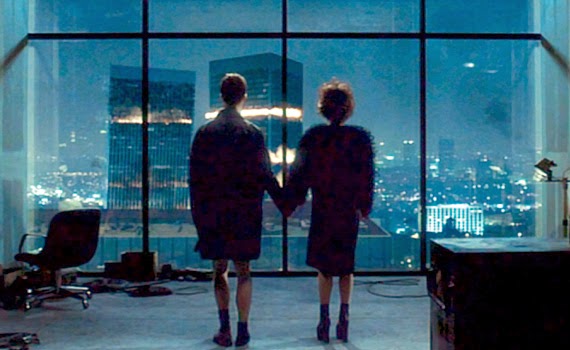
Then of course there are Fight Club's curious parallels to the 9/11 terror attacks. The ultimate objective of Project Mayhem is revealed to be a plot to blow up a series of banks in an unnamed, major American city so as to eliminate all debt. Besides the fact that one of the more iconical images from the film (namely the shot of the Narrator and Marla Singer [Helena Bonham Carter] with their backs to the camera, gazing out of the top floor of an office building as two skyscrapers collapse across the street from a series of explosions) eerily foreshadows the collapse the Twin Towers, there's the curious method Project Mayhem employs to bring down the buildings: controlled demolition. Conspiracy culture had of course are already developed a keen interest in controlled demolition at this point thanks to the Oklahoma City bombing, but such notions would go into overdrive in the wake of 9/11.


Masonic allusions galore, subliminal messages, alternative personalities, secret societies, controlled demolition --this is surely a gold mind for conspiracy bloggers, and yet one that has rarely been tapped. This is in no small part due to the fact the Fight Club has had an enormous influence on post-9/11 conspiracy culture, especially within the patriot movement. Project Mayhem's defining event --the destruction of various financial institutions and the elimination of debt --is no doubt the fever dream of any number self-styled anarcho-capitalist/libertarian revolutionaries out there right now.

But Fight Club is ultimately a smarter film than the overwhelming majority of its audience, and wisely fades to black shortly after the buildings have been blown up. Otherwise the filmmakers would have had to depict the fall out of Tyler's actions, and they likely would not be especially romantic. Less than two years after the film's release 9/11 would put on full display the type of blatant power grabs made possible by major terror attacks, even those directed at major financial institutions.

Would Americans have woken up in Fight Club's aftermath with a glorious debt-free revolt against the banks in full sway, or would they have woken up to find their bank accounts and life savings frozen until further notice? And if the later scenario was the case, would such circumstances touch off a revolution or simply further entrench the powers that be? The funny thing about Tyler''s revolt is that, despite a few juvenile pranks against elites, his final plot for fomenting revolution would have almost surely caused far more suffering for average working stiffs than CEOs.