Welcome to the fourth installment in my examination of the bizarre overlap between the far right and high weirdness. Both topics are murky netherworlds and I have found it useful to outline either at the onset of each installment. To wit, here I am using "high weirdness" as a catchall for a host of fringe topics, including UFOs,
psi, psychedelics and
human potential. As for the far right, in this series I am chiefly concerned with a series of right wing think tanks and other such organizations closely associated with the
military-industrial complex that served as the black heart of the far right from the Cold War up until present.
With the
first installment of this series I recounted
the bizarre shooting spree of Sikh temple shooter Wade Michael Page and the possible deep political implications of his rampage. I also briefly outlined the differences between the "traditional conservative" establishment, based around organizations such as the
Council on Foreign Relations (CFR) and the
Trilateral Commission, and the far right establishment.
With the
second installment the origins of the military-industrial complex were considered as well as the first lobby group for said complex, the
Committee on Present Danger Mach I. Here it was noted that the origins of the military-industrial complex nominally lay with the traditional conservative establishment, but more precisely with a group of middle managers and technocrats revolving around two-time
Secretary of War (and
Bonesman)
Henry Stimson and revered scientist
Vannevar Bush.
 |
| Bonesman Henry Stimson |
Bush has of course long been linked to UFOs, but what is much less well known (but arguably far more relevant) are the individuals who worked under Bush in the
National Defense Research Committee (NDRC) and the
Office of Scientific Research and Development (OSRD) who became deeply involved with
Project ARTICHOKE by 1950.
With the
third and most recent installment I considered how imperialism was enshrined in the far right (who were nominally "
isolationists" at the onset of the Cold War) thanks in no small part to the efforts of General
Douglas MacArthur and the military officers that had served under/with him in the
Pacific Theater of WWII and/or
Korea. In attempting to explain how these officers acquired so much power in the deep state, I began to consider the extensive connections individuals linked to
Roswell (especially the cover up) had to Douglas MacArthur.
Just before wrapping up I had outlined the suspected involvement of reputed
MJ12 member General
Nathan Twining in Roswell. Twining had also served with MacArthur in WWII and would become deeply involved with the far right wing think tank (and vast private intelligence network) the
American Security Council (ASC, which was addressed at length before
here) after retiring from the military. For many years the ASC was dominated by former MacArthur men among its ranks.
The Colonel
At this point it is interesting to note than another former MacArthur officer with close ties to the ASC would allege, in the 1990s, that Twining was in fact the military officer who had overseen the Roswell incident and who played a key role in the aftermath of said incident.
The 1997 work
The Day After Roswell is a curious publication indeed. Its principal author, Colonel
Philip J. Corso, alleged that during the early 1960s he was part of a covert military project to "seed" pieces of the technology recovered at Roswell into the private sector where it could be quietly reverse-engineered. All of this was done with the greatest secrecy, not just to deceive the American public, but to prevent agents of the KGB and CIA (who were/are of course in league with the evil extraterrestrial biological entities bent on enslaving humanity) from acquiring the technology for their own nefarious purposes.
Needless to say, its quite a mixture of
Bircher-style paranoia combined with apocalyptic visions of the
Greys that began to emerge during the 1980s. Corso does not claim to have been present at the Roswell incident, but that he had managed to piece together much of the story during his time in the national security state. In particular, he claims to have been told by
Hermann Oberth, one of the Nazi scientists brought into the space program courtesy of
Paperclip, that Twining was the one responsible for initially seeding extraterrestrial technology into American society via the private sector.
"In the summer of 1947, the scientist at Alamogordo were only aware of the solid-state circuit research under way at Bell Labs and Motorola. So they pointed Nathan Twining to research scientists at both companies and agreed to help him conduct the very early briefings into the nature of the Roswell find. The army, very covertly, turned some of the components over to research engineers for an inspection, and by the early 1950s the transistor had been invented and and transistorized circuits were now turning up in consumer products as well as the military electronic systems. The era of the vacuum tube, the single piece of eighty--year-old technology upon which an entire generation of communication devices including television and digital computers was built, was now coming to a close with the discovery in the desert of an entirely new technology."
(The Day After Roswell, Philip J. Corso & William J. Birnes, pg. 176)
A few pages latter, Corso explains the full significance of these allegations:
"In 1948 the first junction transistor --a microscopically thin silicon sandwich of n-type silicon, in which some of the atoms have an extra electron, and P-type silicon, in which some of the atoms have one less electron – was devised by physicist William Shockley. The invention was credited to Bell Telephone Laboratories, and, as if by magic, the dead end that had stopped the development of the dinosaur-like ENIAC generation of computers melted away and an entirely new generation of miniaturized circuitry began. Where the radio-tube circuit required an enormous power supply to heat it up because heat generated the electricity, the transistor required very low levels of power and no heating-up time because the transistor amplified the stream of electrons that flowed into its base. Because it required only a low level of current, it can be powered by batteries. Because it didn't rely on a heat source to generate current and it was so small, many transistors could be packed into a very small space, allowing for the miniaturization of circuitry components. Finally, because it didn't burn out like the radio tube, it was much more reliable. Thus, within months after the Roswell crash and the first exposure of the silicon-wafer technology to companies already involved in the research and development of computers, the limitations of the size and power of the computer suddenly dropped like the removal of a roadblock on a highway and the next generation of computers went into development. This set up for Army R&D, especially during the years I was there, the opportunity for us to encourage the development with defense contracts calling for the implementation of integrated circuit devices in the subsequent generations of weapons systems.
"More than one historian of the microcomputer age has written that no one before 1947 foresaw the invention of the transistor or had even dreamed about an entirely new technology that relied upon semiconductors, which were silicon-based and not carbon based like the Edison incandescent tube. Bigger than the idea of a calculating machine or an analytical engine or any combination of the components that made up the first computers of the 1930s and 1940s, the invention of the transistor and its natural evolution to the silicon chip of integrated circuitry was beyond what anyone could call a quantum leap in technology. The entire development arc of the radio tube, from Edison's first experiments with filament for his incandescent lightbulb to the vacuum tubes that form the switching mechanisms of ENIAC, lasted about fifty years. The development of the silicon transistor seemed to come upon us in a matter of months. And, had I not seen the silicon wafers from the Roswell crash with my own eyes, held them in my own hands, talked about them with Hermann Oberth, Wernher von Braun, or Hans Kohler, and heard the reports from these now dead scientists of the meetings between Nathan Twining, Vannevar Bush, and researchers at Bell Labs, I would have thought the invention of the transistor was a miracle. I know now how it came about."
(The Day After Roswell, Philip J. Corso & William J. Birnes, pgs. 182-183)
 |
| Hermann Oberth |
There's a lot to take in here. As to the credibility of Corso's claims concerning the transistor originating from "foreign" technology, this shall be considered in a moment. For now, let's focus on several of the details surrounding Corso's story.
Let us start with those German scientists, of whom Corso names three: the famed Oberth and
von Braun, and the highly enigmatic Hans Kohler. In Corso's account, it was these scientists, among other Germans, who were first consulted regarding the Roswell "debris." Oberth and von Braun are of course both Paperclip scientists, with von Braun famously serving as the director of
NASA's
Marshall Space Flight Center during the height of the
space race. Oberth, another famed rocket scientists, is
alleged to have proclaimed the following concerning Nazi scientific advances: "We cannot take all the credit for our record advancements in certain scientific fields alone; we have been helped."
Hans Kohler is an interesting name for Corso to toss about along with such well known scientists as Oberth and von Braun. Not much is known about Kohler (in some accounts his last name is spelled as "Coler"), though many sketchy online sources claim that he was also a Paperclip scientist.
Corso's mention of
Motorola as being one of the two corporations (along with
AT&T, which owned
Bell Labs for decades) to be approached by shadowy officials about reverse-engineering Roswell wreckage is most interesting. This is not the only instance in which
Motorola has been linked to such endeavors.
Longtime Motorola CEO
Robert Galvin, who was the son of Motorola founder
Paul Galvin, had longstanding ties to the ASC as well. He was the chairman of the ASC's National Strategy Committee for years. He was joined on this committee by military men such as General Nathan Twining and General
Curtis LeMay that have long been linked to Roswell (noted in
part three).
That Bell Lab would have been tapped to be the lead in such a project is hardly surprising. Increasingly AT&T (which at this point had an almost total monopoly in telecommunications in these United States) was becoming a defacto arm of the emerging national security state during this era. In 1949 it would be tapped by
President Truman to take over the
Sandia National Laboratory, which is deeply involved in overseeing technology for nuclear weapons. AT&T would oversee Sandia until 1993.
The Deep Private
It is interesting to note that Vannevar Bush was on the board of directors of AT&T from 1947 until 1962. These were apparently the peak years of the reverse engineering project. Was Bush then running an elaborate and highly classified scientific project through AT&T in much the same way he had overseen the National Defense Research Committee and the Office of Scientific Research and Development during WWII? Certainly running such a project through AT&T would be in keeping with the policy of the national security state to outsource many of its darkest secrets to the Deep Private in the post-WWII years.
What's more, it appears that some equally sinister projects were being carried out by another corporation Bush sat on the board of by the late 1940s. This corporation in question was the notorious
Merck & Co. By 1950 its president,
George W. Merck, was an old hand at black ops.
"The decision to locate the nation's biological warfare center at Detrick Field was made in the early years of World War II. President Franklin D Roosevelt had become increasingly disturbed over mounting intelligence reports that Germany and Japan were stockpiling poison gas. There were also reports that Russia, Britain, and Canada were far ahead of the United States in biological weapons research. In early 1942, following the intense work of a number of high-level and blue-ribbon study groups, Roosevelt ordered the War Department – precursor to the Department of Defense – to take whatever measures were necessary to bring United States up to speed with Axis and Allied powers.
"In response, the War Department created the War Research Service (WRS), and installed George Wilhelm Merck as its director. Merck was a natural for the job, as he was already a high-ranking consultant to the War Department on biological warfare. He was also head of Merck & Co., one of the oldest and largest pharmaceutical companies in the world. The firm had its beginnings in the late 1600s in Darmstadt, Germany as the E. Merck chemical factory. In 1891, George Merck, George Wilhelm's father, left Germany to establish Merck & Co, in New York City. His son, George Wilhelm Merck, born in West Orange, New Jersey and a Harvard graduate, had assumed control of the company in 1925. The younger Merck dynamically guided the company to become the largest full-line producer and distributor of pharmaceuticals in the world. Merck & Co. has since been responsible for countless innovations in the drug industry, including many in the controversial areas of enthnogenic products and shamanic inebriants."
(A Terrible Mistake, H.P. Albarelli, pg. 42)
 |
| George W Merck |
As to these "enthnogenic products and shamanic inebriants," easily the most well-known is
MDMA, more commonly known as "Ecstasy" or "molly." Merck synthesized it in 1914. During the 1950s, it was tested at the Army's
Edgewood Arsenal as part of the various Pentagon/CIA behavior modification experiments being conducted there. But I'm getting ahead of myself.
Merck appears to have been close to Secretary of War (and Bonesman) Henry Stimson, who as noted in
part two was one of the key figures in establishing the military-industrial complex. Stimson was who originally brought Merck on as a civilian consultant and who later put him in charge of the
War Research Service (WRS).
Merck played a key role in helping the military set up
Fort Detrick, for years the chief facility for the
US biological warfare program. It also played a key role in the early years of the Pentagon/CIA behavior modification programs. The great H.P. Albarelli turned up a document pertaining to Project ARTICHOKE that indicates that Merck was involved in this operation. The author of this document was H. Marshall Chadwell, Vannevar Bush's former subordinate in the Office of Scientific Research and Development who headed the mysterious Division 19 (noted in
part two). At the time Chadwell was in charge of the CIA's
Office of Scientific Intelligence (OSI), which was deeply involved with Project ARTICHOKE and even briefly oversaw the project in 1952 during Chadwell's tenure.
 |
| H. Marshall Chadwell |
ARTICHOKE had its origins with Project BLUEBIRD. BLUEBIRD was officially initiated on April 20, 1950 (Hitler's birthday), but work on it had already begun in 1949. And it just so happened that Vannevar Bush became a director of Merck in 1949. In 1957 he would become chairman of the board of directors after Merck died and would hold the post until 1962.
Given that Merck & Co appears to have been involved in Project ARTICHOKE in some capacity or another, it seems highly probable that Bush would have at a minimum been aware of these activities. He had overseen countless highly classified projects during World War II and the fact that he joined Merck in the same year that what would become ARTICHOKE was getting off the ground is most eyebrow rising. All of these ties --Merck, Chadwell,
Boris Pash --strongly indicate that Bush was playing a role in Project ARTICHOKE (his links to Stanley Lovell, the
OSS's liaison with the OSRD, indicate he may have been involved in the more well-known
MKULTRA as well), one of which he managed in the private sector.
Is it then so improbable that he could have been involved in another highly classified project via AT&T and Bell Labs? As the man appears to have been involved in highly classified research from at least 1940 onwards, what seems improbable that a heavy like Bush would end up working at AT&T/Bell fore purely commercial reasons. Almost everything Bush did during the latter part of his life appears to have some type of deep state angle to it.
Who Was Corso?
Let us now return to the legitimacy of Corso's claims. In weighing such things, it is useful to consider the man's background so as to determine if he would have even been in position to know such things. So, here it is:
"... Colonel Philip J Corso, a twenty-year Army Intelligence career man until his retirement in August 1963. He had been the military Operations Coordinating Board's delegate to the CIA group planning the 1954 Guatemalan coup. In 1956 Corso had sought to reactivate fifty surviving garrisons of East European paramilitary unit still hanging out in West Germany and tied to the Gehlen spy network. When his Volunteer Freedom Corps, dedicated to rolling back communism, was scuttled as too radical by the Eisenhower administration, Corso attributed the defeat to 'lies by our liberal darlings.' A staunch foe what he considered a laissz-faire CIA, Corso testified before Congress on military muzzling after General Walker was kicked out of West Germany in 1961. Upon leaving Army Intelligence, Corso went to work in 1963 as a 'research assistant' for segregationist Senator Strom Thurmond of South Carolina. And, after the Kennedy assassination, Corso was among the first to spread rumors hinting that Oswald was tied to a Communist ring inside the CIA – and doubling as an informant for the FBI."
(The Man Who Knew Too Much, Dick Russell, pg. 529)
 |
| Colonel Philip J. Corso |
Corso's presence on
Eisenhower's
Operations Coordinating Board (where, according to
Peter Dale Scott in
Deep Politics and the Death of JFK, Corso frequently clashed with
C.D. Jackson, a regular
Bilderberg attendee) and his involvement with the "Volunteer Freedom Corps" strongly indicate that Corso was close to the black heart of the deep state. The latter assignment has led some researchers such as Kevin Coogan to speculate that Corso was involved in
Operation Gladio, which was certainly a possibility given Corso's background in the Army's
Counterintelligence Corps (CIC, which initially oversaw Paperclip, among other black ops).
Corso does seem quite adapt at spreading disinformation, however. Indeed he, along with other members of a secret society officially known as the
Sovereign Order of Saint John (SOSJ, commonly referred to as the
Shickshinny Knights of Malta) appear to have taken the lead in the propaganda campaign to link the
Kennedy assassination to a Communist conspiracy. Peter Dale Scott outlines these developments:
"Corso built on this anti-CIA paranoia by telling his friend and fellow Senate staffer Julien Sourwine, who made sure it was relayed to the FBI, that Oswald was tied to a Communist ring inside the CIA, and was doubling as an informant for the FBI. Shickshinny Knight Herman Kimsey... also spun an elaborate story about how his CIA duties had put him in touch with Kennedy's assassin --the mystery man in Mexico. Finally, the chief press contact of the Shickshinny Knights, Guy Richardson of the New York Journal American, published the claim (soon taken up by Frank Capell, by the John Birch Society, and by Willoughby's American Security Council) that Oswald, like another alleged KGB assassin (Bogdan Stashynsky), had been trained at a KGB assassination school in Minsk. A toned-down version of the story subsequently published by Julien Sourwine's Senate Internal Security Subcommittee, with help supplied via Senator Thomas Dodd from within the CIA."
(Deep Politics and the Death of JFK, Peter Dale Scott, pg. 215)
The SOSJ, which Corso was a member of shortly after retiring from the Army, has been extensively linked to numerous intrigues, ranging from the Kennedy assassination (noted before
here)
to the Oklahoma City bombing. Much of the modern American militia movement can be traced to the SOSJ (noted before
here), including more militant groups
such as The Order. This researcher firmly believes that the SOSJ was a key hub in the American wing of Gladio. Curiously, a website purporting to be the official history of the SOSJ made
the following statement concerning Gladio:
"The Order was engaged worldwide in anti-Communist activities. Former SS Major General Boris Holmston-Smyslovsky, alias Colonel von Reganau, and U.S. Marine Lieutenant General Pedro Del Valle spurred renewed SOSJ activity in opposition to the Communists in Europe after 1948. Holmston-Smyslovsky was an old associate of Prince Awaloff. These men were involved with the Gladio program which prompted the founding of the U.S. Army Special Forces. The secret army of Czar Kirill I formed a nucleus for Gladio 'stay behind' operations which were designed to wage perpetual war on the Communists. As successor to SOSJ Anti-Bolshevik Bloc of Nations operations, Allen W. Dulles, Colonel William J. Donovan, Gen. Reinhard Gehlen and Lt. General Pedro Del Valle initiated NATO’s Operation Gladio during the era of the founding of the U. S. Central Intelligence Agency and German BND. The U. S. Counter-Intelligence Corps, the Gehlen Organization and the Knights of Malta started the Volunteer Freedom Corps otherwise known as Operation Gladio. Ten thousand men were descendants of the secret army of Czar Kirill I and the fifty garrisons of East European Freikorps mentioned by Cherep Spiridovich in the 1920’s and by Phillip Corso, OSJ in the 1950’s. Even in the United States, some knights started anti-Communist domestic militias and supported conservative publications to increase public awareness of the agenda of International Socialism."
While it is generally not wise to believe the things one reads on websites claiming to be the official history of a truly bizarre secret society, it is not often that one encounters a group that not only acknowledges its role in Gladio, but seems to take pride in it. That
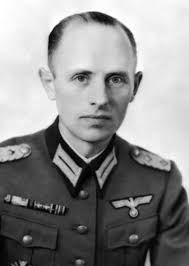
Gehlen and his
Org played a key role in establishing Gladio along with the Army CIC and later the CIA is a fact. And there can be little doubt that Eastern European anti-Communist groups affiliated with the
Anti-Bolshevik Bloc of Nations, as indicated by Coogan's
Dreamer of the Day, were recruited into Gladio. Given the SOSJ's links to numerous acts of terrorism (a longtime modus operandi of Gladio) in these United States over the past fifty years, the involvement of Corso and the Shickshinny Knights in Gladio cannot be discounted.
 |
| Reinhard Gehlen |
If all of this is not curious enough, there's also the distinct possibility (as outlined before
here,
here and
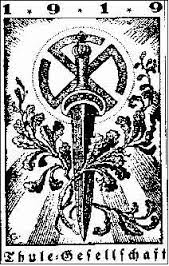
here) that SOSJ has it origins with the infamous
Thule Society. Nor does it appear to have faded away with time. As was noted before
here, General
William Boykin, a veteran of the
Joint Special Operations Command (JSOC) and the CIA's
Special Activities Division (SAD) who helped oversee the ARTICHOKE-like
Copper Green during the
second Iraq War, is a member of some version of SOSJ, though it is unknown if it is a direct descendant of Shickshinny outfit or one of the numerous offshoots. Naturally Boykin has come out as
a Trump supporter like many military intelligence and JSOC veterans in recent months. But moving along.
Disinformation or Something More?
Should Corso's claims then be discounted? Certainly there are compelling reasons to do so, as indicated above. And of course, his book itself is highly controversial for a number of reasons. The great
Christopher Knowles of
The Secret Sun outlined a few of them in his groundbreaking
Lucifer's Technologies series.
In part five he noted:
"The timing seemed suspicious to some. Here was a Lt. Colonel from the Foreign Technology Office telling UFOlogists everything they wanted to hear exactly when they wanted to hear it. And critics noted the book was rife with basic errors of fact.
"Many of errors were curious- some had nothing directly to do with Corso's Roswell claims and were the kind of mistakes that could have very easily been corrected by his co-author Bill Birnes when the book was in the editing process.
"A further controversy erupted when Senator Strom Thurmond --under whom Corso worked as an aide after he left the service- demanded his (rather glowing) foreword be removed from the book, claiming he wasn't aware of the book's subject matter (though a memo reprinted in UFO Magazine later showed that the foreword was for a "Roswell" book).
"So what do we have here? A hoax? A delusional old man cashing in on the UFO craze of the time? A deliberate disinfo campaign meant to splash water on Roswell fever (which in many ways the backlash to the book did)?
"Michael Salla- whose resume is strangely more fitting to a Undersecretary of State than a UFO researcher- dug into the controversy over Corso's book and found than many of the claims made against his reputation and his credibility were either false or trivial. And Thurmond's introduction made it clear that Corso had been a highly partisan Cold Warrior in the 50s and 60s, which Salla claims had made him a lot of enemies."
Case closed then, right? Well, not exactly as nothing is simple when it comes to Roswell, thus it should come as little surprise that the same year
The Day After Roswell was published (1997)
another source came forward to confirm many of Corso's claims concerning the transistor and other technologies allegedly recovered from the debris.
"According to Jack A. Shulman, president of American Computer; the invention of the transistor may have been inspired by the study of the remains of a crashed alien spacecraft, basically reverse engineered technology...
"Alien Technology and humans reverse engineering it was first mentioned in 1997 when, American Computer Company (ACC) suggested the possibility that the study of the remains of a crashed alien spaceship in Roswell in 1947, or another crashed Alien spaceship might have been definitive for the development of the transistor, made in 1948 by Shockley, Bardeen and Brattain doctors in the Research Center of Electronic Circuits at Bell Laboratories.
"The basis for such claims are a series of documents and testimonies that supposedly were in possession of ACC. This theory matches the stories of many others, among them, former Lieutenant Colonel Phillip Corso, who in his book; The Day After Roswell, claims being part of the team that handed the remains of the crashed object and delivered parts to different departments of Bell Laboratories...
"According to ACC, among the remains of the alien craft crashed, researchers found several other technologies; nuclear Energy, robotics, computer systems and communication devices. Many of the pieces of Alien technologies are still being studied and tested today.
"Interestingly, according to ACC, one of the allegedly found parts was composed of silicon and arsenic, and showed, under a microscope, a series of extremely complicated circuits. This “device” could act as high-speed electronic switch and as an amplifier, which inspired the invention of the semiconductors.
"ACC presented many pieces of “evidence” in a meeting held in October 1997 at the University of Princeton where members from ACC highlighted a number of books dated from 1947 and, according to ACC, even from Bell Laboratories, which contain executive orders for the analysis of the secret technology found in 'an unknown object.' "
 |
| allegedly the first transistor developed by Bell |
Of course these claims are also shrouded in controversy, with American Computer Company founder Jack A. Shulman later recanting them and alleging that the elaborate claims posted on his company's official web page were simply "satire." This disclaimer naturally came several years after the initial postings and what was reputed to be none stop harassment of Shulman and his company. As Christopher Knowles noted,
these denials ring rather hollow.
Clearly, there is a lot of disinformation, lies and out right bullshit hovering around this whole ordeal. And yet, as Mr. Knowles brilliantly outlined
here and
here, the history of the transistor, the basis of the modern computer revolution,
is extremely murky and represents a quantum leap in technology over the vacuum tubes the transistor replaced. As such, this researcher believes this there is some merit, broadly speaking, to Colonel Corso's claims concerning the transistor and other technologies reputedly recovered at Roswell.
Roswell
The question then becomes: what exactly happened at Roswell that would warrant a decades spanning cover up that would pull in a deep state heavy like Corso at the end of his life to run an elaborate disinformation campaign? Conspiracy circles are of course rife with theories, with the two most popular being that Roswell was A) a massive PSYOP or B) the actual recovery of a physical flying saucer piloted by extraterrestrial biological entities.
This researcher does subscribe to either.
The failings of point B) our to my mind rather obvious, least of all because it was the initial cover story put out by the military, and I will not dwell on it. As to point A, this is some what compelling. But the question then becomes, to what purpose? To cover up a weather balloon or some other topic secret aircraft? I don't know that decades-spanning secrecy would be needed to cover up a weather balloon or any other type of known technology at this point. I don't discount some type of Nazi UFO entirely, but evidence of this is sketchy.
Another theory put forth is that it was some type of
War of the Worlds-style PSYOP. Unfortunately, the legendary
War of the Worlds of the broadcast
did not spark anywhere near the type of panic that is commonly believed and I'm not sure that a few sensation headlines in a local newspaper would have anywhere the same effect as
Orson Welles' broadcast.
 |
| fake news |
So if it is not a PSYOP or an actual UFO, what then?
I think Christopher Knowles has come up with the most compelling explanation: that it was a kind of ritual that he has dubbed the "Roswell working." On one of his Lucifer's Technologies chapters, he notes many of the peculiar events
leading up to Roswell after WWII came to a close:
"The US Army Signal Corps (inventors of the modern printed circuit board) would kick off the Space Age on January 10, 1946 with Project Diana, in which they bounced radar signals off the Moon from Fort Monmouth, NJ.
"Perhaps knowing Diana was going down, Jack Parsons and L.Ron Hubbard began the Babalon Working in Pasadena, CA, which lasted from January to March of 1946. Some accounts would claim that Hubbard and Parsons encountered an alien in the Mojave Desert on January 18, the same day Marjorie Cameron appeared at the Parsonage.
"In the midst of the Working, the so-called Ghost Rockets began appearing over Scandinavia February 26, 1946. Thousands would be seen through that year. At least one would be reported as having crashed, significantly in the month of July.
"Two days after the first Ghost Rocket was sighted, Parsons went alone to the Mojave, where he claimed he encountered the goddess Babalon whom he said dictated the Liber 49 to him.
"On July 1, 1946 the US began Operation Crossroads, the testing of powerful nuclear weapons. This would allegedly attract the attention of UFOs, who were reported to have deactivated nuclear weapons on many occasions in the US and Soviet Union.
"In folk magic, crossroads were places you went to make deals with demons and other dark spirits...
"The Corporal Missile, using Jack Parson’s solid state fuel, was launched on May 22 at White Sands, NM. (At least one would be destroyed in the upper atmosphere by a UFO)
"On June 21, Harold Dahl claimed to have seen six UFOs near Maury Island in Puget Sound, WA, which would earn him the first modern 'Men in Black' encounter. Not too far away, businessman Kenneth Arnold would have his famous UFO sighting on June 24th, a very powerful day in a number of ritual calendars."
The thing is, virtually all of these incidents feature the involvement of the US military. In the case of
Project Diana and Operation Crossroads (the names of which are ripe with esoteric significance), this much is obvious. But as far as the
Babalon Working is concerned, remember that future
Scientology founder
L. Ron Hubbard as a Navy man who was briefly detailed to the
Office of Naval Intelligence (ONI). Hubbard claimed to have investigated
Parsons on behalf of the ONI,
a claim that has long been disputed.
As to the
Maury Island incident and
Kenneth Arnold's legendary sighting, both of these events came to feature the involvement of the mysterious
Fred Lee Crisman. Crisman was a former military man long linked to the US intelligence community and the far right.
Jim Garrison had once considered subpoenaing Crisman to appear in his trial of
Clay Shaw.
Crisman was also a so-called "
wandering bishop," the network of which has long been linked to strange and occultic practices (addressed before
here and
here).
On the whole then, it would seem that the military was up to some very, very strange things in the wake of World War II. And they were largely acting unilaterally.
The CIC
The
OSS, the WWII-era precursor to the CIA, was disbanded in September of 1945 and had largely begun winding down its activities after the
European Theater was won. The CIA wouldn't exist until the passage of the
National Security Act of 1947 and the
NSA not until 1952. There was the FBI, but it was largely concerned with domestic affairs while occasionally dabbling in Latin America.
The military intelligence services were then largely the only game in town and they do appear to have had ambitious plans unfolding in this era. Possibly the most powerful of the military intelligence services during this time was the Army's
Counterintelligence Corps (CIC). During and after WWII it was deeply involved in two of the emerging deep state's most ambitious programs:
Operation Paperclip and
Operation Alsos (the latter in conjunction with the ONI and Bush's Office of Scientific Research and Development).
 |
| interestingly, one of the early symbols of the CIC was the so-called "Golden Sphinx" seen at the top of this insignia |
Paperclip of course (in)famously recruited numerous "former" Nazi scientists (and later, intelligence assets) to assist the United States in the emerging Cold War. The Alsos mission, organized by Vannevar Bush, was closely related. Here the United States sought to undercover whatever scientific advances the Nazis had made in relation to nuclear, chemical and biological weapons. It has also been long rumored that Alsos mission contributed data to the behavior modification experiments conducted by the CIA and the Pentagon.
Boris Pash, at the time detailed to the CIC, headed Alsos and (as noted before
here) appears to have gone to work on BLUEBIRD shortly thereafter.
And that brings us to another intrigue involving the Army CIC. They appear to have been one of the earliest branches of the emerging national security state to dabble in "
enhanced interrogations" and "behavior modification." This is hardly surprising, considering that the WWII-era CIC was headed by
Federal Bureau of Narcotics (FBN) agent Garland Williams.
 |
| Garland Williams |
Williams, who was addressed before
here briefly, is an especially murky figure. Williams was the mentor to the infamous George Hunter White in the FBN, as well as special contract agent Pierre Lafitte (who also got his intelligence start in the CIC via its WWI-era counterpart, the Corps of Intelligence Police). White himself is well known for his involvement in
MKULTRA, helping
Sidney Gottlieb set up the
safehouses in New York and San Francisco. What is less well known is that both White and Lafitte were also had involvement in ARTICHOKE, and Lafitte may even have contributed to
Frank Olson's as part of his "work" on ARTICHOKE (noted before
here).
It has long been suspected that Williams was also involved in ARTICHOKE and/or MKULTRA, but this has yet to be definitively confirmed. It is interesting to note, however, that Williams was brought back into military intelligence during Korea where he served with the Army's
525th Military Intelligence Service Group. This unit specialized in POW interrogation. As this assignment unfolded well after BLUEBIRD/ARTICHOKE was up and running, there is a strong possibility that Williams oversaw "enhanced" interrogation methods.
Certainly the CIC was well versed in these arts by 1950. After WWII the CIC had developed their own detachment specializing in such things. They were alternatively known as the "Kraut Gauntlet" or simply "the Rough Boys." The great H.P. Albarreli has provided
invaluable information concerning this unit:
"Here it should be noted that, during the cold war years, CIA and Army Counter-Intelligence Corps (CIC) interrogators, working as part of projects Bluebird and Artichoke, sometimes injected large amounts of Metrazol into selected enemy or Communist agents for the purposes of severely frightening other suspected agents, by forcing them to observe the procedure. The almost immediate effects of Metrazol are shocking for many to witness: subjects will shake violently, twisting and turning. They typically arch, jerk and contort their bodies and grimace in pain. With Metrazol, as with electroshock, bone fractures - including broken necks and backs - and joint dislocations are not uncommon, unless strong sedatives are administered beforehand.
"Army CIC interrogators working with the CIA at prisoner of war camps and safe house locations in post-war Germany on occasion used Metrazol, morphine, heroin and LSD on incarcerated subjects. According to former CIC officer Miles Hunt, several 'safe houses and holding areas outside of Frankfurt near Oberursel' - a former Nazi interrogation center taken over by the US - were operated by a 'special unit run by Capt. Malcolm S. Hilty, Maj. Mose Hart and Capt. Herbert Sensenig. The unit was especially notorious in its applications of interrogation methods [including the use of electroshock and Metrazol, mescaline, amphetamines and other drugs].' Said Hunt: 'The unit took great pride in their nicknames, the "Rough Boys" and the "Kraut Gauntlet," and didn't hold back with any drug or technique ... you name it, they used it.' Added Hunt, 'Sensenig was really disappointed when it was found that nothing had to be used on [former Reichsmarschall] Herman Goering, who was processed through the camp. Goering needed no inducement to talk.'
"Eventually, CIC interrogators working in Germany would be assisted in their use of interrogation drugs by several 'former' Nazi scientists recruited by the CIA and US State Department as part of Project Paperclip. By early 1952, the CIC's Rough Boys would routinely use Metrazol during interrogations, as well as LSD, mescaline and conventional electroshock units."
Again, the OSS was disbanded in 1945 and the CIA, which was initially known as the Central Intelligence Group, was not launched until 1947. Thus, it is likely that many of these interrogations on Nazi POWs initially came without much input from either the OSS or the CIA. Thus some of the input provided by "former Nazi" scientists was extracted by the CIC itself, as it was the lead agency in the early years of Paperclip. And of course, it had just finished overseeing Alsos as well. Naturally, the CIC would later be the primary wing of Army intelligence active in ARTICHOKE (which was very much a joint Pentagon/CIA project).
And would you be surprised to learn, dear reader, that the CIC is also the intelligence agency most closely linked to the Roswell incident? At a minimum the CIC was involved in the cover up, but may well have been the lead agency behind the incident. After all, they provided the security for the highly classified Manhattan project which appears to have been closely related to Roswell.
Now, let us consider the implications of all of this. World War II comes to a close just as the OSS is being disbanded. The military is thus free to seek out the spoils of the war in both Europe and Japan without a lot of oversight from the traditional conservative establishment outside of the technocrats of the Manhattan Project.
Shortly there after the Army initiated a series of curious projects, Diana and Crossroads, with highly suggestive names. Jack Parsons also begins that Babalon working with the assistance of ONI man L. Ron Hubbard. Roughly a year later the modern UFO era is ushered in by the Kenneth Arnold sighting. Soon the Maury Island incident also gains press attention and former military man and wandering bishop Fred Lee Crisman arrives on the scene.
 |
| Jack Parsons |
Roswell then unfolds. Shortly there after the National Security Act of 1947, which creates the CIA, is passed. This bill essentially laid the foundation for the national security state while also trying retain traditional conservative control over it via the CIA (briefly noted in the
prior installment). At roughly the same time the Navy's Project CHATTER is launched, the first formal behavior modification program. At the end of 1947 or early 1948 the Navy initiates the even more secretive Project Pelican (noted before
here). It is likely the famed parapsychologist
Andrija Puharich participated in Pelican (noted before
here).
The CIA then launches BLUEBIRD unofficially in 1949, but in close cooperation with the military. In fact, much of the CIA personnel involved in BLUEBIRD and its successor program, ARTICHOKE, came from military backgrounds. Andrija Puharich joins ARTICHOKE in the early 1950s and is involved in the infamous channeling of The Nine in 1953 (noted before
here), when he is in the midst of his work on ARTICHOKE. The Nine, reputed to be an extraterrestrial (or at least some type of nonhuman) intelligence, were contacted via divination and possibly psychedelics. As was noted before
here, this researcher strongly believes that experiments concerning The Nine were a part of ARTICHOKE.
In 1953 MKULTRA is also launched, around the time of the seances with The Nine. But MKULTRA, unlike ARTICHOKE, is purely a CIA project with ample backing from the traditional conservative establishment (especially the
Rockefellers), as noted before
here. Was some one feeling left out of the (military) loop by this point?
Super Soldiers?
Roswell appears to have been surrounded by two incidents, the Babalon Working of Parsons (and Hubbard) and Puharich's Nine seance, in which occultic methods appear to have been used to contact nonhuman intelligences. In this context then the possibility that Roswell may been some type of ritual or summoning becomes all the more compelling. Had the military learned something from the Nazis and/or Parsons that was put to the test at Roswell and later refined by Puharich?
Outlandish perhaps, but I find this explanation more compelling than Roswell as a PSYOP, or a cover up for a weather balloon. Certainly Roswell is ripe with symbolism, as Christopher Knowles has brilliantly chronicled before
here. In particular Mr. Knowles was struck by the parallels between the myths of
Cadmus and the Roswell incident, especially the tales revolving around the Wells of Mars. Knowles writes:
"What's more, Cadmus has a powerful connection to wells, in this case, the Well belonging to the god Mars. And strangely enough, the myth of Cadmus and the Martian Well has strong undertones of genetic engineering (men arising from the 'teeth' of Mars' dragon) and those pesky Reptilians bubbling just beneath the surface:
'While seeking water he [Kadmos] came to the fountain of Castalia, which a Draco, the offspring of Mars [Ares], was guarding. It killed the comrades of Cadmus, but was killed by Cadmus with a stone. Under Minerva’s instructions he sowed the teeth and plowed them under. From them sprang the Spartoe. These fought among themselves, but from them five survived, namely, Chthonius, Udaeus, Hyperenor, Pelorus, and Echion.
"In modern fringe UFOlogy, Reptilians are said to originate in the Draco system. Which is convenient, I guess.
"The Well of Mars is interesting for another reason, one I should mention. That being that Mars is the Red Planet, of course. So it's also the Well of the Red Planet or even, if you like, the Red Well.
"And know what else is red? I'll give you a hint, violets are blue."
 |
| Cadmus slaying the dragon |
When considering the
Spartoi who emerged from the Martian well (or red well or...) I was not reminded of reptiles. Rather, I was struck by how much they resembled "enhanced" or "super" soldiers.
And it just so happens, dear reader, that one of the primary objectives of BLUEBIRD (and later ARTICHOKE) was the creation of "super soldiers" (noted before
here). I suppose this is just a coincidence...
With that I shall wrap things up for now. With the next installment I shall begin considering the ASC in earnest. Until then dear reader stay tuned.