Showing posts with label Colorado. Show all posts

Thursday, December 1, 2016

Trump, the JSOC and the Legacy of ARTICHOKE


"On the terminal point
Of the cul-de-sac
Patients are dying
The horses are dazed
From the glare of the stars
The starry wisdom
Owned by the Baron
And he's got the cure

A drug by the name of World Without End"


The Zeitgeist


2016 will no doubt be remembered for many, many things, few of them especially positive. But there is no doubt in my mind that two TV series that aired over the course of this strange year will be seen as prophetic in the years to come. One was a rival of one of the most revered and influential shows of the past quarter century while the other was an upstart series that premiered on Netflix, which will no doubt be at the forefront of cutting edge entertainment as the old Hollywood system continues to wither on the vine.

I am of course referring to The X-Files event series and Stranger Things. The former was as good of an assessment of the United States in 2016 as one could hope to find. It depicted a nation tearing apart at the seams, awash in disinformation (the Tad O'Malley Show chillingly depicted the rise of the far right "alternative media"), hopelessly divided along class (the gentrification of "Home Again") and ethnic/religious lines ("Babylon"), with the specter of an out-of-control national security apparatus gearing up for the final putsch ("My Struggle I & II") looming over the whole thing.

The X-Files thrived during the Clinton years and returned to the air just as the Clinton train was about to go permanently off the rails. Longtime Clinton insider John Podesta raised the specter of the UFO question during the campaign trail and even flirted with Tom DeLonge's revived Disclosure project like it was 1999. This marked the first serious discussions the political elite have had concerning the UFO question since the last Clinton presidency. But as the end of the year approaches, Podesta is increasingly linked to even more sinister interests, least of all "spirit cooking."

John Podesta
Mulder and Scully's return to the FBI for one more confrontation with the deep state eerily previewed the deep state's use of the FBI for an October Surprise that sunk Hillary's presidential bid (and a prior coup in the CIA that unfolded in 2012, as shall be noted below). Pizzagate and its hints of an elite pedophile network seems positively tame in comparison to the experiments carried out on children on behalf of the deep state as depicted in "Founder's Mutation."

Stranger Things would go a step further, effectively offering up a take on the CIA/Pentagon ARTICHOKE and MKOFTEN experiments that did not fall prey to the mind control red herring. Instead, it boldly embraced the little discussed psi and nonhuman intelligence components that underlined these experiments, as was addressed here. The use of Eleven to breach the "Upside Down World" eerily hinted at Andrija Puharich's contacts with The Nine, which were almost surely carried out under the auspices of ARTICHOKE (noted before here).

Andrija Puharich
Whether or not this was the intention of the series is highly debatable. On the whole, the show appears to have been based upon the standard MKULTRA fair in addition to ample doses of the highly, highly dubious Project Montauk lore. But whether intentionally or not, it went down some of the darkest avenues of the deep state where Pizzagate may only be the tip of the iceberg.

While Stranger Things was set in the 1980s and was largely based upon experiments that had already been concluded by the time Ronnie Raygun was elected president, it re-introduced the ARTICHOKE and OFTEN projects (as well as the much more well known but not nearly as significant MKULTRA experiments) to the national conscience at a time when they seem especially relevant.


The Players

"Capre diem!"
--"The Siege and Investiture of Baron Von Frankenstein's Castle at Weisseria," Blue Oyster Cult


Increasingly, the Trump administration is looking like a junta dominated by the Joint Special Operations Command (JSOC). As was noted before here, General Michael T. Flynn, Trump's handpicked choice for the powerful position of National Security Advisor, cut his teeth in the JSOC. He was the chief intelligence officer for General Stanley McChrystal during his tenure heading the JSOC and played a key role in the institution's use of drone warfare and "enhanced" interrogation methods. But Flynn is not the only former military man close to Trump with ties to the JSOC.

McChrystal himself was at one point being considered for Trump's VP slot (along with his "former" intelligence chief, Flynn). McChrystal reportedly declined not only the Veep spot, but any role Trump might offer him in his administration back in July. Still, McChrystal is reportedly being considered for a slot in Trump's cabinet, possibly the prestigious post of Secretary of State.

General Stanley McChrystal
Erik Prince, the notorious former Navy SEAL and founder of Blackwater, was making allegations in the days leading up to the election that the NYPD was poised to press charges against Anthony Weiner and that they had found evidence on his computer indicating that both Bill and Hillary Clinton had made repeated trips to the pleasure island of convicted pedophile Jeffrey Epstein. Just this week it was announced that Prince's sister, Betsy Prince DeVos, has been tapped to be Trump's Secretary of Education.

Betsy prince DeVos
Nor is Prince the only Blackwater man linked to Trump. Joseph E. Schmitz, a former inspector general for the Department of Defense who took up a post with Blackwater in 2005 after he left the DoD. At some point he also linked up with the Center for Security Policy (CSP), the post-Cold War successor to the infamous American Security Council (ASC, much more information on which can be found here; the CSP is not the only group with ties to the infamous ASC network to be linked to Trump either). Of late he was named as one of Trump's top foreign policy advisers.

Joseph Schmitz
Backwater would become deeply involved in covert ops for both the CIA and the JSOC during the Bush II years and may even have contributed to the divide between the two organizations.
"Although the CIA would take much of the credit and criticism for the US drone program in Pakistan, it was not the only player. JSOC had its own intelligence operations inside Pakistan and, at times, conducted its own drone strikes. At the center of both the JSOC and CIA targeted-killing programs were members of an elite division of Blackwater, who assisted in planning the assassinations of suspected Taliban and al Qaeda operatives, 'snatch and grabs' of high-value targets and other sensitive actions inside Pakistan. Some elite Blackwater SELECT personnel worked for the CIA at 'hidden bases in Pakistan and Afghanistan, where the company's contractors assemble and load Hellfire missiles and 500-pound laser-guided bombs on remotely piloted Predator aircraft.
"Blackwater operatives also worked for JSOC on a parallel program that was run out of Bagram Air Base in neighboring Afghanistan. US military intelligence and company sources told me that some Blackwater personnel were given rolling security clearances above their approved level. Using Alternative Compartmentalized Control Measures (ACCMs), the Blackwater personnel were granted entry to a Special Access Program. 'With an ACCM, the security manager can grant access to you to be exposed to and operate within compartmentalized programs far above "secret" – even though you have no business doing so,' a US military intelligence source told me. It allowed Blackwater personnel who 'do not have the requisite security clearance or do not hold a security clearance whatsoever to participate in classified operations by virtue trust,' he added. 'Think of it as an ultra-exclusive level above top secret. That's exactly what it is: a circle of love.' As a result, Blackwater had access to 'all source' reports that were culled in part from JSOC units in the field. 'That's how a lot of things over the years have been conducted with contractors,' said the source. 'We have contractors that regularly see things that top policymakers don't unless they ask.'
"The military intelligence source said that the Blackwater-JSOC operation in Pakistan was referred to as 'Qatar cubed,' in reference to the US forward operating base in Qatar that served as the hub for the planning and implementation of the US invasion of Iraq. 'This is supposed to be the brave new world,' he told me. 'This is the Jamestown of the new millennium and it's meant to be a lily pad. You can jump off to Uzbekistan, you can jump back over the borders, you can jump sideways, you can jump Northwest. It's strategically located so that they can get their people wherever they have to be without having to wrangle with the military chain of command in Afghanistan, which is convoluted. They don't have to deal with that because they're operating under a classified mandate.'
"In addition to planning drone strikes and operations against suspected al Qaeda and Taliban forces in Pakistan for both JSOC and the CIA, the Blackwater teams also helped plan missions for JSOC inside Uzbekistan against the Islamic Movement of Uzbekistan. Blackwater did not actually carry out the operations, the military intelligence source told me, which were executed on the ground by JSOC forces. 'That piqued my curiosity and really worries me because I don't know if you notice but I was never told we are at war with Uzbekistan,' he said. 'So, did I miss something? Did Rumsfeld come back in the power?' When civilians are killed, 'People go, "Oh, it's the CIA doing crazy shit again unchecked." Well at least 50 percent of the time, that's JSOC [hitting] somebody they've identified through HUMINT or they've culled the intelligence themselves or it's been shared with them and they take that person out and that's how it works.'
"CIA operations were subject to congressional oversight, unlike the parallel JSOC ops. 'Targeted killings are not the most popular thing in town right now in the CIA knows that,' my source told me in 2009. 'Contractors and especially JSOC personnel working under classified mandate are not [overseen by Congress], so they just don't care. If there's one person they're going after and there's thirty-four [other] people in the building, thity-five people are going to die. That's the mentality.' He added, 'They're not accountable to anybody and they know that. It's an open secret, but what are you going to do, shut down JSOC?' "
(Dirty Wars, Jeremy Scahill, pgs. 251-252) 
Erik Prince
Another general with strong JSOC links that has backed Trump is the notorious William "Jerry" Boykin. Boykin has long been linked to the Christian right. Like Joseph E. Schmitz (whom he worked with in the Pentagon), Boykin is also involved in intelligence-connected "Orders of Knighthood" (Schmitz is a member of the infamous Knights of Malta, Boykin the Sovereign Order of Saint John, an organization likely with its origins in the Thule Society) as well as the Center for Security Policy (as are Frank Gaffney, Clare Lopez, James Woolsey and any number of Trump's other foreign policy backers). Presently Boykin is also the "Executive Vice-President" of the Family Research Council (FRC), an offshoot of James Dobson's Focus on the Family (which was its base of operations in Colorado Springs, just a few miles from NORAD). According to Jeremy Scahill in Blackwater: The Rise of the World's Most Powerful Mercenary Army, early financial patrons of the FRC included the DeVos and Prince families, both of whom appear in already have an in in the Trump administration in the form of Betsy DeVos.

Boykin has longstanding ties to the Joint Special Operations Command, having been one of the first members of the Delta Force. He commanded the JSOC at one point and eventually became the commander US Army Special Operations Command at Fort Bragg from 1998 to 2000. From 2000 to 2003 he was the commander of the John F. Kennedy Special Warfare Center, also located at Fort Bragg. During the 1990s, he was also the Deputy Director of Special Activities for the CIA. The Special Activities Division (SAD) is the CIA's primary paramilitary arm.

Boykin would end his service as the Deputy Undersecretary of Defense Intelligence under the notorious Stephen Cambone, a key architect of the Bush II "enhanced" interrogation methods. Boykin was apparently involved in these endeavors.
"Boykin was a career military officer, one of the first Delta force commandos who rose through the ranks to become head of the top-secret Joint Special Operations Command. He had served in the Central Intelligence Agency, and during the war on terror, had been in charge of Army Special Forces before joining Rumsfeld's close-knit leadership team, where he was placed in charge of hunting 'high-value targets.' Boykin was one of the key U.S. officials in establishing what critics allege was death-squad-type activity in Iraq. Asked in a Congressional inquiry about the similarities between the U.S. Phoenix program in Vietnam and special operations in the war on terror, Boykin said: 'I think we're running that kind of program. We're going after these people. Killing or capturing these people is a legitimate mission for the department. I think we're doing what the Phoenix program was designed to do, without all the secrecy.' ... When Boykin came under fire for his anti-Muslim comments, Rumsfeld and other Pentagon brass vigorously defended him. 'Boykin was not removed or transferred. At that moment, he was at the heart of secret operation to "Gitmoize"... the Abu Ghraib prison,' wrote former Clinton senior adviser Sidney Blumenthal. 'He had flown to Guantánamo, where he met Major General Geoffrey Miller, in charge of Camp X-Ray. Boykin ordered Miller to fly to Iraq and extend X-Ray methods to the prison system there, on Rumsfeld's orders.' "
(Blackwater, Jeremy Scahill, pgs. 376-377)
General William "Jerry" Boykin
As was noted before here, General Michael T. Flynn and General Stanley McChrystal were also deeply involved in the "enhanced" interrogations carried out at Abu Ghraib, conducted under a program at times known as "Copper Green." Nominally this program was under the direction of Boykin's then-boss, Stephen Cambone, but as indicated above, its real architect was Donald Rumsfeld (no doubt with ample input from Dick Cheney).

It is likely then that Boykin already has a working relationship with Flynn and McChrystal. Mercifully, however, he is such a lightening rod for controversy that he will almost surely not be offered a role in the Trump presidency. While the media does not seem especially concerned with Boykin's role in a state-sanctioned torture program, they were deeply offended by his anti-Muslim sentiments and references to the US military as a "Christian army."

Another general definitely being considered for a role in Trump's cabinet is General David Petraeus, the former commander of US Central Command and CIA director. Despite attacking Trump during the election, Petraeus has indicated that he would be interested in either the Secretary of State or the Secretary of Defense gigs if they were offered to him. Petraeus has longstanding ties to US Special Forces, but does not appear to have ever actually been a member of the JSOC. Still, he did much to strengthen its authority during the Obama administration, when he first served as Commander of US Central Command, and later as head of the NATO-led International Security Assistance Force in Afghanistan. On Petraeus' watch, the JSOC gained a truly international scope.
"... Genera Petraeus signed a seven-page secret order authorizing small teams of US Special Operations Forces to conduct clandestine operations off the stated battlefields of Iraq and Afghanistan. It was marked 'limdis,' for limited distribution. Hard copies were given to about thirty people. Its original code name was 'Avocado.' The directive, known as a Joint Unconventional Warfare Task Force (JUWTF) Executive Order, served as a permission slip of sorts for US military Special Operations teams to conduct clandestine actions without the president's direct approval for each operation. 'Unlike covert actions undertaken by the CIA, such clandestine activity does not require the president's approval or regular reports to Congress,' reported Mark Mazzetti of the New York Times, who was allowed to read the executive order...
"In addition to authorizing direct actions by Special Operations Forces, the Petraeus order also focused on intelligence gathering, including by American troops, foreign businesspeople, academics and others, aimed at identifying insurgents or terrorists and their locations. The order, which Petraeus drafted in coordination with Admiral Eric Olson, head of the US Special Operations Command, laid out a plan for clandestine operations 'that cannot or will not be accomplished' by regular US military forces or intelligence agencies... 
"Colonel Lang said that at the time the order was issued, JSOC's forces in Afghanistan believed they had already killed or captured their way through the high-value targets in Afghanistan, at a minimum forcing them into other countries. 'That's why it becomes very tempting to start going after people in other countries. Because you've got these highly skilled operators going after targets that are not really worthy of their skills,' he told me. 'The temptation for the leadership – the three-star [general] and above level – is to look for places to employ their lads in greener fields.' Lang, who is a former Green Beret, described the men from JSOC would fight Petraeus's small wars as 'sort of like Murder, Incorporated,' adding, 'Their business is killing al Qaeda personnel. That's their business. They're not in the business of converting anybody to our goals or anything like that.' "
(Dirty Wars, Jeremy Scahill, pgs. 282-283)
General David Petraeus
Essentially Petraeus turned the JSOC into a truly international Murder, Inc that no longer needed congressional or even presidential approval for their missions. They simply struck when they deemed the irons to be hot and faced no real oversight for the trail of bodies they left in their wake. Their increased intelligence functions and ties to operations like Copper Green very much indicate that the JSOC is now in charge of an international Phoenix program, one of which faces far less scrutiny than its Vietnam-era counterpart. Petraeus apparently had a similar vision for the CIA when he was appointed to the directorship.
 "On September 6, 2011, General David Petraeus was sworn in as the director the CIA. A decade after 9/11, the agency had been transformed as a result of its behind-the-scenes turf war with JSOC. And for some veteran intelligence officials, Obama's selection of Petraeus was an ominous symbol. 'The CIA has become more militarize, and is working very closely with JSOC, to the extent that they're even using CIA cover, which would have been unimaginable ten years ago,' former CIA case officer Phil Giraldi told me. 'A considerable part of the CIA budget is now no longer spying. It supporting paramilitaries who work closely with JSOC to kill terrorists, and to run the drone program.' The CIA, he added, 'is a killing machine now.'
"A State Department liaison who worked extensively with JSOC described Petraeus's vision for running the CIA as transforming the Agency into 'a mini-Special Operations Command that purports to be an intelligence agency.' For all the praise Petraeus won for his counterinsurgency strategy and the 'surge' in Iraq, the liaison told me, Petraeus's most significant contribution was as a 'political tool,' and enabler of those within the national security apparatus who wanted to see a continuation and expansion of covert global small wars. Pointing to the 'mystique that surrounds JSOC' and Admiral William McRaven, the liaison said, 'Petraeus was trying to implement that kind of command climate at the CIA.'
"Colonel Patrick Lang told me that once Petraeus arrived at Langley, he 'wanted to drag them in the covert action direction and to be a major player.' "
(Dirty Wars, Jeremy Scahill, pg. 498)
In other words Petraeus wanted to remake the CIA in the image of the JSOC and, in some areas, make the Agency subservient to the Joint Special Operations Command. In some accounts, this did not sit well with the hierarchy of the CIA, which played a role in Petraeus's resignation as DCIA just a little over a year after he had been sworn in. Superficially, the resignation was over an extramarital affair he was having his biographer and his leaking of classified material (which ironically would be used to bring down Hillary as well) but in reality it seems to have been related to the changes he wanted to make to CIA:
"Perhaps the most startling accusation in the book is that Petraeus' affair with his biographer Paula Broadwell was leaked by the members of his personal protection detail. 
"The authors say that senior intelligence officers working on the 7th floor of Central Intelligence headquarters in Langley, Virginia, used their political clout to ensure that the FBI investigated the former Army general's personal life.
"They then told Petraeus that they would publicly humiliate him if he didn't admit the affair and resign.
"'It was well known to Petraeus’s Personal Security Detachment (bodyguards) that he and Broadwell were having an affair. He wasn’t the only high-ranking Agency head or general engaged in extramarital relations, but when the 7th floor wanted Petraeus out, they cashed in their chips,' Webb and Murphy write. 
"The book continues: 'The reality of the situation is that high-ranking CIA officers had already discovered the affair by consulting with Petraeus’s PSD and then found a way to initiate an FBI investigation in order to create a string of evidence and an investigative trail that led to the information they already had—in other words, an official investigation that could be used to force Petraeus to resign.'
"Webb and Murphy said the CIA bureaucracy wanted Petraeus out of the CIA. Senior officials were furious over the way he had been running the agency since he was appointed in September 2011. 
"He was turning the agency's focus from intelligence gathering and analysis to paramilitary operations, including drone strikes.
"Additionally, he ran the CIA like a four-star general, instead of treating it like a political institution, the authors say. His management style made countless powerful enemies within the CIA."
Paula Broadwell, Petraeus's mistress
Not only had Petraeus alienated much of the CIA hierarchy, he was reportedly an outsider in the Obama administration. This is hardly surprising as he could have been a major political rival for Obama. Reportedly he was urged by disgraced former Fox News chairman Roger Ailes (who would play a key role in running Trump's campaign before parting ways with the Donald in the run up to the election) to run for president in 2012 against Obama. He was also reportedly considered as eventual 2012 nominee Mitt Romney's running mate as well.

Hence, there may be something to the rumors that his ousting from the CIA was also meant to destroy his political career. And it all revolved around an FBI investigation that he had leaked classified files to his mistress. And now Obama is on the way out and his chosen successor and her political dynasty have been laid low by a similar scandal while Petraeus is poised to return to the centers of power. Dare I say pay back is a bitch?


Legacy

"Imagine he was me
And I was called Frankenstein"
--"The Siege and Investiture of Baron Von Frankenstein's Castle at Weisseria," Blue Oyster Cult


But back to the matter at hand. It seems evident that the JSOC has emerged as a major player in the deep state and that it is poised to wield enormous power in the Trump regime. This is an especially ominous development when one considers just how much of JSOC's agenda is a result of the legacy of the infamous Project ARTICHOKE and related programs.

As was noted before here, ARTICHOKE had two particular objectives that are especially relevant to the JSOC: the pursuit of "special" interrogation methods and the creation of what would now be referred to as "supersoldiers."

The former are very much the basis for the "enhanced" interrogation methods rolled out by the JSOC under banner of the "Copper Green" program (noted before here) and like operations. In many ways Copper Green, which included the bizarre methods employed at Abu Ghraib, was a modern revival of aspects of ARTICHOKE and similar programs. Certainly it represents the potential for the most ambitious wave of human experimentation since the infamous Vietnam-era Phoenix program, which modern JSOC operations have frequently been compared too. The Phoenix program in turn was very much based upon the methods "pioneered" by ARTICHOKE and MKULTRA.
"The program expanded in 1967 when the CIA, working with other agencies, established a centralized pacification bureaucracy, Civil Operations and Rural Development Support. Under this umbrella, the CIA drew all the scattered counterinsurgency operations --OPS police training, military intelligence, the CIO, and its own interrogation units – into CORDS and then used this labyrinthine bureaucracy as cover for a murderous covert operation called the Phoenix program. With limitless funding and unrestrained powers, Phoenix represented an application of the most advanced interrogation techniques to the task of destroying the Vietcong's revolutionary underground. From its overall strategy to its specific interrogation techniques, Phoenix was the culmination of the CIA's mind control project."
(A Question of Torture, Alfred McCoy, pgs. 63-64)

As for the supersoldiers, this requires some clarification. In season eight, the last great season of the original series, The X-Files strikingly introduced the concept of the supersoldier. One of this researcher's major disappointments with the revival series was that the show did not pick back up the supersoldier plot line, but given that it was initially rolled out during the show's down years and is not especially revered by many fans, this is hardly surprising. Besides, The X-Files depiction of supersoldiers does not appear to be especially accurate. Eleven from Stranger Things appears to be much closer to the actual conception of the super soldier, which put more emphasis on mental than physical prowess.


Knowle Roohrer (Adam Baldwin), The X-Files' most notorious supersoldier (top) and Eleven (Millie Bobby Brown) from Stranger Things (bottom)
The search for the supersoldier was of great interest to US Special Forces by the 1980s and such concepts frequently rubbed shoulders with the objectives of Stargate, Grill Flame and the other remote viewing programs. Allegedly one of the US Special Forces supersoldier operations was referred to as Project Jedi and at times featured individuals also involved in the remote viewing experiments. One such individual was Sgt. Glenn Wheaton, who spoke with journalist Jon Ronson of Project Jedi at length in the early 00s.
" 'A supersoldier,' said Glenn. 'A Jedi Warrior. He would know where all the lights are. He would know where all the power outlets are. Most people are poor observers. They haven't got a clue about what's really happening around them.
" 'What's a Jedi Warrior?' I asked 
" 'You're looking at one,' said Glenn. 
"In the mid-1980s, he told me, Special Forces undertook a secret initiative, codenamed Project Jedi, to create supersoldiers – soldiers with superpowers. One such power was the ability to walk into a room and instantly be aware of every detail; that was level one. 
" 'What was the level above that?' I asked 
" 'Level two,' he said. 'Intuition. Is there some way we can develop you so you make correct decisions? Somebody runs up to you and says, "There's a fork in the road. Do we turn left or do we turn right?" And you go' – Glenn snapped his fingers – ' "We go right!" ' "
(The Men Who Stare at Goats, Jon Ronson, pgs. 14-15)
Project Jedi was reportedly run out of Fort Bragg, the eventual headquarters of the JSOC. This may not have been JSOC's only link to Jedi and other such fringe military programs either. There has of course been much speculation that the closely-related remote viewing program was revived in some form or another for the Global War on Terror. And Ronson would allege in The Men Who Stare at Goats that some of the techniques employed at Abu Ghraib and elsewhere were based as much of methods described in the legendary First Earth Battalion Field Manual, which also envisioned supersoldiers, as ARTICHOKE and MKULTRA. The concepts of Colonel Jim Channon, author of the First Earth Battalion manual, and Colonel John Alexander, a major proponent of the field manual, were specifically singled out by Ronson as still influencing military thinking in the Global War on Terror.


Even more curious was a particular think tank Ronson heard rumblings that General Peter Schoomaker was considering establishing.
"In early 2004 I heard a rumor that Jim Channon had begun privately meeting with General Pete Shoemaker, the new Chief of Staff of the United States Army. 
"President Bush had appointed General Shoemaker to the post on August 4, 2003. His arrival message, to use the military vernacular for an acceptance speech, included the following sentences:
War is both a physical reality and a state of mind. War is ambiguous, uncertain and unfair. When we are at war, we must think and act differently. We must anticipate the ultimate reality check – combat. We must win both the war and the peace. We must be prepared to question everything. Our soldiers are warriors of character... Our azimuth to the future is good. 
"Azimuth? I looked it up. It is 'the direction of a celestial object.' News of General Schoomaker's meetings with Jim Channon did not come as a great surprise to me. (In addition to the linguistic clues, in fact, the timeline of General Schoomaker's career fit. He had been a commander of Special Forces at Fort Bragg between February 1978 and August 1981, and also in the latter half of 1983, during the periods when the Jedi Warriors and the goat starers were at their most active within his corner of the base. I can't believe he hadn't known about, or indeed sanctioned, their endeavors.)
"The rumor was that General Schoomaker was considering bringing Jim back from retirement to create, or contribute to, a new and secret think tank, designed to encourage the Army to take their minds further and further outside the mainstream... 
"Jim e-mailed to say that the General Schoomaker think-tank rumors were true. 'The idea had come about,' he explained, 'because Rumsfeld has now openly asked for creative input on the war on terrorism...mmmm.'...
"But Jim did offer some information about his input into George W. Bush's foreign policy: 
The Army has requested my services to teach the most highly selected Majors. The First Earth Battalion is the teaching exemplary choice. I have done that in the presence of General Pete Schoomaker... I am in contact with players who are or have recently been in Afghanistan and Iraq. I have sent in exit strategy plans based on Earth Battalion ideals. 
I talk weekly with a member of a stress control battalion in Iraq who carries the manual and uses it to inform his teammates of their potential service contribution. Remember, the battalion mythology operates like folklore. It is passed on in stories, not assignments or real world artifacts. The results are ubiquitous, infectious, but not archived well by definition. 
(The Men Who Stare at Goats, Jon Ronson, pgs. 159-162) 
Beyond these rumors, General Peter Schoomaker is an interesting figure. He had previously retired from the Army in 2000, but was called back into service in 2003 to become the Army's Chief of Staff, This is the most senior uniformed military officer in the US Army and also a member of the Joint Chiefs of Staff. It is rather uncommon for a previously retired officer to be called back into service to serve as the Army's Chief of Staff. What's more, Schoomaker was the first officer from a purely special operations background to hold the Army Chief of Staff post, and only the second such individual from such a background to sit of the Joint Chiefs of Staff. Schoomaker's Special Forces background may explain why he was brought out of retirement to effectively head the Army just as the Iraq war was beginning to unfold.

Unsurprisingly, Schoomaker had headed the Joint Special Operations Command from 1994 till 1996 and from there took over the Special Operations Command (which the JSOC is a part of) from 1997 till 2000, when he initially retired. Then he was brought back into the Army just as the JSOC was becoming the principal agency used to conduct the Global War on Terror. One suspects that Schoomaker's return was driven by a desire to have someone with a close working relationship with the JSOC in charge of the Army at a time when the JSOC was acquiring unprecedented power.

General Peter Schoomaker
And what of Ronson's allegations that Schoomaker was poised to launch a new think tank to revive the work of the First Earth Battalion and Project Jedi? In the context of the neo-ARTICHOKE program being carried out under the auspices of Copper Green and related programs, this seems highly probable. And while I have no evidence that the JSOC itself was directly involved in Schoomaker's schemes, given that the man spent most of his career in and around the JSOC, it seems highly probable that his former colleagues were aware of these objectives. And indeed, they may even have had a keen interest in such things, as Special Forces personnel based out of Fort Bragg (home of the JSOC) appear to have been major backers of the supersoldiers scheme for decades.

This raises the specter of both a new ARTICHOKE project and a new Project Jedi being initiated by the JSOC to assist with the Global War on Terror. And now it appears that the JSOC crowd is firmly in control of the Trump White House. The long term consequences of these developments could make the initial wave of CIA/Pentagon human experimentation up through the Vietnam era look tame by comparison. Dark and strange days are lay ahead dear reader. While it is impossible to say where all of this is going, The X-Files revival and Stranger Things give us some disturbing clues.


Friday, July 24, 2015

Sirius Rising and the Soldier of the Apocalyspe


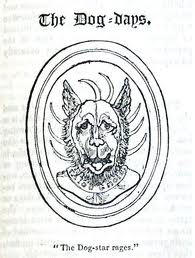
On July 20, 2012, James Eagan Holmes entered a movie theater in Aurora, Colorado, and opened fired during a midnight showing of the then-current Batman movie The Dark Knight Rises.  This event unfolded approximately three days before what has been widely cited as the beginning of a period the ancient world referred to as the "Dog Days of Summer." Of the date, Fortean philosopher Robert Anton Wilson noted: "Celebrations of the Dog Star, Sirius, beginning on July 23, are the origin of the expression 'dog days,' meaning the days from July 23 to September 8, when the last rituals to Sirius were performed" (Cosmic Trigger Volume I, pg. 87).

This period gained reputation for its intensity in the ancient world:
"...  Throughout Latin literature there are many references to 'the Dog Days' which followed the helical rising of Sirius in the summer. These hot, parched days were thought by that time to derive some of the ferocity and dryness from the 'searing' of Sirius. Traditions arose of Sirius being red because it was in fact red at its helical rising, just as any other body at the horizon is red. When marking rhetorical allusions to the Dog Days, the Latins would often speak of Sirius being red at that time, which it was."
(The Sirius Mystery, Robert Temple, pg. 86) 

The extreme heat often associated with the helical rising of Sirius was frequently blamed for the chaos that had a way of unfolding during this period. Certainly the notorious Aurora shooting would have been viewed as an apt event for this time frame in the ancient world.

Aurora shooter James Eagan Holmes, who has been in the news of late after being found guilt of the shooting spree and is now facing the death penalty
The Aurora shooting was followed just a little over two weeks later by the Sikh temple shooting in Oak Creek, Wisconsin. This shooting spree was carried out by Wade Michael Page, a former military man and white nationalist whose victims included the father of Sirius filmmaker Armardeep Kaleka.


While Aurora shooter James Eagan Holmes didn't have such an extreme background, his stock piling of firearms and obsession with Heath Ledger's Joker (a meme of which became closely associated with the Patriot movement via Alex Jones, as I noted before here) indicate that he had some familiarity with Patriot ideology. Page certainly did and this underlining factor was addressed before by this researcher here.

Alex Jones in Joker makeup
Let us now return to the present. On July 23, 2015 (the actual start date for the Dog Days of Summer in many accounts), a 58 year old "drifter" known as John Russell Houser entered a movie theater in Lafayette, Louisiana, and opened fired during a showing of the film Trainwreck at roughly 7:30 PM. This shooting unfolded just a little over a month after the Charleston church shooting, an assault carried out by a would-be white nationalist known as Dylann Roof. This shooting unfolded on June 17, 2015. The numbers 17 and 23 have much esoteric significance and have been closely linked together by Robert Anton Wilson, who dubbed their pairing "the 23/17 phenomenon." The great Tek-Gnostic gave a great rundown of this curiosity before here:
"The 23/17 enigma, simply stated, refers to the belief that many incidents of synchronicity are directly connected to the numbers 23… 17… or some combination or modification of these numbers. Uncle Bob Wilson (aka: Robert Anton Wilson) credits William S. Burroughs as being the first person to identify the 23 enigma. Wilson, in his book The Cosmic Trigger, related the following story:
" 'More important to our narrative, William S. Burroughs (author of ‘Naked Lunch’) introduced me to the 23 Enigma while I was at Playboy... In the early '60s in Tangier, Burroughs knew a certain Captain Clark who ran a ferry from Tangier to Spain. One day, Clark said to Burroughs that he'd been running the ferry 23 years without an accident. That very day, the ferry sank, killing Clark and everybody aboard. In the evening, Burroughs was thinking about this when he turned on the radio. The first newscast told about the crash of an Eastern Airlines plane on the New York-Miami route. The pilot was another Captain Clark and the flight was listed as Flight 23... Burroughs began keeping records of odd coincidences. To his astonishment, 23s appeared in a lot of them.'
"Burroughs wrote a short story in 1967 called '23 Skidoo.' The term '23 skidoo' was popularized in the early 1920s and means 'it's time to leave while the getting is good.' This expression appeared in newspapers as early as 1906.
"Wilson, along with co-author Robert Shea of “Illuminatus!” fame, more clearly identifies the 23/17 phenomenon, in that both numbers are tied to the Discordian Law of Fives. The Discordian holybook, the Principia Discordia states that: All things happen in fives, or are divisible by or are multiples of five, or are somehow directly or indirectly appropriate to 5. To Discordians, 23, a corollary of the law of fives, is considered either lucky, unlucky, sacred to their goddess Eris, sinister, sacred to the unholy gods of the Cthulhu Mythos, or significantly strange. 
"In Illuminatus!, the character Simon Moon illustrates this rational using the following mathematical-numerological-magical formula… in 23: 2 + 3 = 5, and in 17: 1 + 7 = 8 = 2³ ...clear as mud, right? To clarify, Moon pulls in another enigmatic number… 40. In the following excerpt from Illuminatus!, Moon further clarifies…
" 'That brings me to the 40 enigma. As pointed out, 1 + 7 = 8, the number of letters in Kallisti. 8 x 5 = 40.'
"'More interestingly, without invoking the mystic 5, we still arrive at 40 by adding 17 + 23. What, then, is the significance of 40? I've run through various associations… Jesus had his 40 days in the desert, Ali Baba had his 40 thieves, Buddhists have their 40 meditations, the solar system is almost exactly 40 astronomical units in radius (Pluto yo-yos a bit)—but I have no definite theory…  yet.'" 


I've already dealt with the appearance of 17 (and also 23) in the Charleston church shooting before here and the deep political implications of it here.

Needless to say, the overlap between the 2012 and 2015 shootings noted above is curious. The similarities between the Sikh temple and Charleston church shootings are especially striking: In both cases white nationalists shot up holy places associated with minorities. And of course, the same applies to the location of the Holmes and Houser shooting sprees: a theater.

What's more, early reports indicate the Houser was himself interested in white nationalist and Patriot ideology. Raw Story reports:
"Houser signed up for an account with Tea Party Nation in June 2013, but he was not an active commenter.
"Posts on other forums reveal Houser’s belief that the U.S. was racist against white people, sterilization should be mandatory for welfare recipients and former Ku Klux Klan leader David Duke was a more historically significant figure than the Rev. Martin Luther King Jr.
" 'Hitler accomplished far more than any other through "pragmatically forming,” ' Houser posted in January 2015. 
"He wrote something of a manifesto in March 2013, when he asked for help channeling his anger and frustration as a white Christian man living under President Barack Obama...
"Houser argued in a January 2014 forum post that the United States needed a right-wing party like Greece’s neo-Nazi 'Golden Dawn' faction to restore its greatness..." 
Houser
Ah yes, praise for Adolf Hitler and Greece's Golden Dawn. Early indications then seem to point toward Houser being yet another in the ever growing list of right wing extremist responsible for terrorist attacks in the US since the early 00s. The mainstream media will inevitably shift debate to gun control or the Confederate flag while the alternative media will not touch the implications of these attacks with a ten foot pole. And be assured, all will rejoice at the next Islamic terror attack as it will shift debate to a much more comfortable topic.

because who wants to talk about what effects this will have on Greece, for instance?

Thursday, April 23, 2015

Kowalski Part III


"Live life
Live a long life
Feel fine
In the sunshine
Alive
Alive
Good to be alive"
 

Welcome to the third and final installment in my examination of the 1971 cult road movie Vanishing Point. With the first installment I briefly addressed the curious backgrounds of several of the individuals involved in the film as well as its enigmatic opening moments. With part two I began to get into the film in earnest, and broke down the early symbolism associated with its two lead characters, Kowalski (Barry Newman) and Super Soul (Cleavon Little).

Effectively the former is a veteran and ex-police officer who had washed out of race car driving and has been coasting through life as a car delivery driver for the past few years. The latter is a blind African-American DJ operating from Goldfield, Nevada and a man with more than a few metaphysical leanings. Kowalski embarks upon what is seemingly a pointless cross country chase with police in Colorado, Nevada and California (Utah seems to have mysteriously vanished in this film) while Super Soul aids him via the airwaves.


Kowalski (top) and Super Soul (bottom)
For years this film has typically been dismissed as a "B-movie," but instances such as Super Soul referencing Brahman and his seeming ability to communicate with Kowalski telepathically in a film that largely goes for gritty realism tipped off the more astute viewers that there was something strange about this picture. This has led to a reevaluation of the film in recent years that hailed it as a classic of 1970s nihilism and existentialism even if it was allegedly "dated."

In point of fact, this film has aged remarkably well and even seems down right prophetic in parts (especially in how Kowalski's chase becomes a gross media spectacle, thus echoing the rise of reality TV). And while the film certainly has its fair amount of nihilism and existentialism, these labels are far to narrow to encompass such a sweeping film. In point of fact, this film is a kind of psychodrama in which many motifs of the most ancient myths are transplanted into a fairly contemporary American setting. I already began to delve into this a bit in the prior installment and shall continue on that particular course here. So let's get to it.

The chase begins at some point in Colorado when Kowalski refuses to pull over a for a motorcycle cop. This leads to a chase involving another officers that Kowalski easily wins. Soon other police officers join the chase and Kowalski finds himself using a construction zone and either lane on the highway to allude them. During this series of encounters he passes the exit sign for No Name, Colorado and even uses No Name Creek during one instance in the film. The use of No Name here is most interesting as Kowalski's first name is never revealed throughout the film. In the ancient world names were thought to hold tremendous power.
"It should also be observed that some aspects of the invocation of the Name derived from the symbolism of sound and language. In fact, in Indian teaching, the Name (nama) is no different from the sound (shabda). The name of something is 'the sound produced by the activity of the mobile forces which comprise it....' Furthermore, to pronounce a name is in some sense effectually to 'create' or 'present' it. Name (nama) and form (rupa) determine its nature. Hence it is simple to deduce that naming a person or thing is the same as taking control of them. For this reason the Ancient Chinese attached enormous importance to the correct designation since the universal order derived from them. The School of Names ... carried these consequences to their extremes. Genesis 2: 19 also states that Adam was entrusted with the task of naming all living creatures. This was to grant him power over them and this power remains one of the characteristics of the paradisal state.
"The ancient Egyptians believed that 'the personal name was much more than a means of identification.' It was an essential part of the person. The Egyptians believed in the creative and compelling power of the word. The name was a living thing.' All characteristics of the symbol recur in names. (1) They are 'full of significance'; (2) when writing or speaking the name of a person, that person 'is given life and survival,' which corresponds to the dynamics of the symbol; (3) knowledge of the name 'gives power' over that person, which corresponds to the magical aspects, the mysterious bond of the symbol. Knowledge of the name is part of the ritual of conciliation, casting spells, destroying, taking possession of and so on, and the phrase 'his name will no more be among the living' was the most extreme form of  the death-sentence...
"Belief in the power of the name was not something exclusively Chinese, Egyptian or Jewish, it is part of primitive thought-processes. To know a name and to utter it correctly is to be able to exercise power over a person or thing..."
(Dictionary of Symbols, Jean Chevalier & Alain Gheerbrant, pgs. 694)

Kowalski's name is seemingly unutterable as well. A police officer reading out his background remarks "Christian name, Christian name my flat foot, what is that?" after searching for a first name. In a celebrated deleted scene featuring Charlotte Rampling as a mysterious hitchhiker, Kowalski states "first, last and only" when questioned about his full name. As with many things concerning the film, it drops no hint as to why Kowalski only goes by one name and how he has managed to conceal the full extent of his name. In our present society the knowledge of an individual's full name certainly gives authority figures a certain power over the individual, but Kowalski's record is largely open (aside from his time as a cop) outside of his name. Perhaps he does indeed put stock in the ancient notion that knowing something's true name grants power over it. But moving along.

In the midst of his initial confrontation with the police Kowalski flashes back to his time as a motorcycle racer. During this sequence the number 28 is prominently displayed on the back of Kowalski's jacket and is clearly his racing number. The number 28 is typically associated with the moon due to the 28-day, 13-month calendar that was in use during the ancient lunar civilizations. It does, however, have some interesting solar associations.
"That the Osirian year originally consisted of thirteen twenty-eight day months, with one day over, is suggested by the legendary length of Osiris's reign, namely twenty-eight years – years in mythology often stand for days, and days for years – and by the numbers of pieces into which he was torn by Set, namely thirteen apart from his phallus which stood for the extra day. When Isis reassembled the pieces, the phallus had disappeared, eaten by a letos-fish. This accounts for the priestly fish-taboo in Egypt, relaxed only one day in the year."
(The White Goddess, Robert Graves, pg. 381n) 
Osiris
Osiris was very much a solar figure (at least in his latter incarnations) despite his association with the lunar calendar. His dismemberment and reassembly by Isis is a metaphor for the initiatory process that the candidate undergoes. As was noted in part two, Kowalski is very much a solar figure and one who seems to have undergone a kind of incomplete initiation. In this context his association with the number twenty eight is then quite apt.

Nor is the appearance of 28 in this particular flashback Kowalski's only link to the number as well. The license plate for his Dodge Challenger is OA-5599. The numbers 5599 add up to 28.


The appearance of the numbers five and nine are interesting here as well. Five is the number of balance and harmony as well as the symbol of humanity itself. It also stands for the phenomenal world, something Kowalski is attempting to escape. The associations with the number nine is even more interesting. Consider:
"Since three is the number of innovation, its square stands for universality. It is significant that, in so many folktales drawn from all over the world, the  supernumerary, infinity, is expressed by such  repetitions of the number nine as the 999,999 Fravashis who, the Ancient Iranians believed, watched over the semen of Zoroaster, from which all prophets were to spring. The ouroboros, the serpent which bites its own tail and the image of the return of the manifold to the one and hence of primeval and of final Oneness, is related geographically to the way the number nine is denoted in many alphabets such as the Tibetan, Persian, Egyptian hieroglyphics, Arminian and so on. The mystical meaning of nine relates it, too, to what the Sufis term haqq, the final stage of the way, bliss leading to fana, the annihilation of the individual and the rediscovery of the whole, or, as Allendy has it, 'the loss of personality in universal love.' Indian tradition defines more clearly the redemptive meaning of the symbol nine through the nine successive incarnations of Vishnu who, each time, offered his life for the salvation of mankind. Similarly, according to the Gospels, Jesus was crucified at the third hour; his death agonies began at the sixth hour (dusk), and he died in the ninth hour. Claude de Saint-Martin considered that in nine the physical body and all its properties were annihilated. Allendy concludes that Freemasons have made it the internal number of immortality, nine masters discovering the grave and body of Hiram...
"Nine being the last of a series of figures heralds both an end and a fresh beginning, that is to say, a removal to a new plane. This notion of rebirth and germination in association with that of death is, as we have shown, recurring in the concepts of symbolic properties of the number held in several different cultures. As the last of the numbers in the manifested universe, it starts the phase of transmutations. It gives expression to the end of the cycle, the completion of a journey, the tying of a knot."
(Dictionary of Symbols, Jean Chevalier & Alain Gheerbrant, pgs. 705-705)

This is certainly most fitting for Kowalski's circumstances as the film opens and indeed he is in a cycle that serves as both an end and a beginning and one that will include both death and rebirth. In addition to the license's plate number, Kowalski also sports the closely related number three on his race car. But moving along.

At one point during Kowalski' trek in Colorado he is challenged by a fellow motorist in a Jaguar. Kowalski predictably wins in good order by beating the Jaguar to a one way bridge and forcing the vehicle into a near by river bed as his Challenger clears the bridge. A Dodge Challenger is of course a most apt vehicle for Kowalski as he is indeed a challenger and the presence of a Jaguar at this juncture is also interesting. The animal for which the car is anted has some interesting symbolic associations.
"The Maya... regarded the jaguar as being, above all, a god of the underworld, the highest incarnation of the internal powers of the Earth. The jaguar was the god of the number nine, a manifestation of the land 'below.' As lord of that Underworld he sometimes undertook the duties of conductor of souls. At dusk, the Earth is depicted as swallowing the sun, the letter within the open jaws of a jaguar. Lastly the jaguar became a solar deity corresponding with the sun's night journey. When the sun is depicted as a jaguar it is the black sun."
(Dictionary of Symbols, Jean Chevalier & Alain Gheerbrant, pg. 551)
Kowalski racing the Jaguar
As was noted in part two, Kowalski bears many of the characteristic of the solar savior. And indeed the Jaguar did attempt to figuratively devour him, but he escapes from its clutches. But the moment does provide a key point in Kowalski's (the sun) journey for he still finds the humanity to stop and check on the driver despite approaching police cars.

When Kowalski arrives in Nevada things really start getting fun. After some more games with the police, Kowalski seeks refuge in the desert. He takes the Challenger off road and precedes to wander aimlessly for hours. The desert is of course littered with associations. It is both a place of demons and enlightenment, a concept incorporated into Christianity via Christ's forty days in the desert and the temptations of Saint Anthony, among others. In Egyptian mythos the desert was closely associated with Set, the revival of Osiris. As Kowalski is linked with Osiris, this is most apt.

Set
As Kowalski wanders the desert, he retraces his path. The Challenger forms pristine X's against the barren backdrop. The represents a reoccurrence of the crossroads motif first discussed in the second installment of this series.

at the crossroads again
Eventually Kowalski comes upon a grizzled Prospector (Dean Jagger). He saves the driver from a rattlesnake and then assists Kowalski in hiding his vehicle from a police helicopter. The Prospector delivers his musings in a highly eccentric manner, at times hinting mental instability, but always making a certain kind of sense. This figure is a prototype of the "wise old man" archetype.
"The frequency with which the spirit-type appears as an old man is about the same in fairytales as in dreams. The old man always appears when the hero is in a hopeless and desperate situation from which only profound reflection or a lucky idea – in other words, a spiritual function or an endopsychic automatism of some kind – can extricate him. But since, for internal and external reasons, the hero cannot accomplish this himself, the knowledge needed to compensate the deficiency comes in the form of a personified thought , i.e., in the shape of this sagacious and helpful man..."
(The Archetypes and the Collective Unconscious, CG Jung, pgs. 217-218)
A few paragraphs later Jung further elaborates on the wise old man archetype, noting:
"Often the old man in fairytales ask questions like who? why? whence? and whether? for the purpose of inducing self reflection and mobilizing the moral forces, and more often still he gives the necessary magical talisman, the unexpected and improbable power to succeed, which is one of the peculiarities of the unified personality in good or bad alike. But the intervention of the old man – the spontaneous objectivation of the archetype – would seem to be equally indispensable, since the conscious will by itself is hardly ever capable of uniting the personality to the point where it acquires this extraordinary power to succeed. For that, not only in fairytales but in life generally, the objective intervention of the archetype is needed, which checks the purely affective reactions with a chain of inner confrontations and realizations. These cause the who? where? how? why? to emerge clearly and in this wise bring knowledge of the immediate situation as well as the goal. The resultant enlightenment and untying of the fatal tangle often has something  positively magical about it – an experience not unknown to the psychotherapist.
"The tendency of the old man to set one thinking also takes the form of urging people to 'sleep on it.' Thus he says to the girl who is searching for her lost brothers: 'Lie down:  morning is cleverer than evening.' He also sees through the gloomy situation of the hero who has got  himself into trouble, or at least can give him such information as will help him on his journey..."
(The Archetypes and the Collective Unconscious, CG Jung, pgs. 220-221)
the prospector
This is very much the role the Prospector plays in Vanishing Point. He appears just as Kowalski seems to have lost confidence in his actions and he does indeed give him a variation on "sleep on it": After becoming aware of an approaching police helicopter, the Prospector tells Kowalski that the best away to get away from something is to dig in.

Kowalski follows this advise literally, and uses the desert to camouflage the Challenger so that the police helicopter is unable to spot. Later on, as Kowalski realizes he cannot physically elude the police and society at large, he seems to opt for the Kingdom within, as the old 13th Floor Elevators song proclaims. But more on that in a moment.

After helping Kowalski avoid the police the Prospector takes him to a fringe Pentecostal sect holding a revival service in the desert so as to procure gas for the Challenger. The leader of this sect is referred to as "J. Hovah" (Severn Darden) and had previously worked his trade by speaking in tongues to poisonous snakes. But now the revival camp is no longer interested in the snakes as it has a rock band to perform for the congregation instead.


Superficially this sequence is clearly meant as a dig at the then-emerging Jesus freak movement, which was fast pushing the hippies out of California at the time. Many perceived the Jesus freak movement as a reactionary counter to the 1960s counterculture as well as a commercialization of Christianity. Both prospects are entertained in Vanishing Point. Despite peace and love symbols all over the revival and a multiracial band, J. Hovah chastises the Prospector for bringing a stranger to the revival, reminding him that their meetings are closed to the public. And while previously the congregation had expressed its faith by handling and communicating with deadly snakes, now they simply listen to the feel good sounds of the (highly fashionable) house band.


The Prospector naturally gives Kowalski a few final words of wisdom before they go their separate ways. From there Kowalski makes for the California border, but stops after he encounters a biker on the highway named Angel (Timothy Scott) who offers him some speed. The name of this character proves to be quite apt for he becomes a kind of guardian angel for Kowalski, guiding him past a police road block and into the Golden State.

But before all of that Angel takes Kowalski back to his groovy little hippie pad in the desert where his girlfriend (Gilda Texter) rides around naked upon a motorcycle. After hooking up Kowalski with more bennies he takes off on his bike to check on the road to the border. Kowalski is left with the naked rider, who offers him anything he desires. Kowalski of course turns her advances down but accepts a "straight" smoke. While they're conversing Kowalski is shown standing before the side of building with an ankh prominently painted upon it.

The symbolism of the ankh is quite apt for this juncture of the film. Consider:
"Gods, kings and Isis (almost invariably) are depicted holding the ankh to show that they command the powers of life and death and that they are immortal. The dead also carry it at the time their souls are weighed ... Or when they are aboard the boat of the Sun God, as a sign that they seek the same immortality from the gods. Furthermore the ankh symbolized the spring from which flow divine virtues and the elixir of immortality. Therefore to hold the ankh was to drink from that well. It was sometimes held upside down by the loop – especially in funeral rites when it suggested the shape of a key and in reality was the key which opened the gateway of the tomb into the Fields of Aalu, the realm of eternity..."
(Dictionary of Symbols, Jean Chevalier & Alain Gheerbrant, pgs. 27-28)

And Kowalski is well on his way to immortality at this point -indeed, it is his only escape. By the time he reaches California he is obviously running out of West to elude the cops in. But beyond that, his escape has deteriorated into a gross media spectacle by this point. Reporters descend on Cisco, the location police have chosen for the final showdown, like locus determined to reduce Kowalski's run into another quirk of consumerism. He is thus fast becoming a parody of himself in addition to running out of physical space.

After some brief ruminations he choses the only path of escape left to him --either suicide or ascension, depending upon one's point of view. Kowalski finds himself surrounding by police, with the raod before him blocked by two bulldozers. As he speeds towards the bulldozers a crack of light appears between the vehicles. This makes Kowalski break out into a wide smile and speed headlong into the dozers, sending the Challenger into an air-born fireball. This ending has long infuriated and baffled viewers in equal measures for both its suddenness and the seeming senselessness of it. But astute viewers have long surmised that there was more to this sequence than a suicide.

note the light appearing between the two bulldozers, the actual "vanishing point"
of the film's titleCertainly director Richard C. Sarafian seemed quite certain that something more profound than mere death unfolded in the film's final moments. In an interview towards the end of his life the director stated:
"And so that was taken, again, from a concept that's maybe a little bit too esoteric, in terms of a German mathematician by the name of Möbius who wrote about time as a strip; he took a ribbon and twisted it and then tied the ends together; what you get is an elliptical band.  So that the end of it, that there is no end to the road, that we go on, and to another dimension maybe.  So it's very hopeful, maybe, very spiritual kind of--as far as that.  [Then studio head] Richard Zanuck said to me, 'Richard, does he die in the end?'  I told him, I said, 'Mr. Zanuck, it depends on your…your view.'  There was a second ending that was never added, which he wouldn't accept.  And that ending was that when Kowalski heads for the crack between the two bulldozers…it was soundless.  And visually it's the same, but Super Soul goes, 'Yeah,' and celebrates the moment.  So when he screened the picture, he said 'Oh, Richard, he's got to die.'  I said, 'Well, OK, Mr. Zanuck.' And I think the spirit, at least in terms of what I wanted to say was, you know, as Kim Carnes sings in the end credits, 'Nobody knows, nobody sees, till the light of life is ended and another soul goes free.'  Now, if I tried to explain that to the head of a studio, they'd throw a net over you. So for me it was like sneaking under the tent while the devil had his back turned. What I think is that maybe I've allowed the audience to see it through their own prism in terms of what it's about, you know."
Suicide, while rare, was occasionally practiced by Gnostics and Cathars and even Jainists and Buddhists. In the case of the former two ideologies, there was a perception of the material world as evil and death as relief from this earthly hell. The Cathars had a ritual known as Endura that was a kind of suicide trough fasting occasionally practiced, for instance. Kowalski himself has also reached such conclusions concerning the material world by this point and choses to depart his mortal coil. Tellingly, there does not appear to be a body in the Challenger when police are finally able to go through the wreckage.

And it is here that I shall wrap things up. Hopefully this series has inspired its readers to give this forgotten classic of 70s cinema another viewing. And don't stop there --the Primal Scream album inspired by the film that was mentioned in the first installment makes an excellent companion piece. And with that I shall sign off for now --Until next time dear readers.