
As noted in part one of this series, a chief concern of planter type civilizations was suppressing individualism. The altered states of consciousness magic mushrooms and other entheogens produce can influence different people in many different and unpredictable ways. Nomadic peoples accustomed to the freedoms and uncertainties of the open plains would be well suited to the types of experiences magic mushrooms produce. But the urban dwellers in highly regulated city-states, not so much. These city-states were almost entirely the result of an initiated priesthoods.
"...its tiny cities were suddenly bursting into bloom -the whole cultural syndrome that has since constituted the germinal unit of all of the high civilizations of the world. And we cannot attribute this event to any achievement of the mentality of simple peasants. Nor was it the mechanical consequences of a simple piling up of material artifacts, economically determined. It was actually and clearly the highly conscious creation (this much can be asserted with complete assurance) of the mind and science of a new order of humanity, which had never before appeared in the history of mankind; the professional, full-time, initiated, strictly regimented temple priest."
(The Masks of God: Primitive Mythology, Joseph Campbell, pg. 146)

In order for the priest class to accomplish these feats, it needed strict obedience from the populace. The kind of personal and immediate spiritual experiences that magic mushrooms can induce in individuals could potentially create rivals to the priestly authorities across the boards if they were widely used. The very structure of the entire civilization would in fact be threatened. Thus, it seems most plausible that the use of such drugs would be restricted amongst the priest class themselves.
However, there is vast evidence of another narcotic that was heavily used by the whole of these planter societies: opiates.
"The seed of the poppy is a delicious and nonpsychoactive food, as enthusiasts of poppy seed rolls can attest. Yet when the seed capsule is scratched with blade or fingernail,, a milky latexlike material soon accumulates and, as it hardens, turns a dark brown. This material is raw opium. Like the psilocybin mushroom with its association with cattle, and the parasitism of ergot on rye and other cereals, the opium poppy is a major psychoactive plant that has evolved in the presence of human food source. In the case of the opium poppy, Papaver somniferum, the psychoactivity and the nutritional value are sectioned off into different parts of the same plant.
"Opium in various forms has been in the physicians' armamentarium since at least 1600 B.C. An Egyptian medical treatise of that period prescribed opium for crying children just as Victorian nannies dosed infants with opiate-laced Godfrey's Cordial to keep them quiet.
"For most of its history opium was not smoked but rather the black sticky resin was dissolved into wine and drunk, or else rolled into a pellet and swallowed. Opium, as a cure for pain, as euphorint and rumored aphrodisiac, was known in Eurasia for several thousand of years."
(Food of the Gods, Terence McKenna, pgs. 190-191)
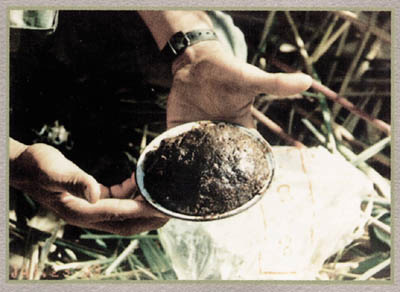
Opium cultivation dates all the way back to Sumeria circa 3400 B.C., as this PBS article notes:
"The opium poppy is cultivated in lower Mesopotamia. The Sumerians refer to it as Hul Gil, the 'joy plant.' The Sumerians would soon pass along the plant and its euphoric effects to the Assyrians. The art of poppy-culling would continue from the Assyrians to the Babylonians who in turn would pass their knowledge onto the Egyptians."Opium was a major sacrament in ancient Crete and other cities that were part of the Minoan civilization.
"During the waning of the millennia-long Minoan civilization and its religion of Archaic worship of a Great Mother, the original source of the connection to the Goddess of vegetable nature came eventually to be replaced by the intoxication of opium. Early Minoan texts testify the the fact that poppies were widely cultivated on both Crete and Pylos during the Late Minoan; in these texts, the poppy head is used as an ideogram in financial tallies. The yield of poppies indicated is so huge that for some time it was assumed that these numbers must refer to grain rather than opium. The confusion of grain and poppy is easy to understand as Demeter on the mainland remains to be elucidated, especially as there is some iconographic confusion between the poppy flower and the pomegranate, also a plant associated with the Mysteries. Kerenyi quotes Theokritos VII. 157:
"For the Greeks Demeter was still a poppy goddess,Bearing sheaves and poppies in both hands.
"A remarkable illustration in Erich Neumann's The Great Mother shows the Goddess in association with a beehive and holding poppy seed capsules and heads of grain in her left hand while resting her right hand on one of the unadorned pillars central to the Minoan earth religion. Rarely have so many elements of the Archaic technology of ecstasy been brought together so explicitly. The figure is almost an allegory of the transformation of Minoan shamanic spirituality in its late phase. Its mushroom roots are symbolized in the aniconic column; they are the touchstones of the Goddess who looks toward the promise of poppies and ergotized grain. The hive of bees introduced the theme of honey, the archetypal image of ecstasy, female sexuality, and preservation that survives the shifting botanical identities of the sacraments"(Food of the Gods, Terence McKenna, pgs. 191-192)

The symbolism of the poppy goddess image McKenna references with a beehive and poppy seed capsules is striking. The beehive is another ancient symbol.
"Hives are the bees' houses and, by metonymy, the bees themselves, collectively, as a tribe. Their symbolic quality is therefore clear. In so far as it is a house, the hive is maternal reassurance and protection: in so far as it is a hard-working collective -and how hard-working: its hum is like that of a workshop or factory -the hive symbolizes the type of organization and directed confederation, subject to strict regulation, which is regarded as soothing and pacifying the individual's basic anxieties. Thus, in some initiation societies and religious communities, patterns of organization call to mind symbolically those through which some heads of state or business chiefs nowadays ensure their personal power in the names of order, justice and security."
(Dictionary of Symbols, Jean Chevalier & Alain Gheerbrant, pg.s. 508-509)

The beehive is certainly an apt symbol of the social order of planter-type civilizations. Are the poppy's capsules the chief tool of this social order? McKenna argued that widespread use of opiates didn't come to the Minoan civilization until it's waning years, but this is highly debatable. Other scholars have argued that opiates were one of the key features of matriarch civilization.
"First, what was the realm over which the Lady presided? Unlike Zeus's affiliation with the open daylight sky, the Lady's domain is the enclosed space, the settled city, the house, but also natural enclosures, like caves, or architectural imitations of subterranean chambers, and her time is night, dark places like the tomb or the womb, or architectural imitations of its symbolism, like the labyrinth. She or the Pillar sometimes appears on top of a mountain, or the mountain itself can be substituted for her in the configuration of flanking beasts, but her sacred space is a cave on the mountain, and not the bright Olympian domicile; or the sanctity of the mountain consists in its resemblance to features of the female anatomy, and not, as with the Olympians, in its celestial separation from earth. She sometimes has her eyes closed, as if dreaming or asleep. Narcosis is the experience in her shamanism, unlike the enlightenment of Zeus, and her special plant is not wild, like Amanita, but a cultivar, in particular, the opium poppy, for which it, too, like Amanita, later has purely symbolic surrogates substituted, for example, the rose (for its similar flower and capsule-like hips) and the pomegranate (whose fruit resembles the poppy capsule).
(The World of Classical Myth, Carl A.P. Ruck & Danny Staples, pg. 32)

There is also some indication that opiates were used in the rites of human sacrifice (discussed in part two) found in the planter societies.
"...the Lotos, the stinging nettle tree, Celtis australis; to eat of its sweet opiate fruit induced such a stupor that one lost all desire to return home again. It is just such visions of paradise that the drugged victims of Apollo (and Artemis) are induced to see so that they hasten willingly to their immolation, singing joyously their last, most beautiful song, like the prophetic swan, that is the god's bird, standing on the threshold of death and seeing the world to come. Such victims were called the pharmakos, drugged upon the pharmakon or 'medicine.' As with the Druids, criminals were used as offerings, treated as if they were the god; but when the available supply of subjects was insufficient, others might have to be called upon to fill the lack."The identities of Apollo and Artemis were quite different in their Minoan form than the commonly known Greek versions.
(The Apples of Apollo, Carl A.P. Ruck, Blaise Daniel Staples & Clark Heinrich, pg. 32)
"The excavation of Knossos led to further discoveries on Crete and the islands of the Cyclades and elsewhere, from which a clear notion of the Mother Goddess in the Greek lands has emerged. Since she is the original deity from whom the women on Olympus evolved, through the assimilation of the Minoan religion by the Mycenaean Greeks, it is essential to grasp certain aspects of her symbolism.
"She is the Lady of the Pillar, whom we have already met at the entrance to the citadel of Mycenae. She is the mainstay of the enclosed space, for which the Labyrinth is one manifestation. When flanked by beasts, as in the Lion Gate, she has been dubbed the Potnia Theron or 'Mistress of Beasts.' The phrase is a quotation from the Homeric epic tradition, where it describes the Olympian goddess Artemis as a huntress. But she was a huntress only after her incorporation into that family as a daughter of Zeus, with her twin brother Apollo...
"The Lady of Beasts was never a huntress amongst the Minoans. She and the male deity who would later become her twin brother were originally Lady and Consort, Rulers of the Labyrinth, and their fearful and sinister identities as recipients of human victims there required the most strenuous evolution of myth to isolate the two of them from their Minoan pasts and to remodel them both into their Classical identities as the most perfect exemplars of Greek female and male pubescent youthfulness. Artemis, despite her sexual maturity, was even made into a perpetual virgin, denied forever her former role as Mother."
(The World of Classical Myth, Carl A.P. Ruck & Danny Staples, pgs. 30-32)

Certainly the connection to death and poppies is still present in the modern era. This is most notable in the remembrance poppy used during Remembrance Day (sometimes known as Poppy Day), a memorial day celebrated in Commonwealth countries for veterans killed since the first World War. The poppy was apparently selected for this honor because these plants grew upon the disturbed earth of battlefields and freshly dug cemeteries in Flanders during the first World War. This imagery was commemorated in the poem "In Flanders Field." This was not the first time poppies were noted to grow upon the sites of recent battlefields. Legends assert that white poppies grew upon the bloody battlefields Genghis Khan left in his wake during the advance of the Mongol Empire. Even Frazer notes this phenomenon.
"In the summer after the battle of Landen, the most sanguinary battle of the seventeenth century in Europe, the earth, saturated with the blood of twenty thousand slain, broke forth into millions of poppies, and the traveller who passed that vast sheet of scarlet might well fancy that the earth had indeed given up her dead."
(The Golden Bough, James Frazer, pg. 336)

So much for death and the poppy. It seems likely to me that opium was the chief narcotic used in many of the ancient planter societies with magic mushrooms being reserved for an initiated priesthood. Opium would help numb the pain of the vast physical labor such a civilization would require in addition to numbing the ambitions of the populace, rather than bringing about enlightenment as entheogens would. Within a matriarchal society in which women were the dominate faction, opiates would be especially appealing to numb the pain of the menstrual cycle and child birth.
The legendary magician Aleister Crowley, a self-professed follower of the 'Sumerian tradition,' made use of drugs in various magical rituals. I mention Crowley now as much of his magical system was an attempt to recreate the Mystery schools of the ancients which were widespread amongst planter-type civilizations.
"In certain magical operations which Crowley performed (e.g. the Abuldiz Working in 1911, the Paris Working in 1914, and the Amalantrah Working, 1918) a variety of drugs was employed.
"Cocaine, which he assigns to the element of Fire, was used for fortifying the will, thus helping to keep the object of the operation firmly in mind. Morphine, slowing and purifying the mind, makes thought and its formulation more vivid and precise. Heroin, it seems, partakes of both these qualities and combines them in a peculiarly subtle manner.
"To the element of Water he attributes hashish and mescal, owing to their image-making properties, and also because they open the gates of Pleasure and Beauty. Morphine he also attributed to this element.
"To Air, which is the element assigned to the reasoning faculties, he attributes ethyl oxide (ether) for its use in mental analysis and the more profound movements of introspection.
"Finally, the element Earth embraces all the directly hypnotic drugs which induce repose and forgetfulness, enabling the Magician to withdraw into the arms of the Great Mother to restore his devitalized vehicles, astral and physical.
"With the attribution of specific drugs to the elements, the old ceremonial and symbolic techniques of subconscious control are superseded by living and experiential aids. Similarly, with sex, alcohol, the mystic dances and circumambulation, the use of mantra and lyrical incantation. These aids, used in conjunction with drugs, stimulate the whorls of energy in the subtle body. In connection with sex and drugs, Crowley wrote in 1917: 'I note, with all stimulant drugs, that if one is with others, the force is entirely dissipated, usually on the sexual plane. If one is alone, one becomes creative at once. This is important, as establishing the Kundalini doctrine, with its upper and lower exits. It does not bear, however, on the doctrine of abstinence from sex; for in normal excitement the sex seems to stimulate the other creative power.
"That is to say, sex seems to stimulate the Kundalini or Serpent Power. Crowley thus observed the direct effects of sex and drugs on the vital centre or magical power in the human organism."
(The Magical Revival, Kenneth Grant, pgs. 97-98)
 |
| Crowley |
I have found virtually no references to entheogens in Crowley's writings on drugs. This may simply have been out of ignorance -the psychedelic properties of magic mushrooms and the likes were all but unknown in Western culture before the 1950s (at least amongst mainstream sources). Possibly the 'directly hypnotic drugs' associated with the element of earth are in reference to entheogens (and are interestingly linked to the Earth mother), but its difficult to say. Kenneth Grant wrote The Magical Revival in the 1970s when the use of entheogens had become widespread, yet he virtually ignores them as well. Of course, the 'directly hypnotic drugs' may also be a reference to opium, which was curiously left out of Grant's elemental classification system.
Further, even though heroin is mentioned in the passage discussing drugs falling under the element of fire, it could actually have been associated with earth as its effect are described as a combination of cocaine and morphine (which was classified under the water element). On the other hand, Crowley claims that heroin aids the powers of concentration, whereas the 'directly hypnotic drugs' are said to induce forgetfulness. Crowley does not seem to believe the same was true of opium, however. If opiates are in fact the bulk of the drugs that fall under earth, it makes the line 'withdraw into the arms of the Great Mother to restore his devitalized vehicles, astral and physical' most curious in regards to what we've already learned about the mother cult that has appeared the world over since the days of ancient Sumer. The noted metaphysical scholar Robert Anton Wilson, himself a big fan of Crowley, seems to have shared a similar view of opiates.
"To activate the first brain take an opiate. Mother Opium and Sister Morphine bring you down to cellular intelligence, bio-survival passivity, the floating consciousness of the newborn. (This is why Freudians identify opiate addiction with the desire to return to infancy."
(The Cosmic Trigger Vol. 1, Robert Anton Wilson, pg. 200)

There are no shortages of references to opiates in the writings of Crowley and his followers. Opiates (especially heroin) and ether seem to have been the main drugs used in Crowley's magical system. The power of heroin was in fact almost to much for the Great Beast to handle.
"Morphine tends to aid concentration and relieve the pressure of anxiety. Like opium, it aids the creative imagination. Objections to the use of these two drugs consist in the fact that they impair executive ability, so that the ideas which they inspire remain sterile and are rarely carried over into practical life. As is well known, opium has the virtue of relieving pain and conferring philosophic tranquility...
"Heroin combines the virtues of opium and cocaine. It excites the imagination, aids concentration, and induces calm. Unlike opium and morphine, however, it increases power and endurance.
"The life-death struggle which Crowley waged against heroin is related in Liber 93. Towards the end of his life, he notes:
" 'There is no yen at all (from the drug) when I am free from (a) care, (b) boredom. To reach physiological minimum I must have (1) daily masseur-valet to get me up and out, (2) supply of books and forced stage or screen visits, (3) secretary at will, (4) company, (5) food and drink.'
"In the same diary he notes that 1914 was the probable date of his first heroin experiment, taking some three grains per day. After the tremendous struggle with the drug -to which reference has already been made -he shook off completely its hold over him and there is no further record of its use until, in 1940, seven years before his death, his doctor began prescribing 1/4 or 1/6 grain for recurrent attacks of asthma. The complaint had again become acute, and this is the first record of heroin consumption in his dairies for many years. From that time on, until his death in 1947, he took steadily increasing doses until in 1946 we read of doses as large as 6 grains per day.
"His excessive use of the drug between 1920 and 1922 he ascribed to financial anxiety, lack of stimulus (correspondence with chelas, etc.), and his inability to get things published.
"The conclusions he reached in respect of the drug in Liber 93 led him to declare that his experience should serve as a preliminary prima facie case for a revolutionary revision of the extant medical theories on the subject, and of the legislation regarding the sale of heroin and similar drugs."
(ibid, pgs. 95-96)
 |
| chunky heroin |
So much for Crowley. I would now likely to briefly return to my theory that the priesthoods and esoteric orders of various matriarchal societies used entheogens in secret rites while promoting the use of opiates to the general populace. We may be able to gleam elements of these practices by examining of the European alchemists of the Middle Ages and the Renaissance. At the heart of alchemical philosophy was a secret raw material that was considered essential to an alchemical work.
"Simply stated, the alchemical work begins with a secret raw material called the prima materia, or prime matter, a single substance absolutely essential to the work but never identified except by the most unusual terms. It is called the radical moisture, the round body from the center, the hermaphroditic monster, Adam's tree of paradise with many flowers, the water, the sperm of the world, the empress of all honor, the dragon, and many other names. Once in hand the prima materia must be transformed through the alchemical operations into the philosopher's stone, although some authors maintain that the prima materia is the stone. In any case, the next step is to extract from the secret stone, through the torment of fire, the miraculous water: the aqua permanens or aqua divina, also known as the strangest of liquids, drinkable gold."Naturally some have speculated that this prima materia is a magic mushroom or some other kind of entheogen. For instance Clark Heinrich argues a text known as the Emerald Tablet, which was highly popular with alchemists in the Middle Ages, is a metaphor for the fly agaric mushroom.
(Magic Mushrooms in Religion and Alchemy, Clark Heinrich, pg. 169)
"...the secret substance's father is the sunlike mature mushroom, whose 'seed' falls from his body to bring about the birth of his offspring. Its mother is the white, rough-textured 'moon' of the mushroom embryo, which seems to give birth to the solar cap. The wind carries the mushroom spores as well as the rainstorms that cause the mushroom's birth. The earth 'nurses' the mushroom from egg to cup as the mushroom draws water from it. 'When it turns toward the earth' corresponds to the end of sporulation, when the upturned cap begins to dry out and turn back toward the ground; this is the optimal harvest time, because fully mature mushrooms have the highest concentration of muscimol, the main active ingredient. Drying converts ibotenic acid to muscimol as well; once completely dry 'its power is complete.' The last statement of the quotation recapitulates the whole process, adding that the substance receives the power of higher and lower things. The 'higher and lower things' refer to the powers of heaven and earth, but also warn the initiate to be aware that the same mushroom can lead to both heaven and hell. The final promise is that the glory (bliss) of all creation awaits the person who likewise receives the powers of the secret substance."
(ibid, pg. 170)
 |
| Mercurius, the personification of the prima materia, showing characteristics of the fly agaric mushroom |
While the use of magic mushrooms amongst alchemists is highly speculative (as is most of anything else associated with alchemy), their connection to opiates is quite firm. This is most overt in the figure of the legendary Paracelsus, the man that essentially reintroduced Western civilization to opiates.
"...the use of opium nearly ceased for many centuries in Europe; the early herbals of Saxon England mention juice expelled from poppies as a cure for headache and sleeplessness, but clearly opium played a very minor role in the armamentarium of medieval Europe. Martin Ruland's Alchemical Lexicon, published in 1612, mentions only the 'osoror' as a synonym for opium, and then without explanation.
"It is to Paracelus, the famed 'father of chemo-therapy,' that we can trace the revival of interest in opium. The great sixteenth-century Swiss alchemist, medical reformer, and quack advocated and used opium on a lavish scale. Here again, as in the case of distilled alcohol, it is an alchemist, one involved in the pursuit of the spirit assumed to be locked into matter, who discovered the means to release the power locked within a simple plant. And, like Lully before him, Paracelsus assumed that he had discovered the universal panacea: 'I possess a secret remedy which I call laudanum and which is superior to all other heroic remedies.'
"Shortly after Paracelsus began promulgating the virtues of opium, physicians of his school of thought were preparing nostrums whose sole basis of activity was the copious amount of opium that they contained. One of these enthusiastic followers, the alchemist van Helmont, became well known as 'Doctor Opiatus,' the first 'croaker' or junk doctor."
(Food of the Gods, Terence McKenna, pgs. 194-195)

 |
| Paracelsus (top) and 'Doctor Opiatus' himself, Jan Baptist van Helmont (bottom) |
Within our own modern society, we may also gleam this tangled web of entheogens and opiates. In fact, the the second half of the 20th century demonstrated the kind of 'destablizing' effects widespread entheogen use can have in a highly organized (e.g. matriarchal derived-society) civilization. In the 1950s the Cryptocracy began experimenting with various psychedelics as tools of mind control, which eventually reached the general populace in the mid-1960s. Large scale social unrest soon followed, and may even have threatened to break out of the Cryptocracy's control. This was chronicled in a prior post that can be found here. By the mid-1970s and onward psychedelics were progressively more and more marginalized despite several short lived revivals. In the 21st century prescription meds, many of the most popular opiate based, seem to be the new drug choice amongst the Cryptocracy for social control. More on the growing prescription drug epidemic can be found here. So far this method is certainly proving to be more predictable than the psychedelic experiments of the 50s, 60s, and 1970s. But then the priesthoods and the magicians of old already knew this.

And so we reach the end the end of this journey in search of the origins of religion, the Scarlet Woman and the role dope has played in both. From the fields of Sumer nearly 7,000 years ago to the pill factories of today, it is quite a long, strange trip indeed.


